

Physical appearance, particularly related to the face, is a significant social factor, and the visible manifestation of age-related changes increasingly impacts psychological well-being. Reflecting this widespread concern, the global anti-aging skincare market was valued at USD 62.6 billion in 2021 and is projected to reach approximately USD 92 billion by 2027. Given this rapid market expansion, ensuring the safety and efficacy of cosmetic formulations is critical.
Historically, product safety and performance relied on animal testing; however, stringent regulations, such as the complete marketing ban enforced in the EU in 2013, have mandated a shift towards non-animal alternatives. While validated New Approach Methodologies (NAMs), such as reconstructed human epidermis models, exist, they are often constrained by high costs, technical complexity, and limited shelf-life. To overcome these limitations, synthetic and natural biomaterial-based scaffolds have been investigated, including those derived from chitosan. This study introduced a cell-free tri-layered chitosan membrane as a novel, material-based model to characterize the physicochemical anti-aging performance of topical cosmetic formulations, offering a cost-effective and accessible alternative suitable for early-stage screening. This scaffold focuses exclusively on measuring physicochemical and mechanical responses, enabling the evaluation of hydration, firmness, swelling, and barrier-like behavior that characterize instrumental measurements often seen in clinical studies.
Methods
The research utilized a cell-free tri-layered chitosan membrane that was ionically crosslinked to provide a controlled polymeric environment compatible with demanding mechanical assays. Three commercial finished cosmetic products (FCPs)—VitCOil, OilSerum, and EyeCr—were incorporated either into the top layer (1L(t)) or across all three layers (3L) at application-level concentrations derived from OECD guidelines. The anti-aging performance was quantified by measuring key biophysical parameters, including pore area variation, water permeation using Franz cells, firmness (Storage modulus, G’), elasticity (maximum strain), swelling index (SI), and moisture retention (MR), with all results normalized against a blank chitosan membrane.
Key Findings
The performance of the membranes depended strongly on the formulation type, concentration, and distribution within the layers.
• VitCOil (Oil-based): Demonstrated the most effective occlusive and barrier properties. It caused a significant reduction in pore area (52–56%) and decreased water permeation by 54–61% across configurations. It also exhibited the highest moisture retention capacity, maintaining 36% to 38% higher water content compared to the blank membrane.
• OilSerum (Hydrophilic Serum): Showed layer-dependent responses, dramatically enhancing swelling by +70% in the 3L configuration and +35% in the top layer. Importantly, at a low concentration (0.083% in 3L), it produced the highest firmness increase (+32%), closely aligning with the brand’s reported instant clinical instrumental result (+29%), suggesting that the membrane captures early physicochemical-driven anti-aging responses.
• EyeCr (O/W Emulsion): Showed balanced effects, enhancing both firmness and elasticity at low concentration. The low concentration (0.024%) resulted in a pronounced elasticity gain, particularly in the top layer (+34%), reinforcing the membrane’s predictive value for assessing viscoelastic improvement.
• Overall, the study confirmed that occlusive oil-rich systems (VitCOil) provide durable protection against water loss, while humectant-rich formulations (OilSerum, EyeCr) primarily facilitate transient hydration.
This research successfully validates the use of a tri-layered chitosan membrane as a novel platform for early-stage physicochemical screening of topical anti-aging products. The novelty lies in providing a cost-effective, cell-free alternative to animal testing and complex biological models, overcoming the mechanical limitations associated with existing reconstructed skin equivalents, while still yielding results that reproduce the directional biophysical trends reported clinically. The model proved useful for predicting physicochemical-driven trends and providing mechanistic insight into the formulation–performance relationship.
For future implications, the study recognizes the need to improve the biomimetic fidelity of the model by optimizing product concentrations and distribution, incorporating biopolymers (such as collagen or ceramides), and employing advanced techniques like 3D bioprinting. To achieve industrial or regulatory acceptance, further targeted validation studies are required to standardize testing conditions, confirm intra- and inter-laboratory reproducibility, and benchmark performance against established in vitro models to strengthen its suitability as a potential non-animal test method.
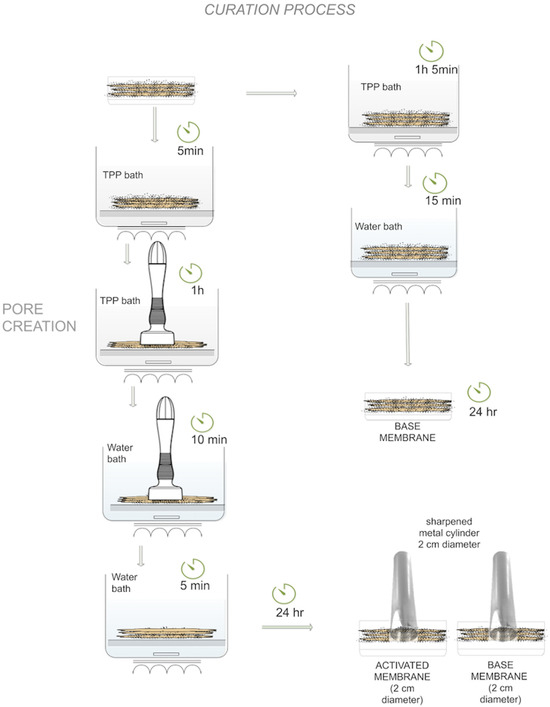
Scheme of the curing process of activated and base tri-layered membranes.
Link to the study: Anti-Aging Evaluation of Cosmetics on a Tri-Layered Chitosan Membrane: An Alternative to Animal Testing