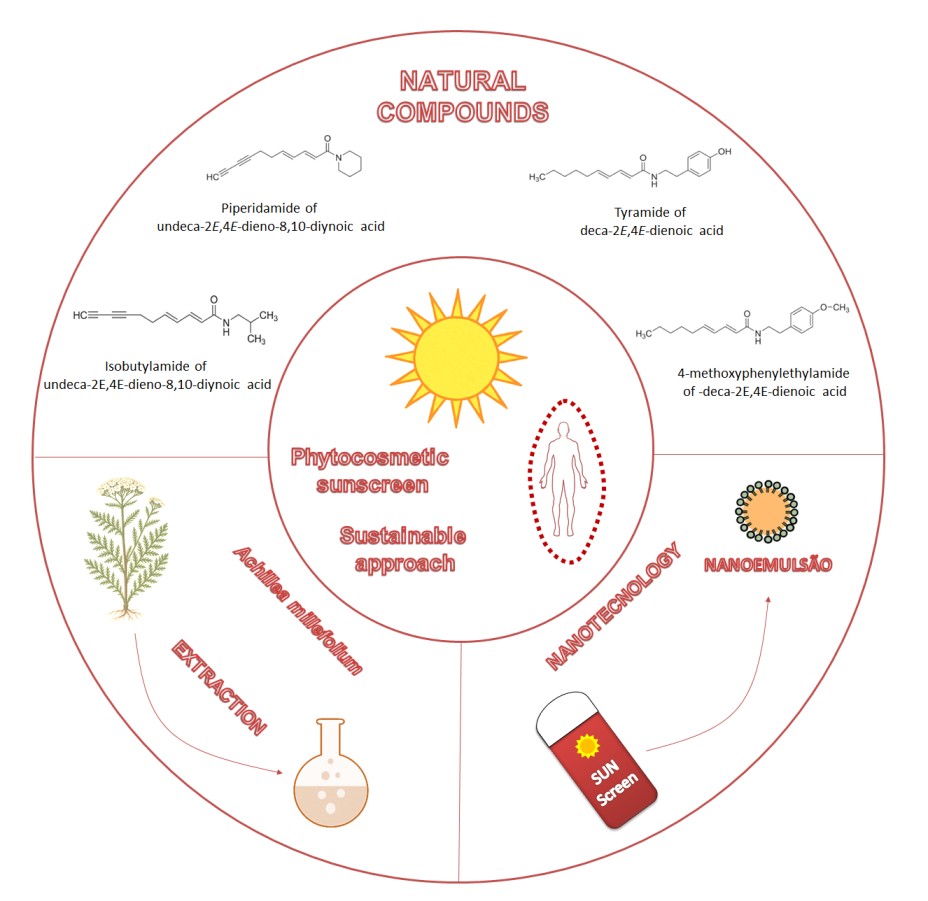
Skin aging, particularly photoaging, is a complex process primarily driven by chronic exposure to solar radiation. This environmental stress leads to the induction of free radicals, cellular deoxyribonucleic acid (DNA) damage, and structural alterations in the skin. The cumulative effect of these extrinsic factors, such as UV radiation, compounds intrinsic aging, resulting in visible signs like wrinkles, hyperpigmentation, dryness, and loss of firmness. Given the increasing global concern for preventing and reversing these signs, anti-aging efforts often rely on multifunctional cosmetics.
While conventional photoprotective formulations frequently utilize organic UV filters, these chemicals have been linked to potential health and environmental concerns, including irritation, toxicity, allergic reactions, and significant ecological impacts like coral bleaching. This combination of environmental and safety concerns has propelled the cosmetic industry toward investigating sustainable and natural formulations. Plant-derived active ingredients are a promising alternative, often possessing inherent antioxidant, moisturizing, and depigmenting properties.
The perennial plant Achillea millefolium L. (Asteraceae) was selected as the potential solution because its aerial parts are known to be rich in phenolic compounds, which exhibit recognized antioxidant potential. Furthermore, A. millefolium contains alkamides, which are bioactive metabolites noted for their anti-aging properties, including smoothing wrinkles and producing a lifting effect. This study aimed to integrate the bioactive crude root extract of A. millefolium—a little-explored source—into a nanometric delivery system to maximize its multifunctional anti-photoaging benefits.
Methods
The crude hydroalcoholic extract of A. millefolium roots was characterized for its chemical profile (HPLC-ESI/MS), total phenolic content, antioxidant capacity (DPPH), tyrosinase inhibition, and safety (HaCaT cell viability). Nanoemulsions were developed via melt-emulsification, incorporating the extract (0.1%, 0.5%, 1%) alongside organic filters (OMC and DHHB). Physicochemical analyses included droplet size (DLS), morphology (TEM), pH, rheology, and spreadability. Finally, photoprotective efficacy was assessed through in vitro SPF, UVA/UVB ratio, and critical wavelength determination.
Key Findings
The research yielded several significant results regarding the extract’s potential and the performance of the nanoemulsion formulations:
• Extract Bioactivity and Safety: The crude root extract confirmed the presence of bioactive compounds, including alkamides and phenolics such as sinapaldehyde. The extract demonstrated potent antioxidant activity (EC50 = 69.11 ± 8.899 µg/mL) and moderate tyrosinase inhibition (19 ± 1.8% at the highest concentration tested). Crucially, the extract exhibited no cytotoxicity in HaCaT keratinocytes at the tested concentrations, reinforcing its safety for topical use.
• Formulation Characteristics: All developed nanoemulsions were confirmed to be in the nanometric scale (mean diameters 217 to 230 nm) and exhibited spherical morphology, confirming the desired physical structure. The pH of all formulations was maintained around 5, which is ideal for compatibility with the skin’s natural physiological state.
• Impact on Stability: The incorporation of the extract, due to its complex phytochemical composition, resulted in a significant increase in the polydispersity index (PDI) compared to the blank formulation, suggesting the extract interfered with the optimal organization of the surfactant layer.
• Rheological Properties: The nanoemulsions displayed pseudoplastic, non-Newtonian behavior (shear-thinning), which is desirable as it facilitates ease of application onto the skin. The viscosity increased proportionally with the extract concentration, with the 1.0% formulation showing measurably higher viscosity, likely due to the hydrogen-bonding capabilities of phenolic compounds.
• Enhanced Photoprotection: The formulation containing 0.5% A. millefolium extract showed the most favorable photoprotective characteristics, achieving the highest in vitro SPF value of 22 ± 5.2, a significant increase compared to the blank formulation’s SPF of 14 ± 0.9.
• Broad-Spectrum Coverage: All extract-containing formulations demonstrated an increase in the UVA/UVB ratio compared to the blank, and reached critical wavelength (λc) values at or near 370 nm. This confirms that the extract enhances the broad-spectrum capability of the nanoemulsion, indicating a shift in the absorption profile toward longer UVA wavelengths.
The research successfully characterized the hydroalcoholic root extract of Achillea millefolium, confirming the presence of alkamides and phenolics linked to antioxidant and depigmenting properties, reinforcing its potential for anti-aging applications.
The novelty of this research lies primarily in the presentation of, for the first time, a stable photoprotective nanoemulsion incorporating a crude extract specifically derived from the little-explored roots of A. millefolium. The study leveraged the root’s unique phytochemical profile—potentially rich in alkamides and sinapaldehyde—as a multifunctional anti-photoaging agent. By integrating the extract into an advanced nanoemulsion platform, the researchers were able to demonstrate a direct correlation between the extract’s bioactive properties (antioxidant/depigmenting potential) and a systematic enhancement of sun protection performance. The results indicate a synergistic effect between the plant’s compounds and the chemical UV filters, particularly at the 0.5% concentration, which delivered the highest SPF and optimal UVA/UVB ratio.
The results point to promising future implications for the development of innovative phytocosmetics. The extract’s multifunctionality (anti-aging, antioxidant, depigmenting, and SPF-enhancing) combined with its verified safety in keratinocytes supports its future utilization. However, as the authors note, further research must include in vivo studies, extended stability testing, and sensory analyses to fully confirm the efficacy, safety, and consumer acceptability of these formulations under real-world conditions.
This research paves the way for cosmetic formulations that not only offer robust UV protection but also actively mitigate photoaging damage using sustainable, plant-based actives. Integrating natural ingredients into advanced delivery systems, like nanoemulsions, is akin to building a high-performance vehicle (the nanoemulsion) that carries a highly efficient, naturally sourced fuel (A. millefolium extract), maximizing both protection and efficacy.
Link to the study: https://www.mdpi.com/2079-9284/12/6/255