

Peptides are recognized as multifunctional bioactive ingredients in cosmetic science, offering diverse beneficial effects such as anti-aging and skin rejuvenation. Peptide ingredients hold significant advantages over other actives, including increased efficacy, safety, selectivity, and lower toxicity or immunogenicity. However, the development of novel peptides for cosmetic applications requires both the identification of new molecular targets and the adoption of advanced design tools.
This study targeted Heat shock protein 47 (Hsp47), a collagen-specific molecular chaperone. Hsp47 is essential for the correct folding of procollagen in vertebrates. Crucially, the expression of Hsp47 is observed to be downregulated during chronological skin aging and is further reduced by photodamage (such as UVB irradiation). Considering that stimulating Hsp47 is known to increase type I collagen expression in dermal fibroblasts, Hsp47 modulation was identified as a plausible strategy for anti-wrinkle applications.
To overcome the inherent limitations of traditional Artificial Intelligence (AI)-guided design, which suffers from the scarcity of comprehensive structure–activity data, the authors developed a novel cheminformatics-assisted peptidomimetic design system. This system integrates molecular fingerprint similarity searches and protein–peptide docking simulations to efficiently design novel peptides targeting Hsp47.
Methods
The cheminformatics-assisted platform used molecular fingerprint analysis to screen a virtual library of approximately 67 million peptides for structural similarity to a hypothetical reference compound, glucosyl–nicotinamide, which was constructed to activate Hsp47. The top candidates were then subjected to protein–peptide molecular docking simulations to predict binding affinities against human Hsp47 (PDB ID: 7BDU). The resulting lead peptide, ICP-1225, was synthesized along with various fatty acid derivatives (including acetyl, hexanoyl, and palmitoyl) to enhance stability and skin penetration. The anti-wrinkle efficacy of these compounds was subsequently assessed using in vitro human dermal fibroblast cultures (measuring Hsp47, COL1A1, and COL3A1 expression) and ex vivo UVB-damaged human skin explant models.
Key Findings
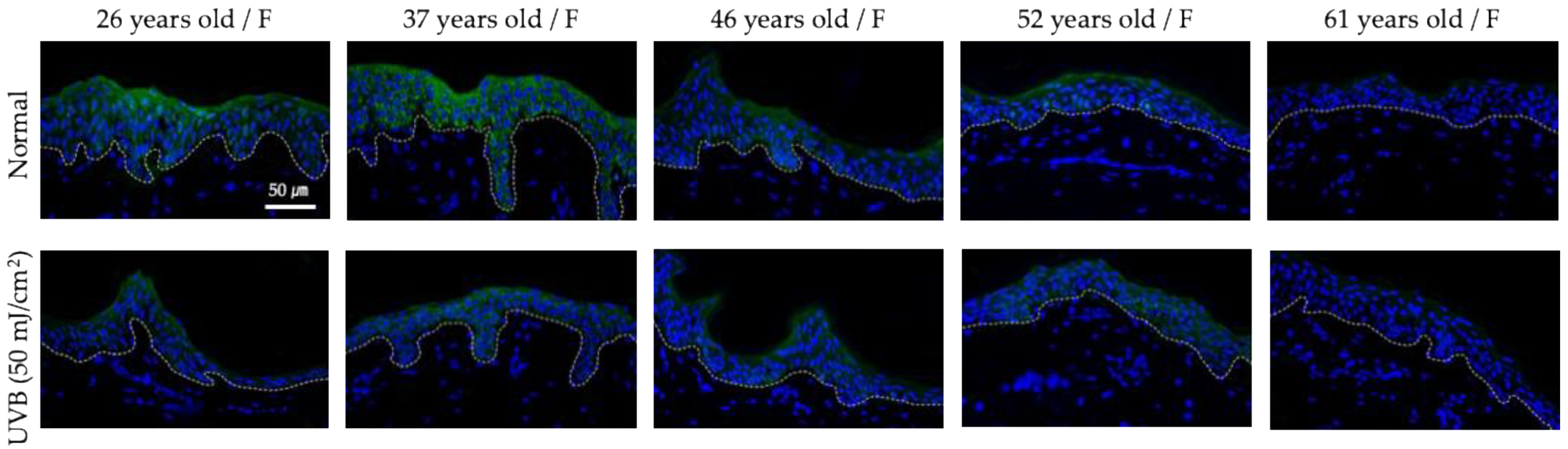
• Hsp47 protein expression was found to progressively decline in human skin with advancing age (from 20s to 60s) and was significantly reduced following UVB irradiation, reinforcing its role as a key anti-aging target.
• From the initial in silico screening, five high-affinity peptide candidates were selected.
• Among these candidates, ICP-1225 (TY) demonstrated the most robust biological activity in vitro, showing stimulatory effects on both Hsp47 and the collagens COL1A1 and COL3A1 in human dermal fibroblasts.
• Peptide derivatization was employed to improve physicochemical properties like stability and penetration. The acetyl derivative, ICP-1236 (acetyl-TY), exhibited the most consistent dose-dependent upregulating activity toward Hsp47 and COL1A1 proteins in vitro compared to the hexanoyl and palmitoyl conjugates.
• In the ex vivo human skin explant model, topical application of ICP-1236 significantly restored the expression of Hsp47 protein attenuated by UVB exposure.
• A similar restorative effect was observed in the dermis, where ICP-1236 treatment led to increased dermal collagen expression.
This study successfully validates the feasibility of employing a cheminformatics-assisted peptidomimetic design system for the rational discovery of novel cosmetic peptides. By identifying Hsp47 as a target implicated in skin aging and generating high-quality molecular data, this approach serves as a hypothesis-generating framework that overcomes some limitations of traditional AI-guided design.
The novelty lies in the successful identification and optimization of a potent Hsp47-modulating peptide. ICP-1236 (N-acetyl-L-threonine-L-tyrosine) represents a promising next-generation anti-wrinkle candidate through the strategic modulation of Hsp47 and collagen pathways.
The future implications of this research are substantial. While the proposed mechanism is currently hypothesis-driven, future work must focus on direct experimental verification of the peptide–Hsp47 interaction (e.g., through co-immunoprecipitation assays). Most critically, the compound warrants further clinical evaluation to validate its anti-wrinkle efficacy and long-term safety within clinical settings. Furthermore, expanding the current platform’s virtual library to include D-type amino acids could enhance the system’s performance and diversity. The compounds, including ICP-1236, are already recognized as potential innovations, being the subject of a pending patent application (KR 10-2025-0050599).
The integration of cheminformatics and peptide design acts like a sophisticated molecular GPS system: it accelerates the journey to a destination (a bioactive molecule) by rapidly mapping and navigating a vast chemical landscape (the virtual library), even if final confirmation (clinical trials) is still required to confirm the molecule’s utility on the road.
Link to the study: https://www.mdpi.com/2079-9284/12/6/260
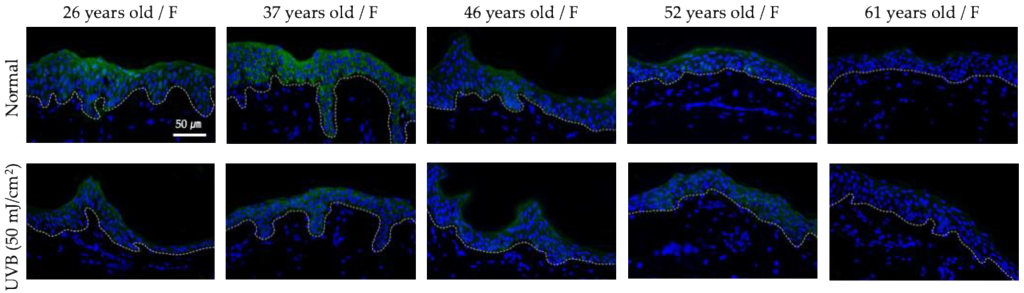
In the figure: Age-dependent decrease in Hsp47 protein in photo-protected tissue (abdomen) obtained from normal human skin (NativeSkin®, Genoskin S.A.S, Toulouse, France). Immunohistochemical staining demonstrated pronounced immunoreactivity in the upper granular layer, which decreased in intensity with advancing age (upper panel). UVB irradiation further reduced Hsp47 expression in the same tissue (lower panel). Green: Hsp47, blue: DAPI, dotted line: dermal–epidermal junction [magnification: ×400].