

Aging is a complex physiological process driven by diverse causes, frequently categorized into the “programmed theory” (congenital programming by genes) and the “accumulation of damage” to cellular components. Facial skin, in particular, is susceptible to damage, often resulting from UV exposure, which accelerates photo-aging by reducing collagen and elastin, key elastic components in the skin’s dermis, leading to the development of wrinkles. Furthermore, age impairs the constant renewal of the epidermis, leading to the accumulation of dead skin cells, increased thickness of the stratum corneum, roughness, and skin dryness. This low moisture content causes skin rigidity and promotes wrinkle formation. Due to the varied and complex causes of aging, effective anti-aging strategies require a wide-ranging approach.
The potential solution explored in this research is rooted in Kampo, a traditional Japanese medicine derived from traditional Chinese medicine. Kampo is characterized by generally combining several natural compounds to achieve a multiple pharmacological effect. This combined approach is considered useful in addressing aging and the various associated physiological changes. Consequently, a medical cosmetic Kampo cream containing various bioactive ingredients was considered a promising candidate for combating wrinkles and other age-related skin issues.
Methods
This preliminary clinical trial used the split-face method to evaluate the cosmetic cream’s effects on 14 healthy female subjects aged 31 to 59 years with dry skin and shallow wrinkles. The subjects applied the Gold Hakuyo all-in-one cream to only one side of their face twice daily for four weeks, with the other side acting as an untreated control. Wrinkle grades were objectively assessed from photographs taken before and after the trial by expert examiners who were blinded to the treatment allocation. Subjective improvements in skin condition were also gathered through a 14-item questionnaire.
Key Findings
The results of the 4-week trial demonstrated objective and subjective improvements on the test side:
• Objective Wrinkle Reduction: A statistically significant difference in wrinkle grade was found on the test side when compared pre- and post-trial (P=0.03), whereas no significant change was noted on the untreated side. A comparison between the test and untreated sides also suggested a significant difference (#P < 0.05).
• Age-Dependent Efficacy: The reduction in wrinkles was more pronounced in older subjects (over 40 years of age) who generally had higher initial wrinkle grades. Changes were less observable in subjects under 40 years of age.
• Broad Subjective Skin Improvement: The reduction in wrinkles on the test side was corroborated by the subjects’ questionnaire responses. Statistically significant improvements were observed in many aging-related parameters on the test side, while the untreated side showed no significant change in any item.
• Specific Improvements: Significant differences (P<0.01) were noted for skin softness, makeup adhesion, smoothness, tightness after face wash, moisture, and overall satisfaction. Other parameters such as roughness, gloss, resilience, clarity, transparency, wrinkles, and texture also showed statistically significant differences.
• Correlation: A positive correlation was found between the decrease in wrinkle grade and the improvement in all skin condition items, with correlation coefficients of 0.4 or higher observed for skin softness, smoothness, moisture, and wrinkles.
• Safety: The test cream proved safe, as no adverse events occurred during the trial period.
The research successfully indicates that the application of the Kampo cream for four weeks delivered a significant anti-wrinkle effect and helped maintain the facial skin in a healthy condition. The study suggests that this efficacy stems from the combined effects of the multiple natural ingredients characteristic of Kampo medicine. The novelty of this product lies in its effectiveness as an all-in-one type cosmetic cream, reducing the need for multiple products while combating wrinkles and various age-related symptoms on facial skin.
However, a limitation of using a blend of multiple Kampo components is the difficulty in clearly identifying the specific mechanisms of action and effects of individual components. Future implications for this research include the need for advanced experimental systems, such as animal and in vitro models using cultured cells, to enable detailed measurements and the elucidation of the molecular mechanisms by which the Kampo components reduce wrinkles. Furthermore, since this study focused on subjects with relatively shallow wrinkles who volunteered for a clinical trial, future verification is required to confirm efficacy for deeper wrinkles and to demonstrate definitive efficacy through larger-scale trials targeting a more general population.
The ability of a multi-component Kampo cream to tackle complex aging processes is like using a symphony orchestra rather than a solo instrument: the diverse ingredients work together to produce a comprehensive and harmonious effect on the skin’s structure and function.
Link to the study: https://www.mdpi.com/2079-9284/12/6/271
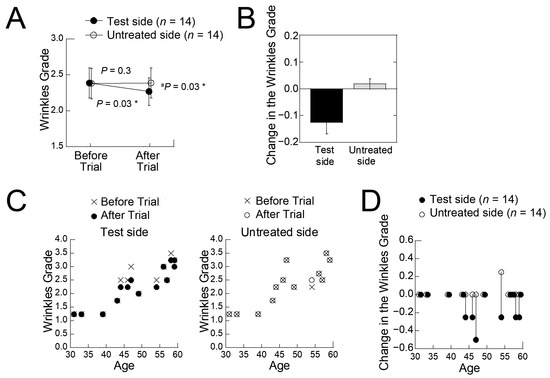
In the Figure: Change in wrinkles around the eyes before and after use of the test cream for 4 weeks. (A): Before and after the 4-week trial, both sides of the subjects’ faces were photographed, and the wrinkles on the photos were evaluated by skilled inspectors according to the wrinkle grade established by Japanese Cosmetic Science Society. Higher wrinkle grades indicate deeper winkles. P values between the test and untreated sides were denoted as #P. (B): Changes in the wrinkle grade on both sides of the face. (C): The relationship between wrinkles on each side of the face and subjects’ age. (D): Changes in the wrinkle grade against the age of the subjects. Error bars denote the standard error of the mean (SEM). *P < 0.05.