

The integrity of the skin’s protective and regulatory barrier function is primarily achieved within the stratum corneum (SC), the outermost layer of the epidermis. The SC utilizes a “brick-and-mortar” structure where corneocytes (bricks) are embedded in a matrix of highly organized intercellular lipids (mortar). Key lipids essential for maintaining this barrier include ceramides, cholesterol, and free fatty acids (FFA), which ideally exist in an approximately equal molar ratio. Disruptions or deficiencies in these lipids, particularly evident in aged skin where total lipid content may be reduced by up to 30%, lead to a defective epidermal permeability barrier, often resulting in increased roughness and dryness.
Given that topical applications of physiological SC lipids can improve barrier recovery in aged skin, there is growing interest in natural lipid sources. Oat lipids derived from Avena sativa have historically been recognized for anti-inflammatory activity, but recent investigation has focused on their valuable lipid content, specifically ceramides. This study investigated a specific Oat Lipid Extract which possesses ‘skin identical’ ratios of fatty acids, ceramides, and cholesterol/sterol, positioning it as a strong candidate for skin barrier repair and enhancement.
Methods
The Avena sativa Oat Lipid Extract was profiled for lipid class composition and fatty acid content using gas–liquid chromatography (GLC) and high-performance thin-layer chromatography (HPTLC). Ceramide classes were characterized through liquid chromatography with tandem mass spectrometry (LC‒MS/MS). The effect on skin structure and composition was analyzed using a multi-method approach, including confocal Raman spectroscopy and immunostaining on human skin explants, and Lipbarvis® transmission electron microscopy (TEM) and immunohistochemical analysis over 56 days to evaluate intercellular lipid lamellae length, hyaluronic acid, and ceramides. Finally, in vivo efficacy was determined by measuring skin roughness (PRIMOS) and hydration (corneometer) on subjects treated for 56 days.
Key Findings
The investigation demonstrated significant improvements in skin barrier structure and function following treatment with Oat Lipid Extract:
• Composition Uniqueness: Oat Lipid Extract revealed a typical total polar lipid content of 40 g kg⁻¹, including 4 g kg⁻¹ ceramides, and was unique among other tested plant oils for possessing a polar lipid fraction alongside a balanced fatty acid profile.
• Skin Identical Lipids: The extract contains ceramide classes that include skin identical sphingosine and phytosphingosine bases, suggesting they can serve as replacements for those depleted in the skin.
• Lipid Delivery: Confocal Raman spectroscopy confirmed that the Oat Lipid Extract induced a significant increase in neutral and polar lipid content in the skin explants and correlated well with the lipid profile of the stratum corneum and viable epidermis.
• Barrier Structural Enhancement: After 56 days, Lipbarvis® TEM analysis showed a statistically significant increase (14%) in the length of the intercellular lipid lamellae. This indicates an improved quality and organization of the epidermal barrier.
• Increased Epidermal Components: Immunostaining demonstrated a significant increase in the amount of detectable hyaluronic acid (14%) and ceramides (10%) in the epidermis after 56 days of treatment.
• Anti-Ageing Efficacy: In vivo human trials showed that treatment with Oat Lipid Extract resulted in a statistically significant reduction in skin roughness and a statistically significant increase in skin hydration after 56 days, validating its anti-ageing potential.
This study represents the first reported preliminary investigation of oat lipids utilizing confocal Raman spectroscopy for the detection of Avena sativa ceramides, supported by Lipbarvis® TEM and immunostaining, to ascertain the delivery and efficacy of Oat Lipid Extract. The novelty lies in confirming that oat ceramides, presented in the unique composition of the Oat Lipid Extract, can be effectively delivered into the stratum corneum. The extract’s composition, containing ceramides with a significant proportion structurally identical to those found in human skin, offers good insight into the possibility of it mimicking the structure and function of the skin’s barrier.
The demonstrable improvements in skin roughness, hydration, and key barrier components (ceramides and hyaluronic acid) highlight the extract’s significant anti-ageing efficacy. Future implications suggest that Oat Lipid Extract is a promising, naturally derived source of skin-replenishing lipids for personal care formulations. However, further research is required to investigate the molecular arrangement and liquid crystalline changes that occur within the SC following replenishment. Additionally, the detailed classification of the ‘skin identical’ properties of this extract needs to be verified and further investigated.
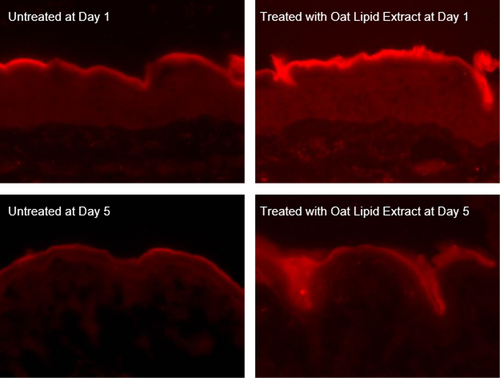
Immunostaining of the polar lipid surface of the treatment of Oat Lipid Extract (right) to viable skin explants versus untreated control (left) at Days 1 and 5. Polar lipids are shown in red.
Link to the study: https://onlinelibrary.wiley.com/doi/full/10.1111/ics.70042