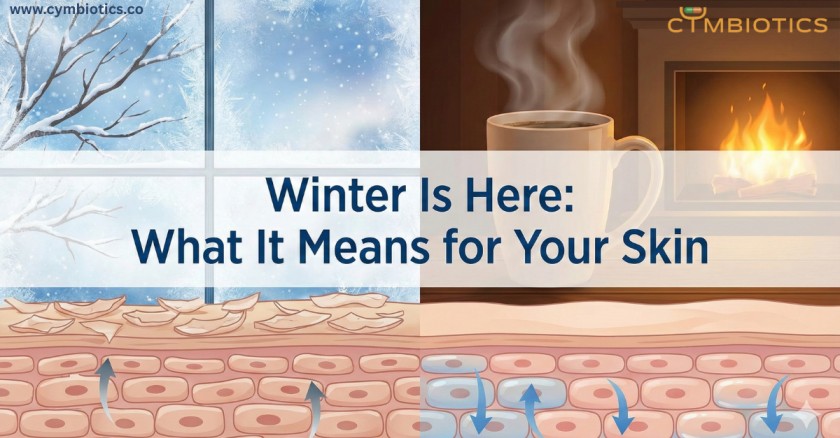
Winter brings its cozy mornings, layered sweaters, and warm drinks, but for your skin, it’s a season of biological stress. As humidity drops and temperatures swing between cold outdoors and heated indoors, the skin’s barrier works overtime to stay balanced. Understanding what truly happens beneath the surface helps you care for your skin more intelligently during the colder months.
Let’s break down the science behind winter skin and explore how Cymbiotics’ research-driven approach supports barrier health when the environment works against it.
Low Humidity & Rising TEWL
Winter air holds very little moisture. This low humidity pulls water out of the skin through transepidermal water loss (TEWL). When TEWL rises:
- The barrier becomes weaker
- Tightness and irritation increase
- Skin looks dull due to reduced light reflection and surface roughness
Hydration is not just about “moisture”; it’s about how well your barrier can retain it. In cold months, that retention becomes compromised.
Cold Temperatures = Vasoconstriction
When your skin is exposed to cold wind or low temperatures, blood vessels constrict. This is your body’s way of preserving heat, but it comes with trade-offs:
- Less oxygen and fewer nutrients reach the skin
- Renewal slows down
- Dullness becomes more visible
A slower turnover means the skin’s natural glow takes a hit, and any dryness or flaking becomes more noticeable.
Reduced Lipid Production
Lipids especially ceramides, cholesterol, and fatty acids, form the “mortar” that keeps your skin barrier stable.
During winter, lipid synthesis naturally drops.
This leads to:
- Flaking
- Micro-cracks (often invisible but impactful)
- Sensitivity and stinging sensations
- Reduced protection from irritants
When lipids dip, even well-formulated moisturizers don’t absorb as well because the skin’s architecture is compromised.
Slower Natural Exfoliation
The enzymes responsible for desquamation (the natural shedding of dead cells) require proper hydration to work efficiently. Winter dehydration slows them down.
As a result:
- Dead cells accumulate
- Skin feels rough
- Products absorb unevenly
- Makeup settles into texture
This uneven turnover is why many people notice a “gray cast” or lack of vibrancy during December and January.
Indoor Heating & Temperature Swings
While heaters make winter comfortable, the warm, dry air they produce strips moisture quickly.
Moving between cold outdoors and warm indoors also shocks the skin, leading to:
- Redness
- Irritation
- Flare-ups in sensitive skin
These rapid shifts destabilize the microbiome, making winter one of the toughest seasons for skin balance.
Disrupted Hydration Pathways
Winter doesn’t affect just one mechanism, it strains all hydration pathways simultaneously:
- Water retention drops
- Lipid levels fall
- Microbiome balance shifts
- Turnover slows down
This creates a perfect storm for flare-ups like:
- Chapped skin
- Eczema episodes
- Burning or stinging after cleansing
- Increased dryness around the nose and mouth
Understanding this multi-layered disruption is key to restoring balance.
Cymbiotics’ Perspective: Supporting Skin Intelligence in Winter
Winter challenges the biological pathways that maintain hydration, renewal, and barrier strength. Cymbiotics’ formulations are designed to support these pathways through innovative delivery systems and biomimetic structures.
Cetosomes™
Our signature technology, Cetosomes™, offers self-assembling nanoparticles that:
- Enhance penetration without disrupting the barrier
- Improve stability of actives in challenging climates
- Help replenish lipids with better efficiency
Perfect for conditions where the barrier is stressed and absorption is inconsistent.
FADD Delivery
Fast Acting Dermal Delivery (FADD) uses:
- CFEP (Cetylated Fatty Ester Penetrant Complex)
- Polar solvents
- Stabilizing antioxidants and silicones
This system ensures:
- Faster actives delivery
- Better hydration performance
- More efficient lipid balance restoration
FADD™ helps counter winter’s slow turnover and weakened absorption.
Supporting Skin Intelligence
Cymbiotics focuses on formulations that work with your skin’s biology, not against it. The goal is to:
- Maintain hydration balance
- Strengthen barrier lipids
- Support microbiome resilience
- Improve penetration of beneficial actives
When the environment becomes harsh, the skin’s intelligence needs support. Cymbiotics’ technologies are developed exactly for these moments.
References
1. Krutmann J, Morita A, Chung JH. Impact of Water Exposure and Temperature Changes on Skin Barrier Function. J Clin Med. 2022;11(3):781.
2. Voegeli R. Physiological, Pathological, and Circadian Factors Impacting Skin Hydration. Skin Res Technol. 2023.
3. Montero-Vilchez T, et al. Transepidermal Water Loss (TEWL): Environmental and Pollution Factors — A Systematic Review. Skin Health Dis. 2022;2(2):e96.