

Melasma is a chronic hyperpigmentation disorder that often proves resistant to therapy. It is recognized as one of the most challenging aesthetic defects to treat, characterized by irregular, well-demarcated discoloration spots typically found on the face, which intensify upon exposure to ultraviolet radiation. Achieving long-lasting lightening of these hyperpigmentation lesions is notably difficult. Historically, invasive treatments like aggressive chemical peels or high-energy light procedures carry the significant risk of inducing post-inflammatory hyperpigmentation (PIH), which can subsequently worsen the skin condition. Consequently, there is an urgent need to identify minimally invasive procedures that can effectively reduce melasma with reduced inflammatory responses. The investigated solution focused on combining a chemical skin stimulator—trichloroacetic acid (TCA) stabilized with hydrogen peroxide (H2O2)—with a potent lightening serum. This innovative approach was considered because the stabilization of TCA with H2O2 reduces the acid’s aggressiveness and minimizes exfoliation, thereby decreasing the critical risk of PIH associated with traditional peels. Furthermore, the modified TCA formulation acts as a penetration promoter, allowing depigmenting substances in the serum—such as tranexamic acid, niacinamide, and ferulic acid—to effectively target and synergistically inhibit melanogenesis at various stages, offering a multi-pronged approach to pigmentation control.
Methods
This preliminary study included ten female volunteers diagnosed with mixed-type melasma (Fitzpatrick II). The subjects underwent six treatment sessions, scheduled 7–14 days apart, employing a sequential application of products. Each procedure involved first applying three layers of a chemical stimulator (33% TCA stabilized with hydrogen peroxide and 5% kojic acid), followed by rinsing and then application of a lightening serum containing ingredients like niacinamide, tranexamic acid, lactoferrin, ferulic acid, alpha-lipoic acid, and phytic acid onto the hyperpigmented areas. Clinical improvement was assessed by three independent experts using the modified Melasma Area and Severity Index (mMASI). Objective quantification of pigmentation reduction and skin texture homogenization was performed using Grey Level Co-Occurrence Matrix (GLCM) analysis on standardized photographic documentation, measuring contrast and homogeneity at baseline (T0), 2 weeks (T1), and 8 weeks (T2) post-treatment.
Key Findings
• Significant Clinical Reduction: Evaluation using the mMASI scale demonstrated significant clinical improvement, with mean mMASI scores decreasing by 62.3% after 2 weeks and 62.9% after 8 weeks following the series of six treatments.
• Objective Confirmation (GLCM): Objective photographic analysis via GLCM confirmed pigmentation reduction across all facial regions. This was evidenced by a decrease in contrast (average 19.5% improvement at T1, 19.8% at T2) and a corresponding increase in homogeneity (average 16.5% improvement at T1, 16.8% at T2).
• Regional Effectiveness: The chin area, which initially presented with the highest intensity of hyperpigmentation in the study group, showed the greatest improvement according to both expert mMASI assessment and objective GLCM contrast reduction.
• Safety Profile: The treatment protocol was well-tolerated, with no serious adverse events or reports of post-inflammatory hyperpigmentation (PIH) during the 8-week follow-up period, suggesting that the TCA-H2O2 modification is safer than traditional chemical peels that carry a high PIH risk.
• Correlation Trend: While there was no statistically significant correlation between mMASI and GLCM parameters before or after treatment, there was a positive trend (R = 0.62, p = 0.056) between the percentage change in mMASI reduction and the percentage change in GLCM contrast after two weeks.
The combined protocol utilizing trichloroacetic acid stabilized with hydrogen peroxide and kojic acid, followed by a multi-ingredient lightening serum, effectively and safely reduced melasma hyperpigmentation, with effects maintained at the 8-week follow-up. The novelty of this research lies in its successful use of a chemical skin stimulator as a penetration enhancer for multiple depigmenting agents without inducing PIH, a common complication in melasma treatments. Furthermore, the research validates the use of Grey Level Co-Occurrence Matrix (GLCM) analysis as an effective quantitative tool to complement the subjective traditional mMASI scale, offering an objective means of assessing skin tone and texture changes in hyperpigmentation therapies.
These preliminary observations offer proof-of-concept for the combined treatment protocol. Future implications necessitate the validation of these findings through larger, randomized, double-blind, controlled trials that include an adequate control group (e.g., using only the serum) to isolate the efficacy of individual components. Additionally, longer follow-up periods (e.g., 12 months) and objective monitoring of compliance and UV exposure are recommended to determine long-term sustainability. The successful integration of GLCM analysis suggests its growing utility as an objective method for monitoring treatment effectiveness in dermatological and aesthetic medicine research.
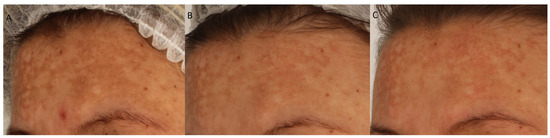
The image: Change in the intensity of melasma on the forehead of Volunteer 1 (A), 2 weeks after (B) and 8 weeks after (C) a series of 6 treatments, left side.
Link to the study: Evaluation of the Degree of Melasma Reduction After Application of a Chemical Skin Stimulation Product in Combination with a Lightening Serum—Preliminary Observations