The cosmetic industry is highly interested in developing formulations that contain effective and safe bioactive compounds for skin lightening, particularly those demonstrating high stability, adequate skin penetration, and good skin compatibility. Kojic acid (KA) is a key ingredient widely known for its ability to inhibit tyrosinase, the primary enzyme in melanin synthesis, thereby offering skin whitening properties. However, the direct use of KA is often limited due to its low stability, sensitivity to heat and light, oxidation, and the potential for adverse effects like skin irritation.
To address these limitations, researchers have explored derivatives such as kojic acid dipalmitate (KDP), which is the esterified form of KA, offering enhanced stability across a wide pH range and resistance to heat and light. Due to its lipophilic nature, KDP may also exhibit increased affinity for the stratum corneum, potentially improving cutaneous absorption. The potential solution was further bolstered by combining KDP with rosehip oil, an ingredient recognized for its antioxidant, anti-inflammatory, and skin regenerative properties, which has demonstrated pigmentation reduction capability. Since both KDP and rosehip oil are susceptible to degradation (KDP via hydrolysis in aqueous environments and rosehip oil via oxidation), nanotechnology—specifically the use of polymeric nanocapsules—was employed as a strategy to protect these active ingredients, limit KDP’s contact with the external aqueous medium, enhance skin penetration, and ensure stability.
Methods
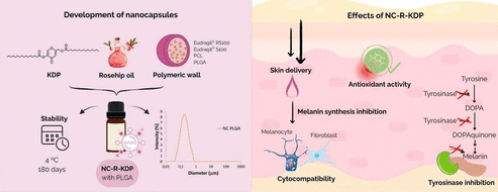
Polymeric nanocapsules (containing 0.1% KDP and 5% rosehip oil) were successfully developed via the interfacial deposition of preformed polymer method. Four different polymers (Eudragit RS100, Eudragit S100, PCL, and PLGA) were tested, and the PLGA formulation (NC-R-KDP) was selected for further evaluation due to its superior stability over 180 days under refrigerated storage. The formulations were characterized for nanoscale features, including a diameter of less than 200 nm, and exhibited high KDP encapsulation efficiency (above 99%). The potential efficacy was evaluated through in vitro assays measuring antioxidant activity (DPPH and β-carotene/linoleic acid assays), tyrosinase inhibition, skin permeation using porcine skin, and melanin content reduction in normal human epidermal melanocytes (NHEM). Cytocompatibility was assessed using NHEM cells and fibroblast-like cells (3T3-L1).
Key Findings
• The PLGA nanocapsule formulation (NC-R-KDP) proved to be the most stable, maintaining its KDP content throughout 180 days of refrigerated storage and exhibiting less KDP degradation into kojic acid compared to other polymers, especially at room temperature.
• In in vitro skin permeation assays, the nanocapsules successfully enabled KDP to overcome the stratum corneum and reach the epidermis (the target layer for melanocytes) and the dermis, suggesting topical rather than systemic activity, and forming a KDP deposit in the stratum corneum.
• NC-R-KDP demonstrated antioxidant activity via two different mechanisms: radical scavenging activity (likely due to rosehip oil) and protection against oxidation (likely due to KDP).
• The nanocapsules significantly inhibited tyrosinase in vitro (17% inhibition at 13.75 μg/mL of KDP) and showed higher antioxidant activity compared to a corresponding kojic acid solution.
• Treatment with NC-R-KDP at a concentration of 3.1 μg/mL of KDP led to a 25% reduction in melanin content in normal human epidermal melanocytes (NHEM) after 96 hours.
• The formulation exhibited good cytocompatibility, allowing for viable cell percentages in fibroblast-like cells (3T3-L1) up to 6.25 μg/mL of KDP and in normal human epidermal melanocytes (NHEM) up to 3.1 μg/mL of KDP.
This research successfully developed polymeric nanocapsules containing kojic acid dipalmitate (KDP) and rosehip oil, demonstrating key advantages in stability and efficacy. The novelty of this study lies in being the first to describe polymeric nanocapsules as a carrier system for KDP, specifically highlighting the superior performance of the PLGA polymer in limiting KDP hydrolysis and maintaining stability over extended periods. By co-encapsulating KDP and rosehip oil, the system leveraged multiple pathways for depigmentation (tyrosinase inhibition and antioxidant activity) and achieved a 25% reduction in melanin content in primary human melanocytes. The nanocapsules successfully delivered KDP to the desired epidermal layer and created a deposit in the stratum corneum, suggesting potential for controlled and prolonged action. The future implication of this work is the potential use of the PLGA nanocapsules (NC-R-KDP) as a high-performance, high-stability component in skin whitening and/or lightning cosmetic formulations.
Link to the study: https://pubs.acs.org/doi/pdf/10.1021/acsomega.5c08878?ref=article_openPDF