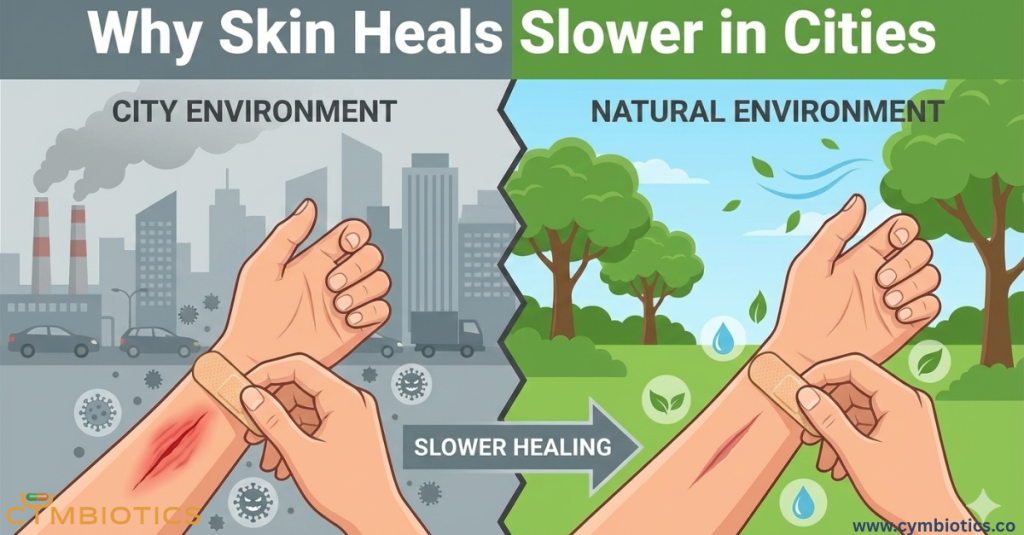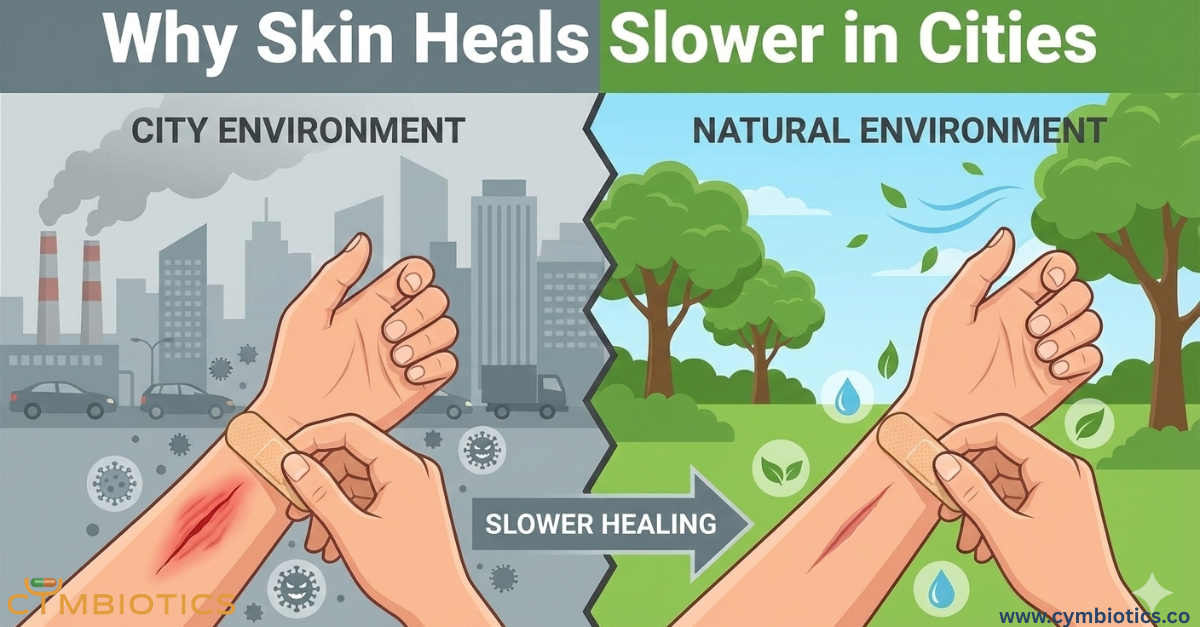

Urban life is often described as fast-paced, stimulating, and demanding. But while cities push people to move faster, the skin often does the opposite. Cuts linger longer, irritation becomes chronic, pigmentation takes time to fade, and barrier recovery feels delayed. This is not incidental. It is biological.
Skin healing is an energy-intensive, tightly regulated process. In urban environments, the skin is forced to operate under continuous stress, often prioritizing defense over repair. Over time, this imbalance slows recovery and compromises resilience.
The Urban Exposure Load
Unlike acute environmental stress, city living exposes skin to persistent, low-grade insults. Airborne particulate matter, nitrogen dioxide, ozone, and heavy metals constantly interact with the skin surface. These pollutants do not simply sit on the skin, they penetrate into the stratum corneum, triggering oxidative stress and inflammatory signaling.
When oxidative burden rises, skin cells divert energy toward neutralizing reactive species rather than rebuilding lipids, proteins, and structural integrity. Repair is not abandoned, but it is delayed. In biological terms, skin enters a survival-first mode.
Oxidative Stress and Slowed Repair
Healthy skin healing relies on coordinated keratinocyte migration, lipid synthesis, controlled inflammation, and extracellular matrix remodeling. Oxidative stress interferes with each of these steps.
Excess reactive oxygen species disrupt enzymatic activity involved in barrier lipid organization and impair signaling pathways that guide orderly repair. The result is not dramatic damage, but inefficient recovery, micro-injuries accumulate, barrier defects persist longer, and sensitivity becomes more frequent.
This is why urban skin often appears dull, uneven, or reactive even in the absence of visible disease.
Circadian Disruption: When Skin Loses Its Rhythm
Skin repair is not constant throughout the day. Cell proliferation, DNA repair, barrier recovery, and lipid synthesis follow circadian rhythms, with peak activity occurring at night.
Urban lifestyles frequently disrupt these rhythms. Artificial lighting, screen exposure, irregular sleep cycles, and psychological stress interfere with hormonal signals that regulate skin regeneration. When circadian timing is disturbed, repair processes become desynchronized. Skin may still heal, but it does so less efficiently and less predictably.
Over time, this circadian mismatch contributes to delayed wound healing, prolonged inflammation, and compromised barrier recovery.
Microinflammation as the New Normal
In cities, inflammation is often not acute but chronic and subclinical. Pollution, stress, and barrier disruption maintain a constant low-level immune response in the skin. While this response is protective in the short term, prolonged activation taxes cellular resources.
Instead of resolving inflammation and rebuilding structure, skin remains locked in a defensive state. Healing slows not because skin is weak, but because it is overworked.
Adaptation Has Its Limits
Skin is remarkably adaptive. It thickens its outer layers, increases melanin production, and alters lipid composition to cope with environmental stress. However, adaptation comes at a cost. Thickened stratum corneum can impair ingredient penetration. Altered lipid balance can increase transepidermal water loss. Defensive adaptations may protect against immediate harm while reducing long-term repair efficiency.
Urban skin often looks “tougher” on the surface but is biologically more fragile underneath.
Rethinking Repair in Urban Skin
Slower healing in cities is not a failure of skincare routines. It reflects a mismatch between environmental demand and biological capacity. Supporting urban skin requires approaches that respect barrier biology, oxidative balance, and cellular energy limits rather than overwhelming the skin with intensity.
This shift marks a broader change in dermatological thinking, from forcing rapid results to enabling consistent, sustainable repair.
Cymbiotics’ Perspective: Supporting Skin Under Urban Stress
At Cymbiotics, skin is understood as a dynamic, living system constantly negotiating with its environment. Urban skin faces unique challenges, and addressing them requires science-backed strategies that work with skin biology rather than against it.
Cymbiotics continues to advance dermal technologies and formulation approaches designed to support barrier stability, optimize delivery efficiency, and reduce biological strain on stressed skin. By focusing on long-term resilience rather than short-term correction, Cymbiotics aligns innovation with the realities of modern urban living.
In cities that never slow down, skin needs solutions that understand when to protect, when to repair, and how to restore balance quietly, consistently, and intelligently.
References
- “The influence of air pollution on skin microbiome and barrier physiology” – Authors not listed, Skin Research and Technology, 2024.
Open Access: https://pubmed.ncbi.nlm.nih.gov/39460761/ - “Wound healing in human skin equivalents reconstructed with biopolymers under fine-dust exposure” – Soongsil University researchers, Polymers, 2025. Open Access: https://www.mdpi.com/2073-4360/17/7/901
- “Air pollution and skin disorders: mechanisms of injury and barrier disruption” – Multiple authors, PMC (PubMed Central), 2024. Open Access: Air pollution and skin disorders – PMC
- “Reactive Oxygen Species and Antioxidant System in Selected Skin Disorders” – Juliana Md Jaffri, Malaysian Journal of Medical Sciences, 2023. Open Access: Reactive Oxygen Species and Antioxidant System in Selected Skin Disorders – PMC