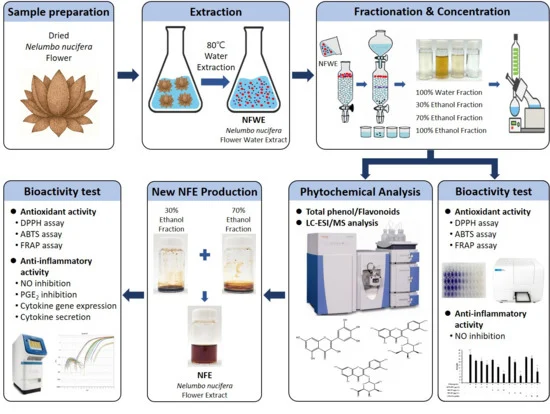
As the global population ages, there is an escalating demand for products that maintain skin health and combat signs of aging. Skin aging is primarily driven by oxidative stress and chronic low-grade inflammation, often referred to as “inflammaging,” which degrades structural proteins like collagen and elastin, leading to wrinkles and laxity. To address these issues, natural plant-derived extracts are increasingly sought after due to their established safety and high concentration of bioactive compounds. The Nelumbo nucifera Gaertn. (lotus) flower was considered a potential solution because it is rich in polyphenols and flavonoids, such as myricetin and quercetin, which possess potent antioxidant and anti-inflammatory properties. Furthermore, harvesting flowers is more sustainable than using other plant parts as it causes minimal damage to the overall plant structure.
Methods
Lotus flowers were extracted using hot water followed by sequential fractionation via porous resin chromatography with stepwise ethanol elution (0%, 30%, 70%, and 100%). The 30% and 70% ethanol fractions were combined to formulate a novel Nelumbo nucifera flower extract (NFE). This extract was then evaluated for its phytochemical profile using LC-ESI/MS and its biological activity through various in vitro antioxidant assays and anti-inflammatory tests on murine RAW264.7 macrophages and human HaCaT keratinocytes.
Key Findings
• Phytochemical Enrichment: The 30% and 70% ethanol fractions contained the highest levels of total polyphenols and flavonoids, respectively.
• Major Bioactive Compounds: LC-ESI/MS analysis identified nine major flavonoids, with myricetin and quercetin-3-O-galactoside found in high concentrations within the active fractions.
• Potent Antioxidant Activity: The NFE and its constituent fractions exhibited strong radical scavenging and reducing power in DPPH, ABTS, and FRAP assays, with the 30% fraction showing the highest potency.
• Macrophage Modulation: NFE significantly inhibited the secretion of inflammatory mediators, including nitric oxide (NO) and prostaglandin E2 (PGE2), in lipopolysaccharide-activated RAW264.7 cells.
• Skin Cell Protection: In human HaCaT keratinocytes, NFE reduced the expression and secretion of pro-inflammatory cytokines interleukin (IL)-6 and IL-8 without causing cytotoxicity.
The novelty of this research lies in its systematic fractionation approach, which effectively separated and enriched the bioactive constituents of a water-based lotus flower extract to create a highly potent NFE. This method ensures a safe, biocompatible, and sustainable process for obtaining high-quality raw materials. The future implications of this study suggest that NFE has significant potential as a multifunctional ingredient for cosmetic, nutraceutical, and pharmaceutical applications aimed at improving skin health. Future research should focus on elucidating the specific molecular signaling pathways (such as Nrf2/ARE and NF-κB) and conducting clinical trials or 3D skin model studies to validate these results in real-world scenarios.
Link to the study: https://www.mdpi.com/1467-3045/47/12/1065