

The skin barrier, primarily located in the stratum corneum, is the body’s first line of defense against external stressors and essential for preventing transepidermal water loss. Ceramides are the central lipid components required for the lamellar organization of this barrier; however, a depletion or imbalance in ceramide subclasses is frequently linked to clinical issues like dryness, sensitivity, and atopic dermatitis. Traditionally, the cosmetic industry relied on exogenous ceramide replenishment, but the efficacy of this approach is often limited by complex formulation challenges such as solubilization and stable lamellar integration. To address this, researchers have shifted toward stimulating endogenous ceramide homeostasis, a more foundational solution that aims to enhance the skin’s natural biosynthetic, processing, and recycling pathways.
Key Findings
• Tri-Pathway Homeostasis: Epidermal ceramide levels are maintained through three principal routes: de novo synthesis in the endoplasmic reticulum, the salvage pathway which recycles sphingosine, and sphingomyelin hydrolysis.
• Transcriptional Regulation: Nuclear receptors like PPARs and LXRs act as “liposensors” that synchronize keratinocyte differentiation with the synthesis and trafficking of barrier lipids.
• Metabolic Sensing: The AMPK–mTOR–SIRT1/autophagy axis serves as a critical quality control node, where activating AMPK or inhibiting mTORC1 can shift cells toward a lipid-anabolic state favorable for barrier repair.
• Ingredient Specificity:
◦ Niacinamide promotes ceramide production by increasing the expression and activity of the enzyme serine palmitoyltransferase (SPT).
◦ Sphingoid bases (e.g., phytosphingosine) utilize the salvage pathway to specifically remodel the distribution of ceramide subclasses.
◦ SIRT1 activators have been shown to enhance the production of ultra-long-chain (ULC) ceramides, which are vital for structural integrity.
• Extracellular Maturation: For a durable barrier, ceramides must be processed into ω-hydroxy ceramides to form the corneocyte lipid envelope (CLE), a protein-lipid scaffold that stabilizes lamellar membranes.
The novelty of this research lies in its mechanism-first organization, moving beyond simple ingredient descriptions to map bioactives to specific regulatory nodes like transcriptional sensors and metabolic quality-control pathways. Future implications for the cosmetic industry include the adoption of high-resolution lipidomics to verify that ingredients are effectively remodeling barrier-critical subclasses rather than just increasing total lipid quantity. By aligning multi-target formulations—which combine topical replenishment with endogenous stimulation—with rigorous clinical standards, developers can create more potent, evidence-based treatments for compromised skin.
To understand this complex system, think of the skin barrier as a brick wall where ceramides are the mortar; rather than just patching holes with external cement, these new strategies focus on teaching the masons to mix and apply more durable, high-quality mortar from within the wall itself.
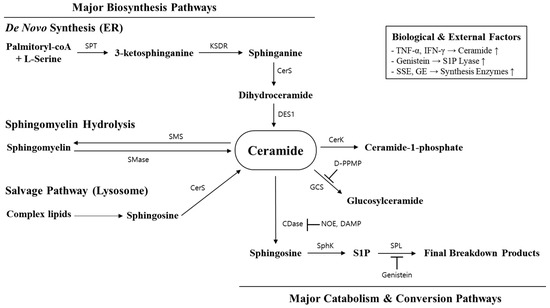
Overview of Major Ceramide Metabolic Pathways and Regulation Mechanisms.
Link to the study: https://www.mdpi.com/2079-9284/13/1/8