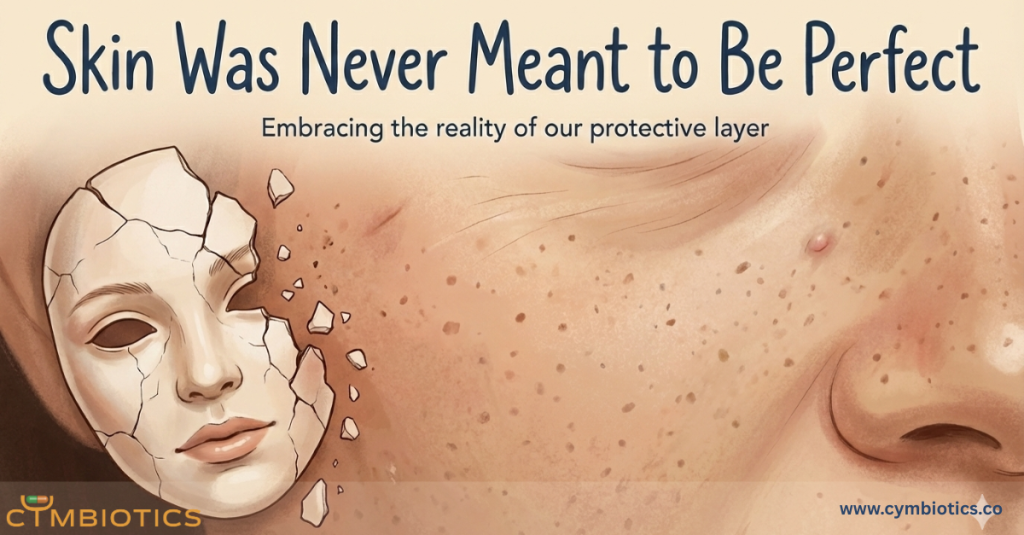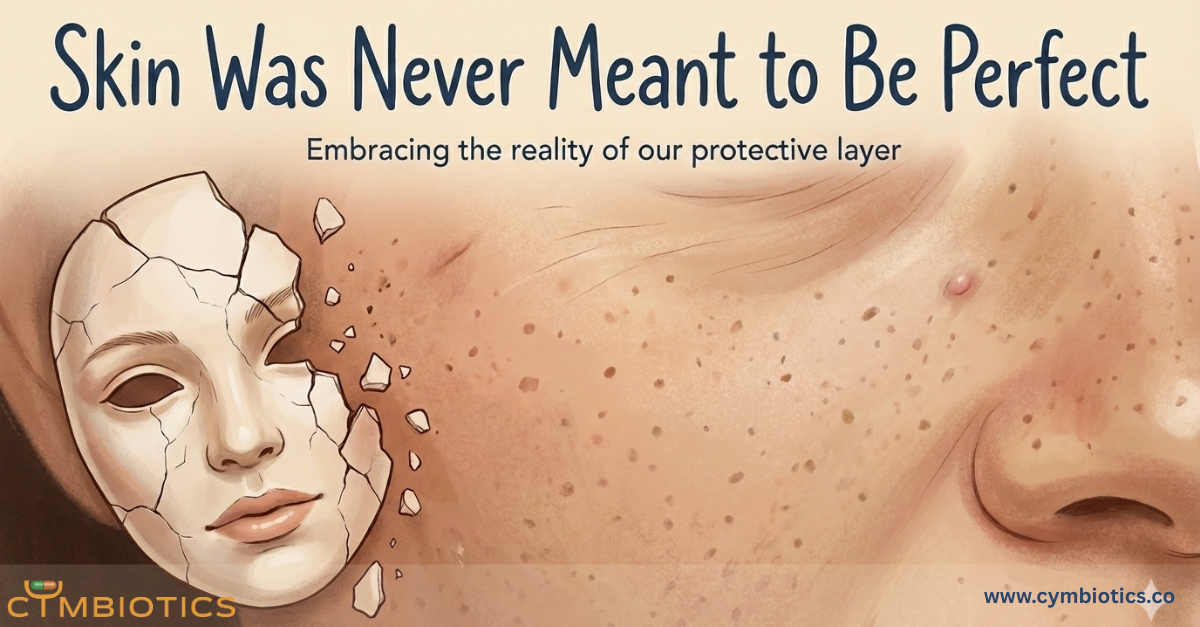

The Expectation Problem
Modern skincare often frames skin as something that should appear uniform, flawless, and unchanging. Texture is treated as a problem. Variability is seen as failure. Any visible response is quickly labelled as damage. Yet biologically, skin was never designed to be perfect. It was designed to be responsive.
Skin is a living organ, constantly negotiating between the body and the environment. Expecting visual perfection from a system built for protection, adaptation, and repair misunderstands its fundamental purpose.
Skin’s Primary Job Is Protection, Not Appearance
The outermost layers of skin exist to form a barrier, not to look smooth under artificial lighting. This barrier regulates water loss, blocks pathogens, and responds to physical, chemical, and microbial stress.
To perform this role, skin must remain dynamic. Cells are continuously renewed. Lipids reorganize themselves to maintain structural integrity. Immune signals remain active at low levels, ready to respond when needed.
This constant activity means skin will never be visually static. Fluctuations in texture, tone, and hydration are not flaws, they are indicators of a functioning system adapting to its conditions.
Variability Is a Feature of Healthy Skin Biology
Skin changes daily. Temperature, humidity, stress, sleep, nutrition, and hormonal rhythms all influence how skin behaves at a given moment.
At the cellular level, keratinocytes adjust their differentiation patterns. Lipid synthesis shifts based on environmental demand. Microcirculation adapts to regulate heat and nutrient delivery. These adjustments often show up as subtle changes in how skin looks or feels.
Uniformity would require biological rigidity, and rigid systems break more easily. Healthy skin remains flexible, responsive, and capable of change.
Why ‘Perfect’ Skin Is Often a Sign of Over-Control
When skin appears unnaturally uniform for prolonged periods, it is often being tightly controlled rather than supported. Excessive exfoliation, aggressive cleansing, and constant stimulation can suppress normal skin signalling.
In the short term, this may reduce visible variability. Over time, however, barrier lipids thin, cell turnover becomes dysregulated, and immune reactivity increases. Skin becomes less resilient and more reactive, despite appearing ‘smooth’ initially.
Biologically, silence is not the same as health. Skin that no longer responds appropriately has lost part of its regulatory capacity.
Texture, Sensation, and Change Are Biological Signals
Fine lines, transient roughness, occasional sensitivity, or shifts in hydration are ways skin communicates its internal state. These signals reflect changes in barrier organization, water movement, or inflammatory tone.
Attempting to erase every signal often interrupts the very feedback loops that allow skin to maintain balance. Supporting skin requires listening to these signals rather than overriding them.
Skin health is not defined by the absence of sensation or texture, but by the ability to recover and re-stabilize after stress.
The Cost of Chasing Perfection
Pursuing perfect skin encourages short-term thinking, immediate smoothing, instant brightness, rapid correction. Biology, however, operates on timelines of renewal, repair, and adaptation.
When interventions prioritize appearance over function, skin may temporarily comply while long-term integrity erodes. Reduced lipid diversity, impaired desquamation, and heightened sensitivity are common consequences of chronic over-intervention.
Healthy skin does not resist change. It manages it.
A Biology-First Perspective on Skin Health
Viewing skin through a biological lens reframes expectations. The goal is not perfection, but functional stability, a barrier that holds, renews, and recovers.
This perspective values:
- Resilience over flawlessness
- Recovery over instant correction
- Regulation over suppression
Skin that is allowed to function naturally may still show texture, pores, and variation. That variation is evidence of life, not failure.
The Cymbiotics Perspective
At Cymbiotics, skin is approached as a complex, self-regulating biological system. Formulation and delivery strategies are designed to work with skin physiology rather than override it.
Technologies such as Cetosomes™ and FADD™ are developed as support mechanisms, enhancing compatibility, stability, and delivery while respecting barrier integrity and natural signalling pathways.
This biology-first approach reflects a broader commitment to enhancing health and well-being through continuous innovation and science-backed formulations, without demanding perfection from a system that was never meant to be perfect.
References
- “Skin Barrier Function: The Interplay of Physical, Chemical, and Immunologic Properties” – Baker et al., Cells (2023).
- “Skin Barrier Function: Why It Matters” – Del Rosso & Kircik, J Clin Aesthet Dermatol (2025).
- “Skin Barrier Function and the Stratum Corneum: Key Components” – (Epidermal barrier review).