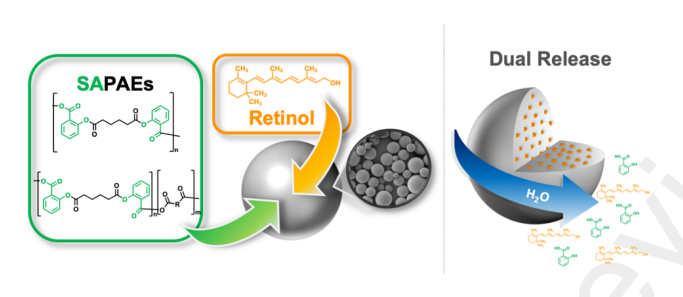
Retinol is a vital derivative of Vitamin A used extensively to treat skin pathologies such as acne, psoriasis, and photodamage due to its ability to regulate cellular proliferation and inflammation. However, its clinical efficacy is severely hampered by its low aqueous solubility and extreme chemical instability when exposed to light, heat, and oxygen. Current delivery systems often suffer from imprecise and inefficient release profiles, which can lead to skin irritation or sub-therapeutic results. To address these issues, researchers developed a platform using salicylic acid-derived poly(anhydride-ester)s (SAPAEs). This solution was considered ideal because SAPAEs are not just passive carriers; they covalently incorporate salicylic acid—a synergistic bioactive—into their backbone, allowing for the simultaneous, controlled release of two therapeutic agents as the polymer degrades.
Methods
The researchers synthesized four distinct SAPAE compositions via melt-condensation polymerization, utilizing various diacid comonomers (PA, FA, and AA) to tune degradation kinetics. Microspheres with a reproducible size of approximately 10 µm were then fabricated using an oil-in-water solvent evaporation method to encapsulate retinol. The resulting formulations were characterized using 1H NMR, SEM, and thermal analysis to confirm chemical structure, morphology, and drug-polymer miscibility. Finally, in vitro release and degradation studies were conducted across pH 5.5, 7.4, and 9.0 to evaluate the platform’s pH-responsive behavior.
Key Findings
• High Bioactive Loading: The platform achieved exceptionally high salicylic acid loadings (54–77 wt%) through the polymer backbone and physical retinol encapsulation of 0.5–1.5 wt%.
• Distinct Release Mechanisms: Kinetic modeling confirmed that salicylic acid release is governed by surface erosion of the polymer, whereas retinol release is primarily driven by Fickian diffusion.
• pH-Responsive Degradation: Both bioactives exhibited faster release in basic environments (pH 9.0) compared to acidic or neutral conditions, reflecting the pH-dependent hydrolysis of the anhydride and ester linkages.
• Tunable Kinetics: By adjusting the ratio of anhydride-to-ester bonds via copolymerization, the researchers successfully modulated the polymers’ hydrophobicity and glass transition temperatures.
• Superior Performance of SAA-co-PA: Among the tested compositions, the copolymer containing p-phenylenediacetic acid (PA) demonstrated the most stable profile, featuring the lowest retinol burst release (~30%) and sustained delivery of both agents.
Conclusion
The novelty of this research lies in the creation of a modular, bioactive polymeric platform that stabilizes fragile retinol while simultaneously delivering high concentrations of salicylic acid from the carrier itself. Unlike traditional encapsulation methods, this system offers independent tunability of two different release mechanisms within a single vehicle. These findings have significant future implications for the development of advanced topical therapies, as the platform can be adapted for the co-delivery of various lipophilic bioactives. Future studies will focus on evaluating the biological performance and therapeutic efficacy of these microspheres in in vitro and in vivo models.
Link to the study: https://papers.ssrn.com/sol3/papers.cfm?abstract_id=5975892