
The Myth of One-Type Skin
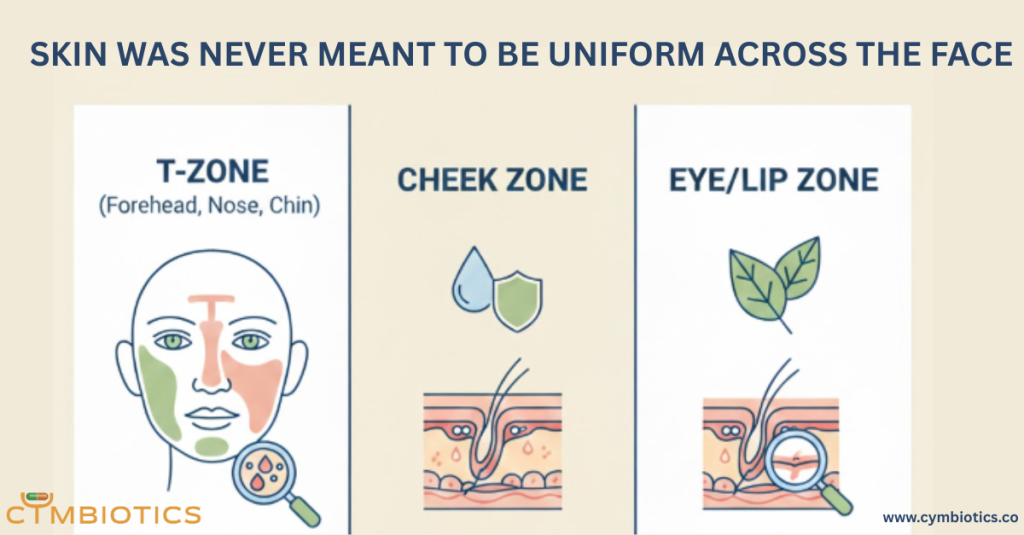
Facial skin is often discussed as if it behaves as a single, uniform surface. Dry, oily, sensitive, or combination are treated as fixed categories, applied across the entire face. Biologically, this assumption does not hold.
Different regions of the face are built differently, supplied differently, and regulated differently. Expecting identical behavior from the forehead, cheeks, nose, and jawline ignores the structural and functional diversity that exists within facial skin itself.
Regional Differences in Skin Thickness
Skin thickness varies significantly across the face. Areas such as the eyelids and periorbital region have a much thinner epidermis and dermis compared to the cheeks or forehead.
Thinner skin contains fewer protective cell layers and less structural support. This makes these regions more prone to dehydration, mechanical stress, and visible vascular changes. Thicker areas, in contrast, tolerate friction and environmental exposure more effectively but may retain debris and dead cells more easily.
These anatomical differences explain why fine lines, sensitivity, and irritation often appear earlier around the eyes, while congestion or uneven texture may be more noticeable in thicker regions.
Sebaceous Gland Distribution and Lipid Supply
Sebaceous gland density is not evenly distributed across the face. The central facial region typically contains a higher concentration of oil-producing glands, while peripheral areas such as the cheeks and jawline have fewer.
Sebum contributes to barrier lubrication, antimicrobial defense, and lipid organization at the surface. Regions with higher sebum output maintain surface flexibility and microbial balance more easily, but are also more susceptible to clogged pores and inflammatory responses when regulation is disrupted.
Areas with lower gland density rely more heavily on internally synthesized barrier lipids and are therefore more vulnerable to dryness, tightness, and impaired recovery under environmental stress.
Microcirculation and Nutrient Delivery
Blood flow within facial skin is not uniform. Vascular networks vary in density and responsiveness across different zones, influencing oxygen delivery, nutrient supply, and thermal regulation.
Regions with richer microcirculation tend to show faster inflammatory responses, quicker repair, and more visible flushing. Areas with lower perfusion may appear dull, heal more slowly, and show delayed recovery after stress.
These differences affect how quickly skin can adapt to temperature changes, mechanical irritation, or barrier disruption, contributing to visible variation in tone and vitality across the face.
Cellular Turnover and Surface Renewal
Rates of cell production and shedding are also region-dependent. Mechanical exposure, glandular activity, and local hydration all influence how quickly cells move through the epidermal layers.
Slower turnover can lead to surface roughness and uneven light reflection, while faster turnover may increase sensitivity and transient inflammation. Because these rhythms vary across facial zones, texture and brightness rarely change uniformly.
This biological variability is one reason why certain areas may appear smooth while others feel rough or congested at the same time.
Why Uniform Skincare Responses Are Unlikely
Because facial regions differ in structure, circulation, lipid supply, and renewal dynamics, they will not respond identically to environmental exposure or topical interventions.
A single stimulus may hydrate one area while irritating another. Barrier repair may occur quickly in well-perfused zones and slowly in lipid-poor regions. These differences are not signs of imbalance, but reflections of localized skin physiology operating as intended.
Understanding skin as a mosaic of functional zones rather than a single surface allows for more realistic expectations of how skin behaves and recovers.
Biological Variation Is Part of Skin Stability
Uniformity would require suppressing regional biology and forcing identical behavior across structurally different tissues. From a physiological perspective, this would reduce adaptability rather than enhance it.
Healthy skin maintains stability not by being identical everywhere, but by allowing each region to regulate itself within its own biological limits. Variation across the face is therefore not a defect in skin function, but an expression of functional specialization.
The Cymbiotics Perspective
Cymbiotics approaches skin as an integrated but regionally diverse biological system. Formulation and delivery strategies are designed to support barrier integrity, hydration balance, and cellular communication without overriding localized regulation.
Technologies such as Cetosomes™ and FADD™ are developed to enhance compatibility and dermal support while respecting the natural variability of skin structure and function across different facial zones.
This approach reflects a broader commitment to enhancing health and well-being through continuous innovation and science-backed formulations, acknowledging that skin does not need to be uniform to be healthy.
References
1. Topographical variations in skin barrier and regional physiology – Dajnoki et al., Journal of the European Academy of Dermatology & Venereology, 2025.
2. Regional differences in sebum secretion on the face – Regional difference in sebum production by androgen susceptibility in human facial skin, PubMed, 2013.
3. Facial skin thickness and microanatomy variation – Reference Values for Skin Microanatomy, Journal of the American Academy of Dermatology, 2018.
4. Variable permeability barrier across skin regions – Regional Differences in the Permeability Barrier of the Skin, International Journal of Molecular Sciences (MDPI), 2021.
5. Facial skin blood flow varies regionally – Regional differences in facial skin blood flow responses, PubMed, 2019.