
The regulation of hair growth is a complex process primarily governed by the health and activity of Human Dermal Papilla Cells (HDPCs), which can be negatively impacted by inflammation and the inhibition of growth pathways. To address these issues, yeast fermentation of Platycladus orientalis leaves was explored as a solution to enhance the plant’s natural bioactivity. This approach was considered because it potentially creates a more potent supernatant (PYFS) capable of modulating internal cellular signals, such as the Wnt/β-catenin pathway, to promote hair follicle cell health and proliferation.
Methods
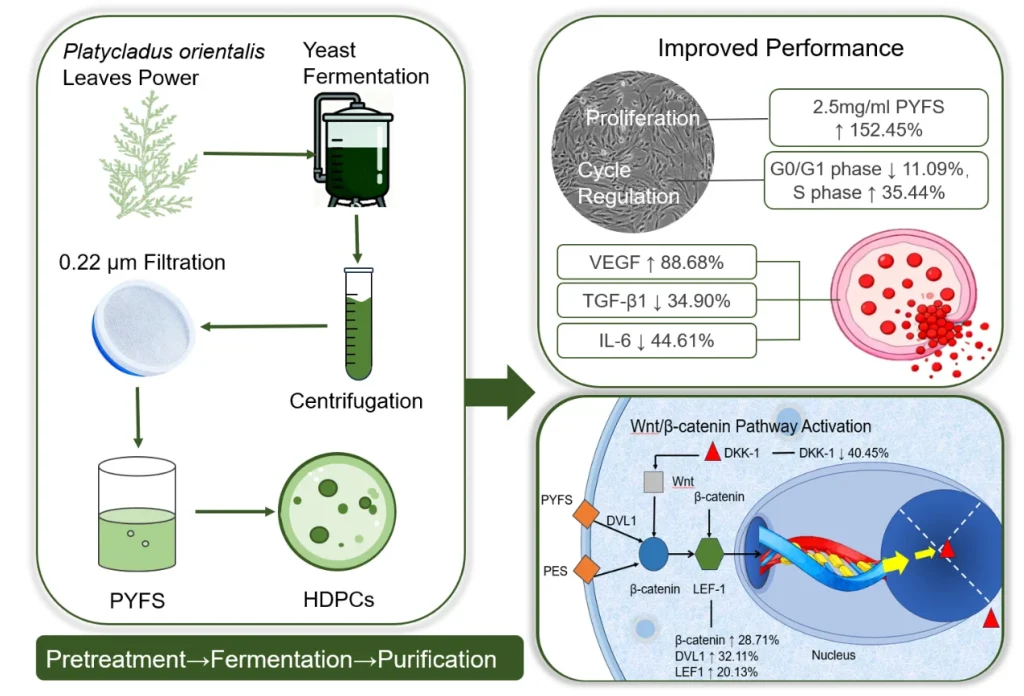
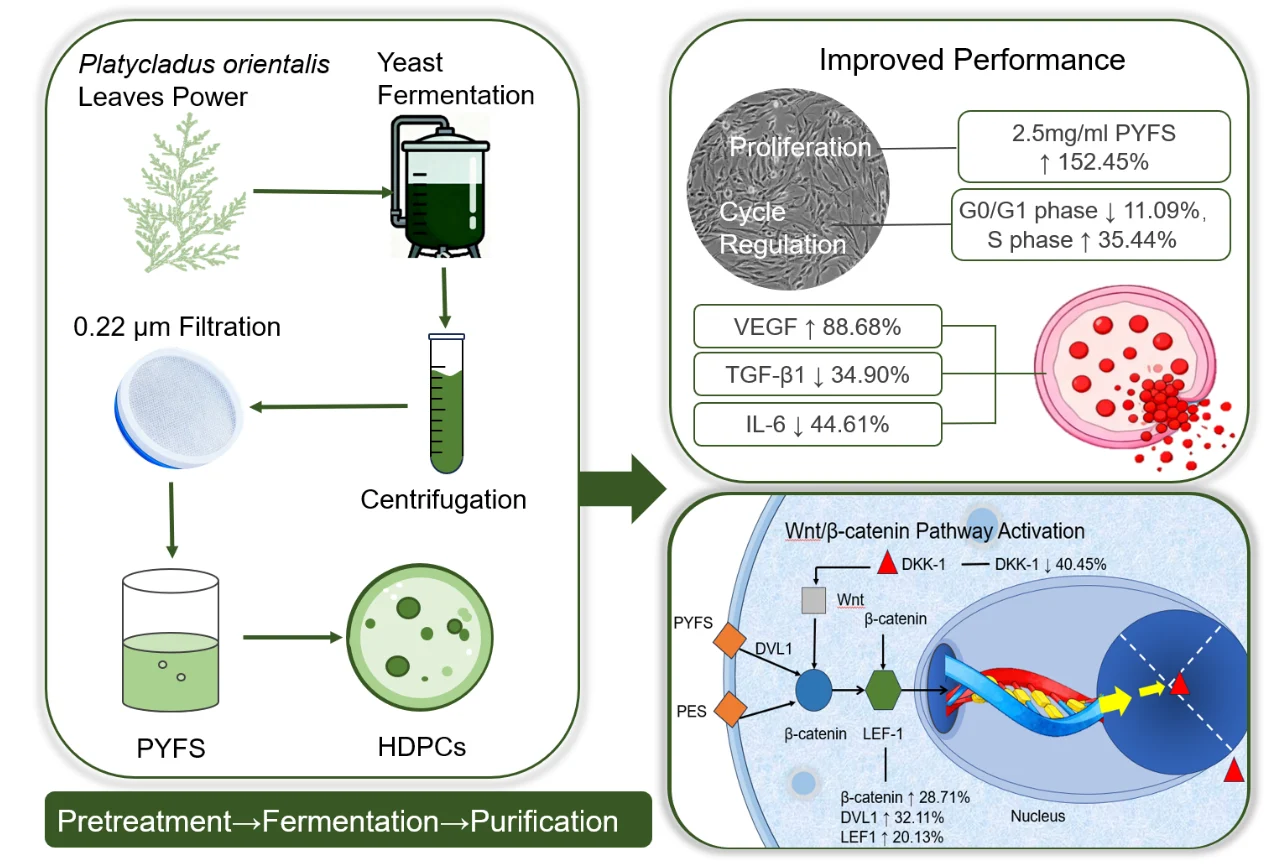
The experimental process began with the pretreatment of Platycladus orientalisleaves into powder, which then underwent yeast fermentation. The resulting broth was processed through centrifugation and 0.22 μm filtration to isolate the Platycladus orientalis Yeast Fermentation Supernatant (PYFS). Finally, the PYFS was applied to HDPCs to observe changes in cell cycle regulation, cytokine expression, and molecular signaling pathways.
Key Findings
• Significant Proliferation: Application of 2.5 mg/ml of PYFS led to a 152.45% increase in the proliferation of HDPCs.
• Cell Cycle Optimization: PYFS successfully regulated the cell cycle by decreasing the G0/G1 phase by 11.09% and increasing the S phase by 35.44%, promoting active cell division.
• Positive Cytokine Regulation: The treatment resulted in an 88.68% increase in VEGF (Vascular Endothelial Growth Factor), while reducing inhibitory factors TGF-β1 (34.90% decrease) and IL-6 (44.61% decrease).
• Wnt/β-catenin Activation: The research identified a clear activation of the Wnt/β-catenin pathway, characterized by a 40.45% reduction in the inhibitor DKK-1 and significant increases in β-catenin (28.71%), DVL1 (32.11%), and LEF1 (20.13%).
The novelty of this research is found in the successful application of yeast fermentation technology to Platycladus orientalis, creating a supernatant that specifically targets the Wnt/β-catenin signaling pathway to stimulate HDPCs. The future implications of these findings are substantial, suggesting that PYFS could be developed into a primary active ingredient for advanced cosmetic treatments aimed at preventing hair loss and promoting hair density through bioprocessed natural extracts.
Link to the study: https://www.mdpi.com/2079-9284/13/1/14#