

Skin wound healing is a sophisticated biological process involving four overlapping phases: hemostasis, inflammation, proliferation, and remodeling. While traditional pharmacological approaches utilize growth factors and cytokines, they are often limited by high costs, potential adverse effects, and low efficacy, necessitating the search for efficient new biomaterials. Cosmeceutical peptides (CPs) have emerged as a solution because they are bioactive, specific, and stable agents that can modulate skin regeneration. Specifically, short synthetic peptides offer structural flexibility and ease of synthesis, allowing them to interact with membrane receptors to stimulate repair. This study investigates CP-02, a novel octapeptide designed to address the dual role of promoting rapid healing while simultaneously reducing scar formation.
Methods
The octapeptide CP-02 (sequence: CDARSDAR) was synthesized with a purity of 95.8% and dissolved for multi-level testing. In vitro studies utilized Human Dermal Fibroblasts (HDFs) to evaluate cytotoxicity through MTT assays and cell migration via scratch assays. In vivo regenerative activity was assessed using zebrafish larvae for caudal fin amputation recovery and adult zebrafish for full-thickness dermal wound closure following intramuscular injections. Finally, transcriptional responses were measured using qRT-PCR to analyze the expression of genes related to the cell cycle, growth factors, and inflammation.
Key Findings
• Enhanced Cellular Dynamics: In HDFs, CP-02 treatment significantly accelerated wound closure in a concentration-dependent manner and increased cell viability at doses up to 250 µg/mL.
• Transcriptional Activation: The peptide upregulated genes essential for tissue repair, including cell cycle regulators (CCND1, MYC) and critical growth factors (FGF2, EGF, VEGFA).
• Rapid Larval Regeneration: Zebrafish larvae treated with 5 µg/mL of CP-02 showed a significant increase in fin fold length and growth area (3.5 mm²) compared to controls (2 mm²) after 72 hours.
• Superior Adult Dermal Healing: Adult zebrafish reached a 76% healing rate by 16 days post-wounding, significantly outperforming the vehicle control group’s 44%.
• Histological Improvement: Treated tissues exhibited reduced inflammatory cell infiltration, complete granulation, and well-reconstituted epidermal layers by day 12.
• Anti-Fibrotic Effects: During the remodeling phase, CP-02 suppressed pro-fibrotic mediators like acta2 and ctgfb, promoting scar-reducing regeneration.
The novelty of this research lies in identifying CP-02 as a multifunctional signal peptide that concurrently drives rapid tissue regeneration and prevents excessive scarring, a dual capability rarely found in short peptides. Its structural simplicity and amenability to large-scale synthesis make it a more cost-effective and economically viable candidate than complex recombinant proteins. For future applications, CP-02 is viewed as a pro-healing agent that could be integrated into advanced delivery platforms, such as peptide-based hydrogels or encapsulated within exosomes, to provide sustained release and enhanced immunomodulatory effects in clinical skincare.
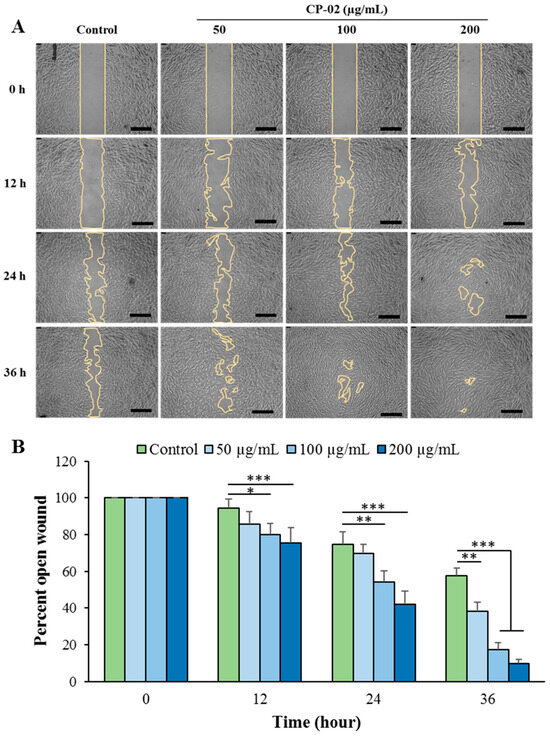
Effect of CP-02 on in vitro cell migration. (A) Representative images of scratch (wound healing) assay showing the migration of HDFs treated with CP-02 (50, 100, and 200 µg/mL) at 0, 12, 24, and 36 h. (B) Quantitative analysis of the percent open wound area (%) relative to the initial (0 h) wound area. Two-way ANOVA was performed to determine the statistical significance. * p ≤ 0.05, ** p ≤ 0.01, *** p ≤ 0.001. Scale bar: 500 µm.
Link to the study: https://www.mdpi.com/2079-9284/13/1/16