

Atopic dermatitis (AD) is a chronic, relapsing inflammatory skin condition characterized by persistent itching, xerosis (dryness), and epidermal barrier dysfunction. It affects approximately 10–20% of children and 5–8% of adults, often leading to disrupted sleep and a significant reduction in overall quality of life. While pharmacological treatments like corticosteroids are effective, their prolonged use is often restricted due to side effects such as skin atrophy and local irritation. Consequently, there is a growing interest in Revodiol Calming Cream® (RCC) as a non-pharmacological solution that utilizes cannabidiol (CBD) and Annona cherimola fruit extract. CBD is considered an answer to these issues because it interacts with the endocannabinoid system (ECS) in the skin to support homeostasis, enhance barrier recovery, and reduce redness. Furthermore, the synergistic combination of CBD with Annona cherimola extract and natural humectants is designed to provide both immediate and long-lasting hydration while soothing discomfort.
Methods
This prospective study evaluated 20 adults and 22 children with mild-to-moderate atopic-prone skin over a 56-day period of twice-daily RCC application. Clinical efficacy was measured through the SCORAD index, pruritus scales, and a Visual Analog Scale (VAS), while skin barrier function and topography were monitored via biometric tools such as the Mexameter®, Tewameter®, and Visioscan®. Safety was assessed through continuous dermatological supervision and participant-reported tolerance. Linear mixed-effects models were utilized to perform statistical analysis on the resulting correlated biometric data.
Key Findings
• Significant Symptom Reduction: By day 56, the SCORAD index scores decreased by 55% in adults and 60% in children, indicating a marked improvement in the overall severity of atopic signs.
• Alleviation of Itching and Dryness: Pruritus (itching) scores dropped by 57% in adults and 76% in children, while skin dryness was reduced by over 60% in both groups.
• Restoration of Skin Barrier: Transepidermal water loss (TEWL) showed significant improvements, with a 33% reduction in adults and a 37% reduction in children, confirming a reinforced skin barrier.
• Improved Skin Topography: Visible skin peeling decreased by 75% in adults and 68% in children, alongside measurable improvements in skin smoothness and condition.
• Enhanced Quality of Life: Subjective satisfaction reached 75% among participants, and adult quality of life scores (DLQI) improved by 23%.
• Proven Safety Profile: The formulation was well tolerated with no serious adverse events, showing only mild and transient local reactions in a small minority of subjects.
The novelty of this research lies in its clinical validation of a cannabinoid-based formulation specifically within a pediatric population, addressing a significant knowledge gap in current dermocosmetic literature. By demonstrating that the synergistic interaction between CBD and botanical extracts effectively restores skin balance, the study establishes RCC as a viable, safe alternative for the daily maintenance of sensitive and atopic-prone skin. Future implications suggest that while these results are promising, subsequent research should incorporate larger sample sizes and randomized, placebo-controlled designs to further elucidate the long-term mechanisms of action and reinforce these clinical observations.
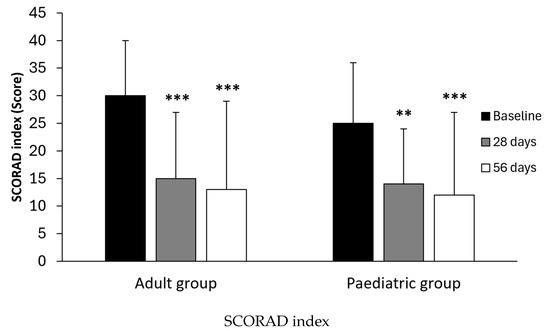
In the image: Evolution of SCORAD index over 56 days in adult and paediatric populations. (** p < 0.01; *** p < 0.001).
Link to the study: https://www.mdpi.com/2079-9284/13/1/20