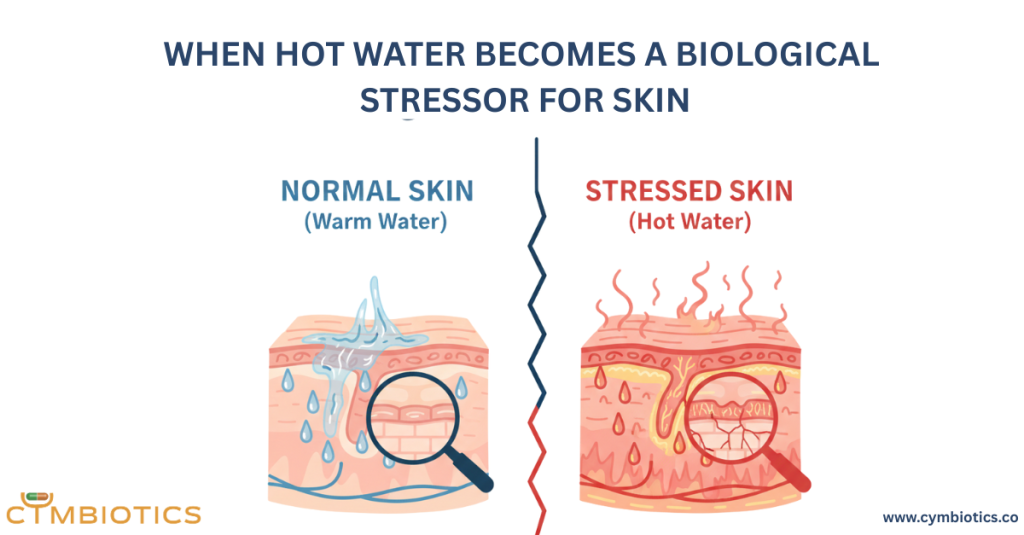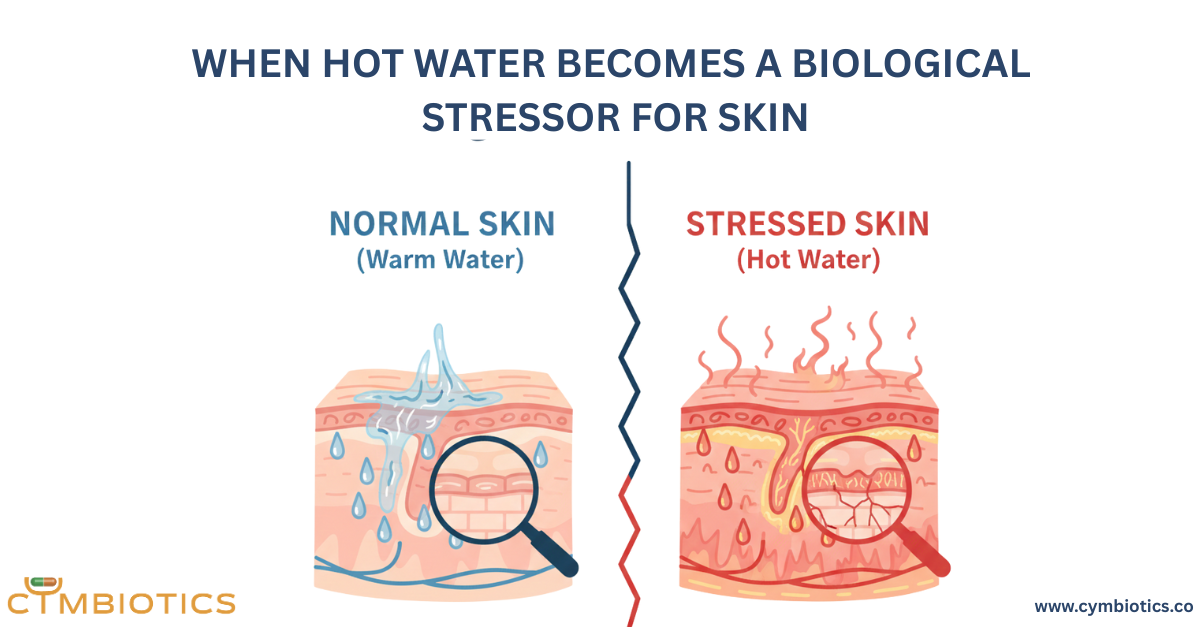

Hot showers and warm hand washes are part of daily comfort. Heat relaxes muscles, improves circulation, and feels cleansing. But from a biological perspective, skin does not interpret high temperatures as comfort, it reads them as stress.
While obvious burns are easy to recognize, most heat-related skin damage begins long before visible redness or pain appears. At the cellular level, repeated exposure to very hot water can quietly disrupt barrier integrity, accelerate water loss, and trigger inflammatory signaling. Understanding this invisible damage is essential when designing products meant to support long-term skin resilience.
How Heat Interacts With Skin at the Molecular Level
Skin proteins, enzymes, and lipids function within narrow temperature ranges. When exposed to elevated heat:
- Structural proteins begin to lose their native configuration (a process known as denaturation)
- Cell membranes become more permeable
- Enzyme systems involved in repair and lipid synthesis become less efficient
Laboratory studies show that prolonged exposure to water temperatures above normal skin temperature can disrupt keratin organization and weaken the intercellular lipid matrix, even without causing immediate tissue injury.
In simple terms:
Heat doesn’t need to burn to damage. It only needs to destabilize structure.
Barrier Damage Happens Before Visible Injury
The outermost layer of skin, the stratum corneum, is often described as a “brick and mortar” structure, with corneocytes as bricks and lipids as mortar. Hot water affects both:
- Lipid bilayers become more fluid and disorganized
- Tight junction integrity weakens
- Transepidermal water loss (TEWL) increases
This means skin may feel dry, tight, or sensitive after hot exposure not because moisture was “washed away,” but because barrier control over water movement has been compromised.
Importantly, this disruption can occur without redness, peeling, or stinging, making the damage functionally significant but visually subtle.
Why Some Areas React Faster Than Others
Not all facial or body regions respond to heat equally. Sensitivity depends on:
- Epidermal thickness
- Sebum distribution
- Blood vessel density
- Nerve ending concentration
Areas such as the face, neck, and hands have thinner protective layers and higher vascular activity, which means:
- Inflammatory mediators are delivered faster
- Sensory irritation thresholds are lower
- Recovery can take longer with repeated stress
This explains why frequent hot-water exposure often shows first as facial sensitivity, redness around the nose, or persistent hand dryness, even in individuals without diagnosed skin conditions.
Repeated Heat Exposure and Chronic Barrier Stress
Occasional exposure to heat is something skin can recover from. The problem arises with daily, repeated thermal stress.
When barrier disruption happens faster than repair processes can restore lipid architecture, skin enters a cycle of:
- Persistent low-level inflammation
- Impaired lipid synthesis
- Increased permeability to irritants
Over time, this can contribute to heightened sensitivity, delayed recovery after environmental exposure, and reduced tolerance to active formulations.
From a formulation science standpoint, this matters deeply: products applied to skin already under thermal stress must account for compromised barrier dynamics, not ideal laboratory conditions.
Heat, Microcirculation, and Inflammatory Signaling
Hot water increases blood flow to the skin through vasodilation. While short-term circulation increase can be beneficial, repeated stimulation can:
- Enhance inflammatory mediator release
- Increase oxidative stress in superficial tissues
- Prolong redness and reactive responses
Heat also activates transient receptor potential (TRP) channels, thermosensitive receptors that modulate pain, itch, and inflammatory signaling. Once sensitized, these pathways can remain hyper-responsive, contributing to long-term discomfort even with mild stimuli.
This is one reason individuals who frequently use hot water often report that their skin becomes “reactive” over time.
What This Means for Product Development
Understanding heat-induced barrier stress changes how formulations should be designed:
- Delivery systems must avoid further lipid disruption
- Actives must remain stable in compromised barrier environments
- Vehicles should support recovery rather than amplify permeability
Advanced topical research increasingly focuses on systems that can enhance penetration without mechanically or chemically weakening barrier architecture, allowing ingredients to reach target layers while maintaining structural integrity.
This is where lipid-compatible delivery systems, self-assembling nanoparticles, and controlled-release mechanisms become critical tools in modern dermatological formulation.
Supporting Skin That Is Already Under Stress
Real-world skin is not resting in controlled conditions. It is continuously exposed to:
- Temperature shifts
- Cleansers
- Environmental pollutants
- Mechanical friction
Thermal exposure is just one of many daily stressors, but it is one of the most underestimated. Formulations that acknowledge this reality must prioritize:
- Barrier-compatible carriers
- Reduced irritancy profiles
- Support of endogenous repair pathways
Rather than assuming perfect barrier conditions, effective topical systems work with skin physiology as it exists in daily life.
Conclusion: Respecting Skin’s Thermal Limits
Skin is remarkably resilient, but resilience depends on structural stability. Heat, even when it feels soothing, can act as a biological disruptor when exposure is frequent or intense.
Barrier damage does not always look dramatic. Often, it accumulates quietly, altering how skin responds to products, environments, and recovery processes over time.
For formulation science, this reinforces a critical principle:
protecting skin integrity is not only about ingredient selection, but also about respecting the biological thresholds that maintain functional balance.
At Cymbiotics, understanding how everyday behaviors interact with skin physiology informs how topical delivery systems are designed, not just to deliver, but to deliver responsibly within the limits of living tissue.
Because long-term skin performance depends not on pushing biology harder, but on working in harmony with it.
References
1. “Impact of Water Exposure and Temperature Changes on Skin Barrier Function” – Herrero-Fernandez et al., Journal of Clinical Medicine, 2022.
2. “Heat effects on drug delivery across human skin” – Scholz et al., International Journal of Pharmaceutics, 2015.
3. “The Effects of Skin Temperature Changes on the Integrity of Skin Tissue: A Systematic Review” – Brown et al., Skin Research and Technology, 2023.
4. “Artificial human skin: cytokine, prostaglandin, Hsp70 and histological responses to heat exposure” – Boyce et al., Burns, 1999.