

Chronic overexposure to ultraviolet (UV) radiation is a major risk factor for adverse skin outcomes, including erythema, photoaging, and photocarcinogenesis, with skin cancer rates rising significantly in fair-skinned populations. While commercial sunscreens are effective, their active ingredients (UV filters) are increasingly scrutinized due to environmental safety concerns and potential health risks such as photoirritation, endocrine disruption, and the generation of reactive oxygen species. To address these issues, plant oils were investigated as a sustainable solution because they are renewable, biocompatible, and possess inherent emollient and antioxidant properties that may provide measurable UV resistance.
Methods
Researchers developed ten W/O emulsion formulations incorporating five different plant oils (olive, avocado, sesame, flaxseed, and grape seed) at 15% and 30% concentrations, alongside a control base. These formulations were subjected to physicochemical characterization (pH and conductivity), rheological analysis to evaluate flow behavior and viscoelasticity, and in vitro occlusion tests to measure water retention. Finally, the sun protection factor (SPF) was determined using a spectrophotometric method to estimate the photoprotective potential of each oil-enriched system.
Key Findings
• Physical Stability and Compatibility: All formulations were confirmed as physically stable W/O systems with a pH of approximately 6.0, which is highly compatible with the skin’s natural barrier.
• Rheological Performance: The emulsions exhibited shear-thinning, pseudoplastic flow, and thixotropy, properties that facilitate uniform spreading and stable film formation on the skin surface.
• Structural Modulation: Increasing the oil concentration from 15% to 30% generally reduced shear stress, consistency index, and viscoelastic moduli, suggesting that higher oil content leads to a softer internal structure.
• High Occlusivity: All emulsions demonstrated occlusion factors greater than 60%, with 30% olive and grape seed oils providing the highest levels of barrier protection against water loss.
• Photoprotective Potential: Measurable UV protection (SPF > 1) was only achieved in emulsions containing 30% olive, avocado, or flaxseed oil, with avocado and flaxseed oils reaching SPF values of approximately 3.
The novelty of this research lies in demonstrating that plant oils can serve as more than just emollients; they are functional structural modulators that enhance the occlusive and photoprotective performance of cosmetic emulsions. By showing that specific concentrations of avocado and flaxseed oils can provide inherent SPF value, the study suggests significant future implications for the development of “green” cosmetics. Specifically, these functional plant oils could be combined with reduced concentrations of conventional UV filters to create sustainable, high-performance sunscreens that minimize chemical exposure while maximizing skin barrier health.
Link to the study: https://www.mdpi.com/2079-9284/13/1/23
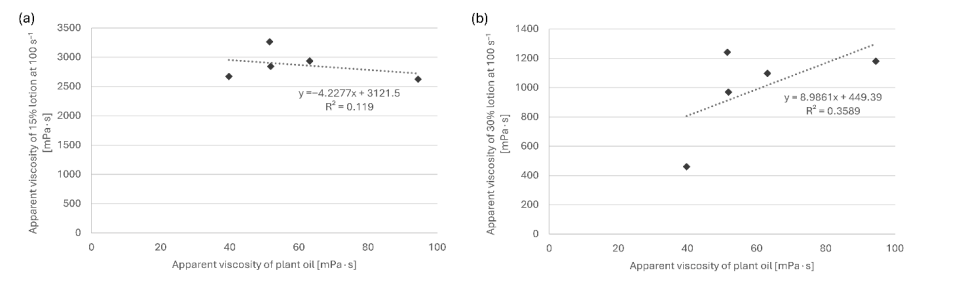
In the image: Correlation between apparent viscosities of plant oils and the corresponding emulsions
prepared with (a) 15% oil and (b) 30% oil.