

Skin inflammation, such as atopic dermatitis and psoriasis, remains a significant health burden, as keratinocytes respond to external stressors by releasing excessive pro-inflammatory mediators. While traditional treatments like corticosteroids, antibiotics, and biological drugs such as Dupilumab are used to manage these conditions, they are often associated with adverse side effects, including ocular issues, skin peeling, and systemic toxicity. Furthermore, long-term steroid use is particularly challenging in pediatric populations. Cold plasma technology has emerged as a promising alternative due to its known efficacy in wound healing and immune regulation. However, traditional plasma devices often require bulky gas supplies, complicating their practical use. The development of an air-based no-ozone cold plasma device (Air NCP) offers a compact, wireless solution that utilizes ambient air while eliminating harmful ozone, making it a potentially safer and more convenient therapeutic option for human application.
Methods
The study assessed the Air NCP’s safety and efficacy using human keratinocytes (HaCaT) where inflammation was induced by tumor necrosis factor-alpha (TNF-α). Researchers measured the device’s operating temperature and ozone output while evaluating cell viability through the sulforhodamine B (SRB) assay. To determine anti-inflammatory effects, changes in gene and protein expression were analyzed using reverse transcription-polymerase chain reaction (RT-PCR) and Western blot analysis. Finally, the concentration of the inflammatory mediator prostaglandin E2 (PGE2) was quantified via enzyme-linked immunosorbent assay (ELISA).
Key Findings
• Safety and Biocompatibility: The Air NCP operated at a safe average temperature of 22.16 °C and maintained ozone levels well below safety thresholds (0.006 ppm), showing no cytotoxicity in HaCaT cells.
• Reduction of Inflammatory Cytokines: Direct treatment with Air NCP significantly decreased the expression of major pro-inflammatory cytokines, including TNF-α, IL-6, and IL-1β.
• Inhibition of Signaling Pathways: The device suppressed the activation of critical inflammatory pathways, notably reducing the phosphorylation of NF-κB, STAT3, and Mitogen-Activated Protein Kinase (MAPK) factors such as ERK, JNK, and p38.
• Decreased Inflammatory Mediators: Treatment led to a time-dependent reduction in COX-2 expression and a significant decrease in PGE2 production, which are key drivers of tissue damage and inflammation.
• Direct vs. Indirect Efficacy: The study noted that direct plasma treatment was effective in reducing inflammation, likely due to the action of charged particles or electrons, whereas indirect treatment (using plasma-treated media) did not yield significant results.
The novelty of this research lies in the development and verification of a compact, air-based, and ozone-free plasma system that overcomes the portability and safety limitations of previous gas-dependent models. By providing evidence of efficacy specifically in human keratinocytes, this study bridges the gap between successful animal models and potential human clinical use. The findings suggest that the Air NCP could serve as a non-invasive, drug-free therapeutic tool for managing chronic inflammatory skin diseases. Future implications include the potential for clinical validation and the development of this technology into a standard device for promoting tissue recovery and alleviating skin inflammation with minimal side effects.
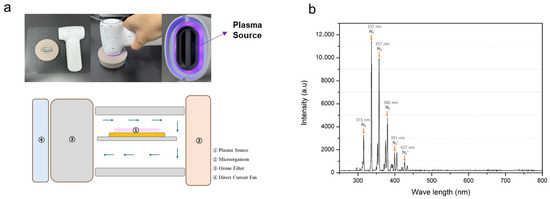
In the Image: Characteristics of the air-based no-ozone cold plasma device (Air NCP) used in this experiment. (a) Image of the Air NCP. (b) Optical Emission Spectroscopy intensity emitted from the Air NCP.