

Chronic exposure to ultraviolet (UV) irradiation is a primary driver of skin photoaging, clinically manifesting as wrinkles, textural deterioration, and a loss of elasticity. This process is characterized by collagen degradation mediated by matrix metalloproteinases (MMPs) and the release of pro-inflammatory cytokines. While Hexapeptide-9 (H-9) serves as a collagen-mimetic peptide, its efficacy is limited by poor skin penetration and susceptibility to enzymatic degradation. Similarly, the antioxidant Caffeic Acid (CA) suffers from chemical instability and poor dermal absorption. To overcome these inherent limitations, researchers developed Caffeoyl hexapeptide-9 (CH-9), a novel Peptide-Drug Conjugate (PDC) that covalently links H-9 and CA to synergistically enhance bioactivity, stability, and transdermal delivery.
Methods
The study employed a multi-methodological approach involving in vitro cell-based assays and 3D full-thickness skin models to assess collagen restoration and anti-inflammatory activity. Computational research, including molecular docking and dynamics (MD) simulations, analyzed interactions with the MMP2 enzyme and skin lipid bilayers. Physical robustness was evaluated via thermal stability testing and in vivo confocal Raman spectroscopy to quantify skin permeability. Finally, a randomized double-blind clinical trial involving 96 participants validated the ingredient’s efficacy in improving skin firmness over 28 days.
Key Findings
• Enhanced Collagen Restoration: CH-9 significantly restored collagen types I, III, and IV in UV-irradiated fibroblasts, whereas the parent peptide H-9 only significantly increased type IV.
• Direct Antioxidant Function: Unlike H-9, CH-9 demonstrated potent radical-scavenging activity against hydroxyl and peroxyl radicals, a property conferred by its caffeoyl moiety.
• Anti-Inflammatory Properties: CH-9 suppressed the release of pro-inflammatory cytokines (IL-6 and IL-8) in skin models by inhibiting the NF-κB signaling pathway.
• MMP2 Inhibition: Molecular docking revealed that CH-9 binds to the catalytic domain of MMP2, coordinating with the zinc ion to inhibit enzyme-driven collagen degradation.
• Superior Skin Permeation: MD simulations and in vivo Raman testing confirmed that CH-9 inserts more stably and deeply into the stratum corneum lipid bilayer compared to H-9.
• Clinical Efficacy: In a 28-day study, topical application of CH-9 resulted in a 32.17% improvement in skin elasticity and a 30.60% increase in firmness, significantly outperforming H-9.
• Improved Stability: CH-9 exhibited superior thermal and solution stability over free CA, avoiding the oxidative browning typically observed in cosmetic formulations.
The development of CH-9 represents a significant novelty in cosmetic science as it marks the first major exploration of PDC technology for anti-photoaging, effectively bridging the gap between peptide targeting and small-molecule bioactivity. By addressing the traditional efficacy-delivery trade-off, this research establishes a strategic platform for creating a new generation of multifunctional cosmetic ingredients. The future implications of this work suggest that covalent modification strategies can be expanded to enhance the pharmacokinetics and clinical performance of diverse biomolecules in both pharmaceutical and dermatological applications.
Link to the study: https://www.mdpi.com/2079-9284/13/1/24
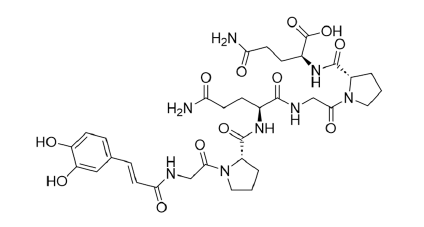
In the image: Chemical structure of CH-9