

Acne vulgaris is a chronic inflammatory skin disease affecting approximately 85% of adolescents and young adults, often resulting in distressing sequelae such as scarring and postinflammatory hyperpigmentation (PIH). Because the etiology of acne is multifaceted—involving sebum production, follicular colonization by C. acnes, hyperkeratinization, and inflammation—successful treatment requires targeting multiple mechanisms of action. The triple-combination gel (CAB), consisting of clindamycin phosphate 1.2%, adapalene 0.15%, and benzoyl peroxide (BPO) 3.1%, was developed as a solution to address these diverse pathways while simplifying patient regimens to a once-daily application to improve adherence.
Methods
Data were pooled from two identical 24-week, open-label, single-center studies involving 50 participants aged 12 years and older with moderate-to-severe acne. Participants applied the CAB gel to their entire face every night and underwent assessments every 4 weeks to evaluate lesion counts, global severity, and skin appearance. Primary endpoints included treatment success (a ≥2-grade reduction in Investigator’s Global Assessment), while secondary measures assessed scarring, dyspigmentation, and skin hydration.
Key Findings
• Treatment Success: By week 24, 67% of participants achieved treatment success, with significant reductions in global severity observed as early as week 4.
• Lesion Reduction: There was a significant reduction in inflammatory (88%) and noninflammatory (68%) lesions by the end of the 6-month period.
• Improvement in Sequelae: Significant cumulative improvements were noted in scarring (33% reduction) and both investigator- and participant-assessed PIH and PIE (over 70% reduction).
• Skin Barrier Support: For the first time, CAB was shown to strengthen the skin barrier, with a 9% decrease in transepidermal water loss and a 27% increase in skin hydration at week 12.
• Safety and Tolerability: The treatment was well tolerated, with over 70% of participants reporting no itching, burning, or redness throughout the study.
• Patient Satisfaction: At the study’s conclusion, 95% of participants stated they would use the product again and would recommend it to others.
The novelty of this research lies in its demonstration of CAB gel’s long-term efficacy—not only in clearing active lesions but also in improving acne scarring and dyspigmentation over a 6-month period. Furthermore, it provides the first evidence that this specific formulation enhances skin hydration and barrier function, countering the dryness typically associated with BPO-containing products. These findings imply that CAB gel is a highly effective, long-term management option that may improve patient adherence and psychosocial outcomes by addressing both active acne and its lasting physical marks.
Link to the study: https://www.tandfonline.com/doi/full/10.1080/09546634.2026.2612873#abstract
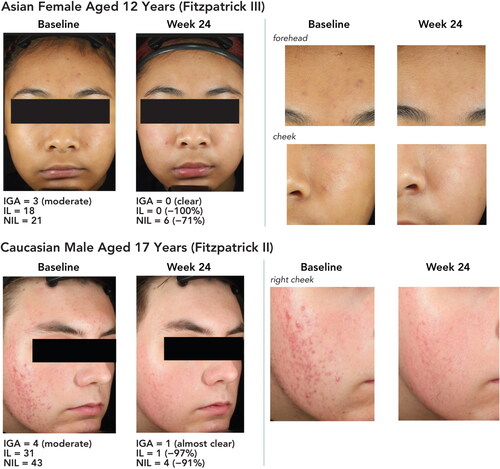
In the image: Acne improvements at week 24. Individual results may vary. Photographic Images ©2025. Courtesy of Study Investigator. IGA: Investigator’s Global Assessment; IL: inflammatory lesion; NIL: noninflammatory lesion.