
When Skin Feels Different, It Often Is
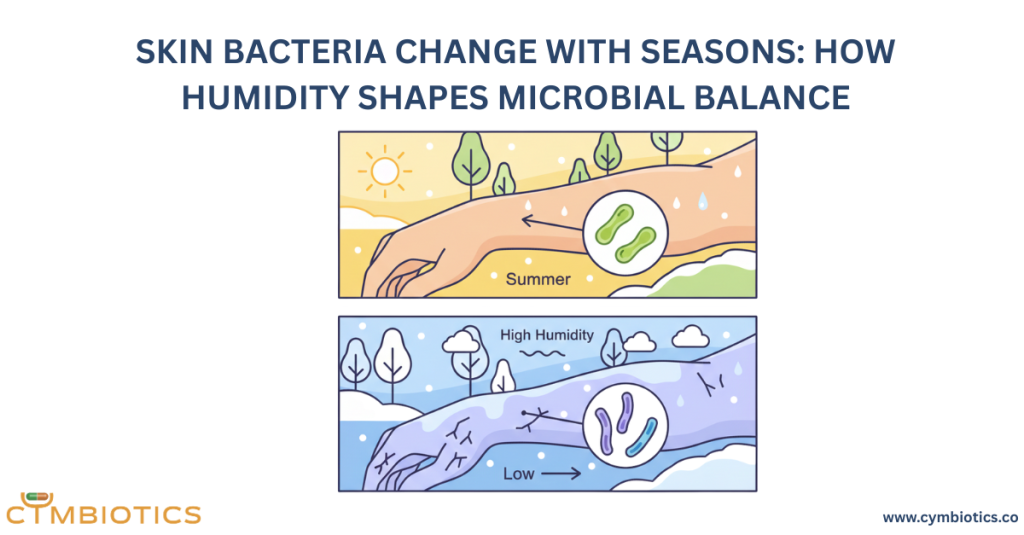
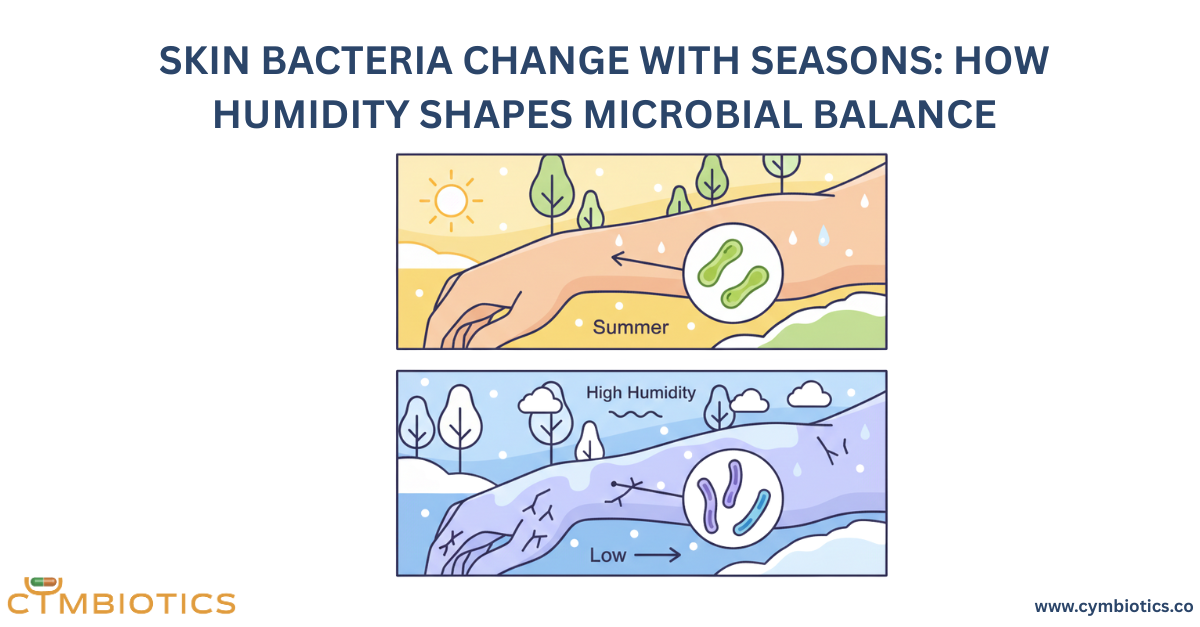
Many people notice that skin behaves differently across the year calmer in some months, more reactive in others. These changes are often blamed on temperature alone, but another environmental factor plays a major biological role: humidity.
Humidity influences how much water remains within the outer layers of skin, how lipids are organized, and how tightly cells adhere to each other. These shifts do not only affect skin structure, they also reshape the conditions in which skin-resident microorganisms live. As humidity changes, the skin microbiome adapts, sometimes in ways that influence irritation, breakouts, and barrier stability.
The Skin Microbiome Is Environment-Sensitive by Design
Human skin hosts diverse communities of bacteria, fungi, and viruses that coexist with host cells. These microorganisms are not passive passengers. They interact with immune cells, compete with potential pathogens, and influence inflammation signaling.
Microbial populations vary naturally across:
- Oily versus dry regions
- Areas with different oxygen exposure
- Zones with higher or lower moisture
Because moisture strongly shapes nutrient availability and surface chemistry, ambient humidity becomes a key regulator of microbial balance. When environmental humidity shifts, so do hydration gradients at the skin surface, altering which microbes are most likely to thrive.
How Humidity Alters Skin Conditions at the Surface
Humidity affects skin through several interconnected mechanisms:
- Higher humidity increases water retention in the stratum corneum
- Lower humidity accelerates transepidermal water loss (TEWL)
- Lipid organization adapts to regulate permeability
These physical changes modify:
- Surface pH
- Availability of metabolic substrates
- Adhesion of microbes to corneocytes
As a result, certain bacterial species gain competitive advantage under moist conditions, while others become more dominant when skin is drier and lipid structure becomes tighter but more fragile.
Seasonal humidity therefore acts not just as an external climate factor, but as a biological filter shaping microbial ecosystems on the skin.
Microbial Shifts Can Influence Barrier Stability
The relationship between skin microbes and the barrier is bidirectional.
Some microbial populations support:
- Lipid processing
- Tight junction signaling
- Controlled immune tolerance
Others can promote:
- Low-grade inflammation
- Disruption of corneocyte cohesion
- Increased sensitivity signaling
When humidity-driven shifts favor populations that stimulate inflammatory pathways, the skin may become more reactive, even if there is no visible infection or overt disease.
This helps explain why some individuals experience increased sensitivity, itching, or breakouts during seasonal transitions, when microbial communities are actively reorganizing in response to changing environmental moisture.
Why Seasonal Transitions Are Particularly Challenging
Rapid changes in humidity, such as moving from monsoon to dry seasons or from humid summers to air-conditioned indoor environments, create periods of biological instability.
During these transitions:
- Barrier repair mechanisms are still adapting
- Microbial populations are shifting
- Immune signaling thresholds may be temporarily lower
This combination increases the likelihood of:
- Irritation
- Flare-ups of chronic sensitivity
- Delayed recovery after minor insults
Importantly, these responses do not require pathogenic infection. They can arise from imbalances within otherwise normal microbial communities, shaped by environmental moisture conditions.
Product Interaction with a Changing Microbiome
Formulations applied to skin during periods of microbiome adjustment interact with:
- Altered surface pH
- Modified lipid architecture
- Variable microbial metabolism
If delivery systems disrupt barrier lipids or alter surface chemistry too aggressively, they may unintentionally favor microbial shifts that worsen sensitivity rather than support stability.
This is why topical systems increasingly aim to:
- Maintain lipid compatibility
- Avoid unnecessary barrier perturbation
- Support physiological rather than forced penetration
The goal is not to control microbial populations directly, but to preserve the skin environment that naturally supports balanced communities.
Supporting Skin During Seasonal Microbial Shifts
From a biological perspective, the most effective way to support microbial balance is to stabilize the host environment:
- Protect lipid organization
- Maintain hydration gradients
- Minimize unnecessary barrier disruption
When the structural and biochemical conditions of the skin remain stable, microbial ecosystems are more likely to self-regulate without triggering immune stress responses.
This approach recognizes that the microbiome functions as part of an integrated skin system, not as an isolated target for intervention.
Cymbiotics Perspective: Working With Skin’s Living Ecosystem
Understanding that skin bacteria respond dynamically to humidity reinforces a key principle of topical science: delivery systems must respect skin as a living ecosystem, not a static surface.
At Cymbiotics, formulation strategies are developed with awareness of:
- Barrier architecture
- Microenvironment stability
- Controlled interaction with deeper layers
Technologies such as Cetosomes™ and FADD™ are designed to support targeted delivery while minimizing disruption to surface structure, helping maintain conditions that allow skin’s natural microbial communities to remain balanced.
This aligns with Cymbiotics’ broader mission. enhancing health and well-being through continuous innovation and science-backed formulations that strengthen, rather than override, skin’s biological functions.
Because supporting skin means supporting the systems : cellular, structural, and microbial, that allow it to regulate itself across changing environments.
References
- Seasonal Dynamics of the Skin Microbiome and Barrier Metrics – Seo et al., Journal, 2023.
- The Effect of Environmental Humidity and Temperature on Skin Barrier Function – Thyssen et al., European Academy of Dermatology and Venereology Review, 2015.
- Seasonal Variations in Skin Hydration, TEWL, Sebum, and Elasticity – Journal of Dermatological Science, 2020.
- Lifestyle and Environmental Influences on Homeostatic Skin Microbiota – EAACI Task Force Report, Journal, 2023.