

Hair loss is a widespread condition that significantly impacts a patient’s mental well-being and overall quality of life. It is primarily caused by disruptions in the hair follicle cycle, often involving factors such as dihydrotestosterone (DHT) signaling, oxidative stress, and microinflammation. While treatments exist, there is a high demand for safe, natural alternatives with minimal side effects. Cacumen Platycladi (Platycladus orientalis leaves), a traditional Chinese medicine, was considered a potential solution due to its historical use in treating hair loss and its rich composition of bioactive flavonoids. These compounds are known for their antioxidant and anti-inflammatory properties, making them ideal candidates for a multi-targeted approach to hair follicle protection.
Methods
The researchers employed a gradient extraction method using 1,3-butanediol, ethanol, and water to enrich bioactive compounds, which were then identified through LC-MS analysis. The study evaluated the extract’s efficacy via in vitro assays measuring 5α-reductase inhibition and its antioxidant effects on human dermal papilla cells (HDPCs). Protein expression and signaling pathways were further analyzed using Western blot and immunofluorescence techniques. Finally, a 12-week randomized, double-blind clinical trial was conducted with 60 participants to measure changes in hair loss count and density.
Key Findings
• LC-MS analysis identified that the primary active components of the extract are flavonoids, specifically quercitrin, myricetin, and myricitrin.
• The extract demonstrated significant antioxidant capacity, effectively reducing reactive oxygen species (ROS) levels in HDPCs and achieving a DPPH scavenging IC50 of 8.31 mg/mL.
• CPE successfully inhibited 5α-reductase activity in a dose-dependent manner, addressing a central cause of androgenetic alopecia.
• Molecular testing revealed that CPE upregulates the PI3K/Akt/mTOR signaling pathway, which in turn promotes the expression of VEGF (for vascular support) and COL17 (for follicle stem cell maintenance).
• In the clinical trial, participants using the CPE serum showed a significant reduction in hair loss after 4 weeks and an increase in local hair density after 12 weeks compared to the placebo group.
• The treatment was found to be safe and well-tolerated, with no adverse reactions reported by participants during the 12-week study period.
The novelty of this research lies in its development of a targeted gradient extraction process that maximizes the enrichment of specific flavonoids to combat hair loss through multiple biological mechanisms simultaneously. By combining biochemical assays with molecular analysis and a clinical trial, the study provides a robust validation of Cacumen Platycladi as a potent, natural botanical active. Future implications suggest that CPE could serve as a primary ingredient in anti-hair loss cosmetics and a complementary approach in clinical hair-loss management. Further research may focus on utilizing ex vivo human hair follicle organ cultures to more deeply understand how these molecular changes maintain the anagen phase of hair growth.
Link to the study: https://www.mdpi.com/2079-9284/13/1/28
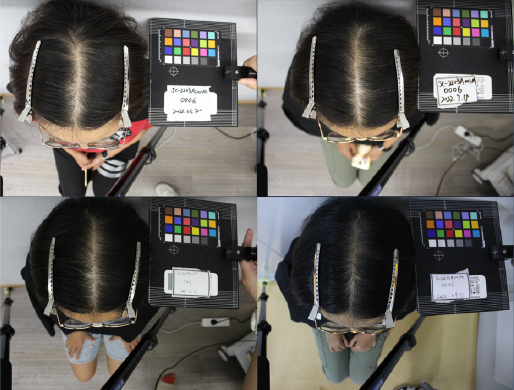
In the image: Standardized clinical photography used to evaluate overall hair density over a 12-week period. These images represent the methodology for qualitative grading of scalp coverage, which complemented quantitative local hair counts to provide a holistic view of the treatment’s efficacy