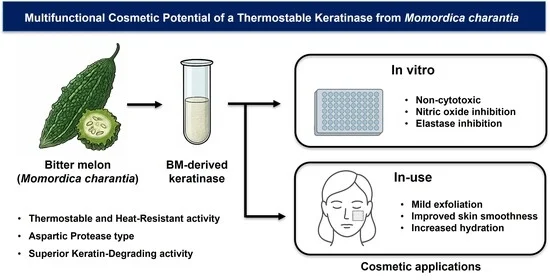
The stratum corneum, the skin’s outermost layer, often accumulates keratin-rich corneocytes due to aging, environmental stress, or hormonal imbalances, leading to a dull and rough texture. While chemical exfoliants like alpha and beta hydroxy acids are effective at removing this buildup, they frequently cause skin irritation, especially in sensitive individuals. To address this, researchers investigated a keratinolytic enzyme derived from bitter melon (Momordica charantia) as a potential solution, as it offers a gentler enzymatic approach while overcoming the thermal instability that limits the use of other plant-derived proteases like papain.
Methods
The researchers extracted the enzyme from bitter melon pulp through homogenization, ammonium sulfate precipitation, and dialysis before lyophilizing it into a powder. Biochemical characterization assessed the enzyme’s activity, pH, and thermal stability, while in vitro assays evaluated its cytotoxicity and anti-inflammatory effects. Finally, a 4-week clinical in-use test was conducted with 11 healthy volunteers who applied a 0.5% enzyme solution twice daily to measure improvements in skin hydration, smoothness, and desquamation.
Key Findings
• Superior Activity and Yield: The bitter melon extract exhibited higher protein concentration and stronger keratin-degrading activity compared to papaya and date palm extracts.
• Exceptional Stability: Unlike common enzymes that lose function above 50°C, this enzyme retained over 80% activity at 70°C and remained stable across a broad pH range of 5.0 to 9.0.
• Enzyme Classification: Inhibition by Pepstatin A confirmed that the keratinase functions predominantly as an aspartic protease.
• Safety and Multi-functionality: The enzyme showed low cytotoxicity in murine macrophages and demonstrated significant anti-inflammatory and elastase-inhibitory activities.
• Clinical Efficacy: Participants experienced a 49.88% reduction in desquamation and a 26.04% improvement in skin smoothness, alongside a significant increase in skin hydration.
The novelty of this research lies in identifying a thermostable plant protease that maintains its structural integrity and efficacy under the harsh conditions of cosmetic formulation and storage. By proving that bitter melon-derived enzymes can simultaneously provide mild exfoliation and enhanced hydration, this study opens the door for future implications in the development of sustainable, multifunctional cosmetic ingredients that serve as robust alternatives to traditional chemical exfoliants.
Link to the study: https://www.mdpi.com/2079-9284/13/1/40