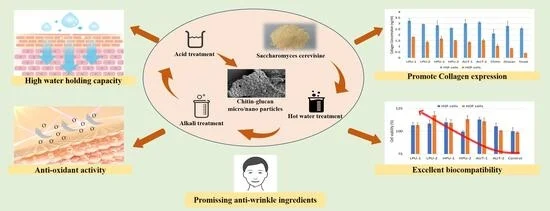
Skin aging and wrinkle formation are primarily driven by the depletion of the extracellular matrix, oxidative stress from free radicals, and a reduced ability of fibroblasts to produce collagen. While animal-derived chitin and chitosan from crustacean shells are widely used in cosmetics, they are unsuitable for non-animal product lines and often require chemical modification to achieve stability. Saccharomyces cerevisiae (Baker’s yeast) was identified as a promising solution because it is a safe, non-animal source with GRAS (Generally Recognized as Safe) status that produces a unique chitin-glucan (CG) copolymer. Researchers theorized that physical disruption of the yeast cell wall could yield sub-micron particles with a robust 3D network capable of both prolonged moisture retention and direct cellular stimulation.
Methods
The researchers extracted CG through a four-step process involving extraction, deproteinization, desalination, and freeze-drying. To evaluate the effect of processing on bioactivity, they compared three physical cell disruption methods: low-power ultrasonic bath, high-power ultrasonic probe, and autoclaving at varying treatment times. The resulting particles underwent physicochemical characterization (size, crystallinity, zeta potential) and biological testing, specifically measuring antioxidant activity, fibroblast viability, and collagen Type I expression.
Key Findings
- Structural Optimization: While milder ultrasonication preserved more mass, autoclaving for 40 minutes (AUT-2) produced the most effective particles, characterized by the smallest size (~480 nm) and highest crystallinity.
- Superior Hydration: The extracted CG demonstrated a powerful “barrier effect,” with the AUT-2 samples showing the highest water and oil holding capacities for sustained moisture retention.
- Antioxidant Defense: All extraction methods yielded CG with significant free radical scavenging activity, achieving approximately 64–67% radical scavenging activity (RSA) to protect skin cells from oxidative damage.
- Collagen Stimulation: The CG micro/nano-particles significantly upregulated Collagen Type I-α1 expression in human fibroblasts, outperforming both commercial pure chitin and pure yeast controls.
- Biocompatibility: Indirect MTT assays confirmed the particles are highly biocompatible, promoting fibroblast growth and protecting cells from oxidative stress.
The novelty of this research lies in establishing a definitive structure–function relationship for yeast-derived CG, proving that the extraction-induced nano-structure, rather than total mass yield, is the primary determinant of biological efficacy. It introduces a “triad” anti-aging mechanism where the material simultaneously acts as a physical moisture reservoir, an antioxidant shield, and a cellular signal for collagen synthesis. Future implications suggest that S. cerevisiae CG can serve as a sustainable, high-performance ingredient for vegan anti-aging formulations, with future work focused on scaling up the autoclaving process and initiating in vivo clinical trials.
Link to the study: https://www.mdpi.com/2305-7084/10/3/33