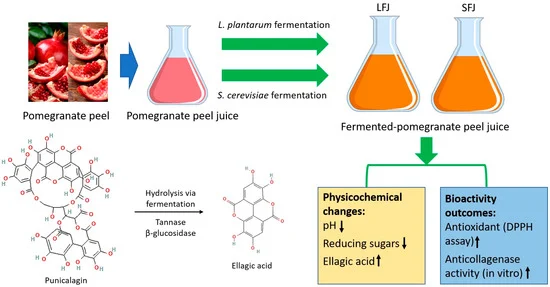
Skin aging is a complex process driven by intrinsic factors, such as the accumulation of reactive oxygen species, and extrinsic factors like ultraviolet (UV) radiation, which accelerates oxidative stress. UV exposure induces the expression of matrix metalloproteinases (MMPs), enzymes that degrade collagen and elastin, leading to wrinkles and a loss of skin elasticity. To combat these effects, research has increasingly focused on natural antioxidants and anticollagenase agents. Pomegranate peel, an underutilized by-product of fruit processing, is a potent source of ellagitannins, which can be converted into ellagic acid—a polyphenolic compound with documented skin-protective properties. Microbial fermentation was considered as a solution to enhance this bioactivity, as it utilizes enzymes like tannase to hydrolyze ellagitannins, thereby increasing the bioavailability of ellagic acid and the overall functional value of the peel.
Methods
Pomegranate peel juice (20% w/v) was prepared, sterilized, and inoculated separately with Lactiplantibacillus plantarum and Saccharomyces cerevisiae. The fermentation was conducted over 168 hours, during which pH, reducing sugars, and ellagic acid concentration (via HPLC) were monitored. Antioxidant activity was evaluated using the DPPH radical scavenging assay, while anticollagenase activity was measured through a colorimetric inhibition kit. Quantitative data were analyzed using 1-way ANOVA and Tukey post hoc tests to ensure statistical significance.
Key Findings
- Enhanced Ellagic Acid Yield: Fermentation significantly increased ellagic acid levels, rising from 263.86 µg/mL in non-fermented juice (NFJ) to 329.87 µg/mL for L. plantarum (LFJ) and 341.41 µg/mL for S. cerevisiae (SFJ).
- Superior Antioxidant Activity: Both fermented extracts showed higher radical scavenging capabilities than NFJ, with LFJ reaching 83.25% and SFJ reaching 82.70% inhibition compared to 73.82% for the control.
- Improved Collagenase Inhibition: Fermented juices demonstrated a greater ability to protect the extracellular matrix, with SFJ showing the highest inhibition at 73.66%, followed by LFJ at 71.81%, both of which outperformed NFJ at 67.43%.
- Physicochemical Changes: Active microbial metabolism was confirmed by a progressive decrease in pH and a marked reduction in reducing sugar content, particularly in the yeast-fermented samples.
The novelty of this research lies in its systematic evaluation and direct comparison of different microbial strains for pomegranate peel fermentation under identical conditions, clarifying how specific species influence bioactive outcomes. By transforming a common agricultural by-product into a high-value ingredient, this study supports the principles of green cosmetics and the circular economy. Future implications include the potential development of these fermented extracts into stable, bioavailable topical formulations targeting skin rejuvenation; however, further studies regarding product formulation, long-term stability, and safety are required to translate these findings into commercial skincare products.
Link to the study: https://www.mdpi.com/2079-9284/13/2/73