

Global water scarcity, driven by climate change and industrial demand, poses a significant challenge, especially for the cosmetics industry, where water constitutes up to 95% of many products. Simultaneously, the cork industry generates massive volumes of cork boiling wastewater (CBW), a dark, acidic effluent that presents environmental hazards due to its high organic load and toxicity. Reusing CBW as a cosmetic ingredient was proposed as a potential solution because it aligns with circular economy principles by upcycling a waste product into a value-added resource. Furthermore, CBW naturally contains phenolic compounds and tannins that possess antioxidant properties, offering potential bioactive benefits for skin health.
Methods
Researchers characterized three CBW samples for physicochemical properties and antioxidant activity before selecting CBW A for treatment with silica gel to reduce cytotoxicity. Human keratinocyte (HaCaT) viability was evaluated using a resazurin assay to compare treated (TCBW A) and untreated samples. TCBW A was then incorporated into an oil-in-water (O/W) cream to assess its impact on formulation parameters like pH, droplet size, and texture. Finally, the cream’s short-term stability was monitored over 90 days at 25 °C and 40 °C through organoleptic, rheological, and microbiological assessments.
Key Findings
- Physicochemical Variability: CBW samples varied significantly in conductivity, turbidity, and phenolic content based on the collection day, with CBW C showing the highest antioxidant activity but also high turbidity and conductivity.
- Cytotoxicity Reduction: While untreated CBW A was toxic to human keratinocytes at high concentrations, silica treatment (TCBW A) significantly improved cell viability, making it comparable to deionized water.
- Safety Profile: Heavy metal concentrations in the treated wastewater remained within established cosmetic safety limits, and the final formulation met strict microbiological quality standards.
- Formulation Stability: The resulting cream was a homogeneous, woody-scented product that maintained physical stability and uniform droplet size over 90 days of storage at 25 °C.
- Bioactive Potential: Despite some loss of phenolic content during silica treatment, TCBW A retained enough properties to serve as a stable and sustainable water substitute.
This research is highly novel as it represents the first-ever study to evaluate the feasibility of using cork boiling wastewater in cosmetic applications. By transforming a hazardous industrial by-product into a safe raw material, the study provides a concrete framework for industrial upcycling. The future implications of this work include reducing the cosmetic industry’s freshwater footprint and promoting more sustainable resource management through circular bioeconomy strategies. Further studies are needed to conduct a full life cycle analysis and optimize treatment methods to maximize the retention of beneficial antioxidants while ensuring long-term safety.
Link to the study: https://www.mdpi.com/2079-9284/13/2/75
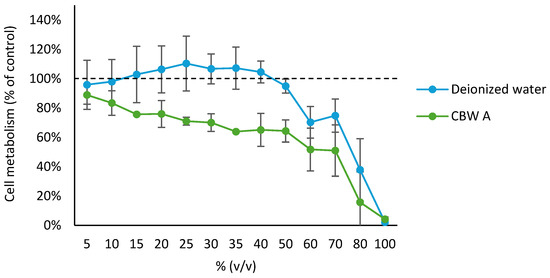
In the image: Effect of CBW A on HaCaT cell metabolism. HaCaT human keratinocytes were treated for 24 h with increasing concentrations of deionized water or CBW A. Cell metabolic activity was assessed using the resazurin assay. Data are presented as mean ± SEM from at least three independent experiments and expressed as % of untreated control. The dashed horizontal line represents 100% viability of the untreated control.