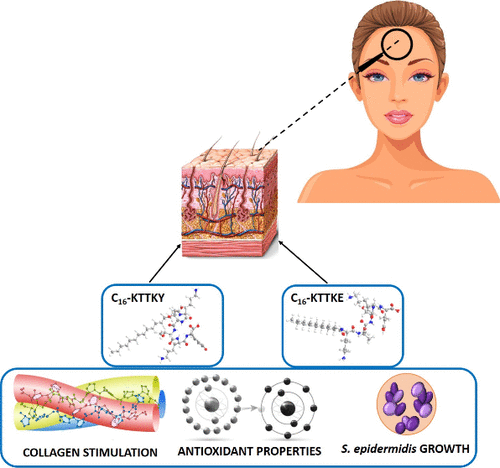
Skin aging is a complex, multifactorial process characterized by a significant decrease in essential proteins like collagen and elastin, which leads to the formation of fine lines and wrinkles. Factors such as UV exposure, pollution, and lifestyle choices accelerate this degradation by increasing reactive oxygen species (ROS) that disrupt cellular integrity. While many treatments exist, there is a demand for non-invasive solutions that can effectively penetrate the skin barrier to stimulate natural repair processes. Lipopeptides, particularly analogues of the matrikine C16-KTTKS, are considered an ideal answer because they mimic natural in vivo compounds, possess low allergenic risk, and can self-assemble into nanostructures that improve the delivery of active ingredients to deeper dermal layers.
Methods
The researchers synthesized two novel lipopeptides, C16-KTTKE and C16-KTTKY, and characterized their self-assembly behavior using fluorescence spectroscopy, circular dichroism, and cryo-TEM. Biological performance was evaluated through MTT assays for cell viability and Picrosirius red staining to quantify collagen production in human dermal fibroblasts. The antioxidant potential was measured by tracking intracellular ROS levels in HaCaT cells, while the influence on skin microbiota was determined by monitoring the growth of S. epidermidis. These comprehensive physicochemical and biological analyses allowed for a direct comparison of the functional differences between the two new molecules.
Key Findings
- Structural Self-Assembly: Both lipopeptides successfully self-assembled into nanotape morphologies characterized by a β-sheet secondary structure.
- Collagen Stimulation: C16-KTTKY demonstrated a significant 3-fold increase in total collagen production, whereas C16-KTTKE promoted a decrease in collagen at higher concentrations.
- Antioxidant Capacity: C16-KTTKE exhibited superior antioxidant properties compared to C16-KTTKY, showing ROS scavenging capabilities similar to resveratrol at specific concentrations.
- Microbiota Support: Unexpectedly, both lipopeptides stimulated the growth of S. epidermidis, a beneficial bacterium that helps maintain the skin barrier and inhibit harmful pathogens like S. aureus.
- Concentration-Dependent Toxicity: Significant reductions in cell viability (below 70%) were observed at concentrations exceeding 0.00625 wt % for C16-KTTKE and 0.00156 wt % for C16-KTTKY.
The novelty of this research lies in the development of the first multifunctional lipopeptides that combine the collagen-stimulating core of KTTKS with tyrosine or glutamic acid residues to target antioxidant protection and microbiota health simultaneously. These findings have significant future implications for the cosmetic industry, suggesting that these molecules could serve as key active ingredients in a new generation of non-invasive anti-aging products. By balancing collagen regeneration with the regulation of commensal microorganisms, these lipopeptides offer a holistic approach to maintaining skin integrity and preserving the essential skin barrier function.
Link to the study: https://pubs.acs.org/doi/full/10.1021/acsomega.5c12526