

The delivery of active pharmaceutical ingredients (APIs) and bioactive cosmetic compounds to or through the skin presents significant challenges due to the skin’s function as a robust physical barrier. Conventional drug administration routes, such as oral and parenteral methods, often face limitations, including rapid drug degradation (in the case of oral delivery) or poor patient compliance due to the invasive nature of injections (parenteral routes). Furthermore, many dermatological and cosmetic issues, such as eczema, inflammatory conditions, and skin aging, are characterized by a loss of skin moisture and dryness, demanding specialized topical treatments that restore the skin barrier.
To overcome these disadvantages, hydrogels have gained significant attention as potential solutions. Hydrogels, which are networks of hydrophilic polymers that can retain a large quantity of water, are effective vehicles for both transdermal drug delivery (TDDs) and topical skincare applications, allowing for efficient encapsulation and controlled release of active ingredients. Among the various polymers used, Hyaluronic Acid (HA) stands out as the most frequently used polymer in this field. HA is a naturally occurring biopolymer known for its biocompatibility, moisture-retention properties, and vital role in maintaining skin hydration, elasticity, and structural integrity. HA-based hydrogels have thus emerged as a cornerstone in both therapeutic drug delivery systems and advanced topical skincare formulations, offering a mechanism to enhance skin penetration and improve hydration.
Key Findings
• Dual Functionality and Superior Hydration: HA-based hydrogels are utilized effectively in both pharmaceutical approaches to facilitate transdermal transport into systemic circulation, and in cosmetics to enhance skin hydration and support the delivery of bioactive compounds. These hydrogels are superior to many conventional formulations due to their ability to absorb and maintain water in their structure.
• Role of Molecular Weight (MW): The MW of HA significantly influences its application. High molecular weight (HMW) HA (over 1000 kDa) is favored as a gelling agent, forming viscous and elastic networks, while low molecular weight (LMW) HA (under 500 kDa) is often incorporated for its bioactivity and believed ease of skin penetration.
• Controlling Release and Stability: HA undergoes rapid degradation by hyaluronidase enzymes in body tissues, giving it a short half-life. To overcome this limitation, cross-linking strategies (using agents like 1,4-butanediol diglycidyl ether (BDDE) or pentaerythritol tetra-acrylate (PT)) are used to modify HA, resulting in hydrogels with improved mechanical strength, lower enzymatic degradation rates, and enhanced biological compatibility.
• Active Ingredient Loading: Active ingredients can be loaded into hydrogel matrices using the post-loading (osmosis dependent) method or the more efficient in situ loading method, where the drug is added during the polymer preparation. The in situ method achieves higher drug delivery efficiency by encapsulating the active simultaneously with network formation.
• Pharmaceutical Applications: HA-based hydrogels are used as effective transdermal delivery systems for localized and systemic treatment, suitable for delivering anti-inflammatory agents and peptides. HA is also valuable in osteoarthritis treatments, ophthalmology, wound healing, and cancer treatment (by targeting CD44 receptors).
• Cosmetic Applications: In cosmetics, HA is a prominent ingredient used to limit skin aging, restoring skin hydration and elasticity to reduce the appearance of wrinkles and fine lines. HA hydrogels are common in facial masks, under-eye patches, and anti-aging products, providing immediate plumping and long-term benefits.
• Advanced Delivery Systems: Recent advancements in TDD involve incorporating HA hydrogels into systems like microneedles (MNs) and nanocarriers. MNs physically bypass the stratum corneum barrier, enhancing the penetration of macromolecular actives. Combining nanocarriers (such as liposomes or polymeric nanoparticles) with HA hydrogels provides synergistic action, improving dermal penetration and controlled release.
The novelty of this research lies in its comprehensive synthesis of the dual roles of Hyaluronic Acid (HA)-based hydrogels, explicitly linking their applications in both the pharmaceutical sector (as transdermal delivery systems) and the cosmetic sector (as superior moisturizers and delivery vehicles for topical actives). By detailing the structural modifications and cross-linking techniques required to improve stability and manage enzymatic degradation, the review provides crucial strategic design considerations necessary to overcome the natural limitations of linear HA polymers.
The future implication of this research strongly favors the development of smart hydrogel systems. These systems are designed to respond dynamically to physiological stimuli, such as changes in pH, temperature, or electric fields, allowing for highly personalized and precise delivery of active compounds. Furthermore, the ongoing integration of biodegradable and eco-friendly HA hydrogels with advanced technologies—specifically nanotechnology (nanocarriers) and microneedles—will continue to enhance effectiveness for both medical treatment and cosmetic enhancement, cementing HA-based hydrogels as a cornerstone of the next generation of drug delivery and skincare systems. This progression suggests that HA-based hydrogels will operate less like simple carriers and more like intelligent, responsive vessels designed to interact purposefully with the body’s environment.
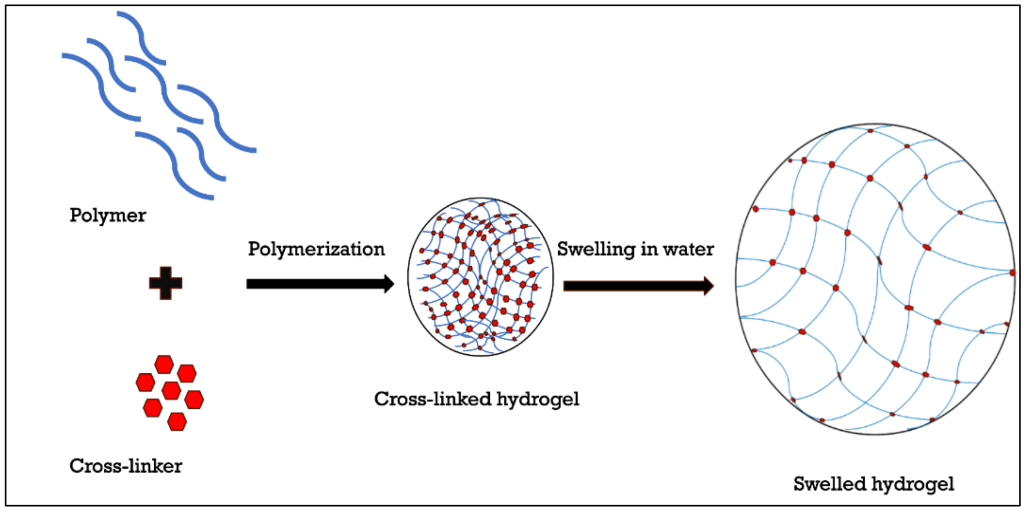
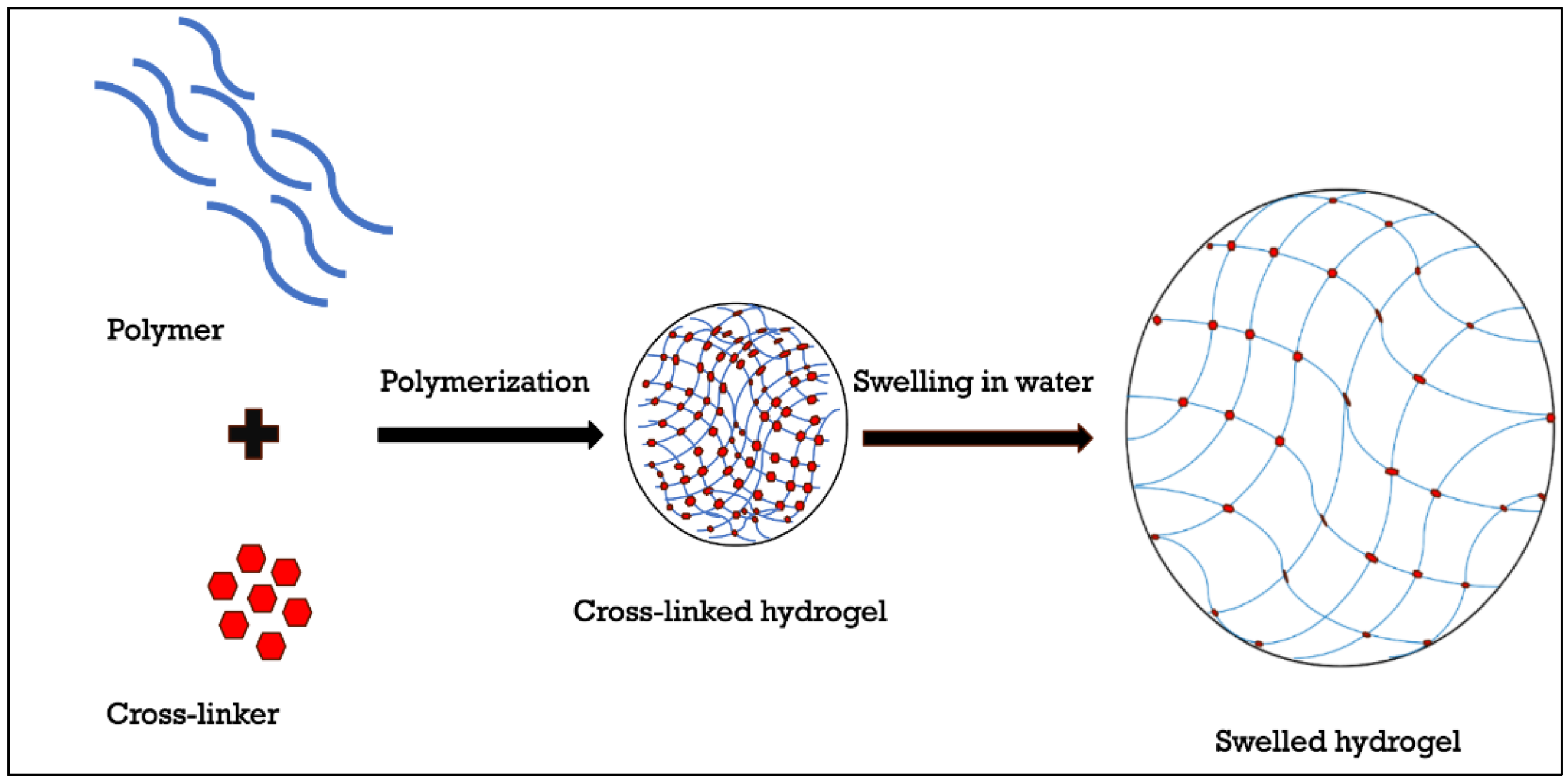
Figure Schematic representation of hydrogel synthesis illustrating the three-dimensional cross-linked polymer network responsible for water intake and swelling behaviour.
Link to the study: https://www.mdpi.com/2079-9284/12/6/265