Skin repair and anti-aging are established and vital research themes in dermatological and cosmetic science. As the largest immune organ, the skin gradually loses its physiological function and structural integrity due to internal (endogenous) factors like oxidative stress and inflammation, and external (exogenous) factors such as UV radiation and pollution. These changes manifest as endogenous aging, characterized by fine lines, loss of elasticity, and epidermal thinning. Although many methods exist to delay skin aging, contemporary research often lacks integration with historical medicinal principles.
Traditional Chinese Medicine (TCM), with a history spanning approximately 5000 years, contains systematic records of medicinal plants used to improve skin health. TCM’s theoretical foundation, established over 2500 years, includes the Five Elements framework (Wood, Fire, Earth, Metal, and Water), which correlates with five specific colors (green, red, yellow, white, and black). These elements and colors correspond to the body’s internal organs (liver, heart, spleen, lung, and kidney). Rooted in the TCM theoretical framework of the Five Elements and the associated principle of “Five Colors Entering the Five Organs” from the Huangdi Neijing, researchers formulated a specific combination of five chromatically representative medicinal plants—mung bean (green), white truffle (white), black truffle (black), chrysanthemum (yellow), and Lycium barbarum (red)—to investigate their potential synergistic anti-aging and skin regenerative effects. This approach aimed to utilize the traditional concept of “holistic synergy” for cosmetic application.
Methods
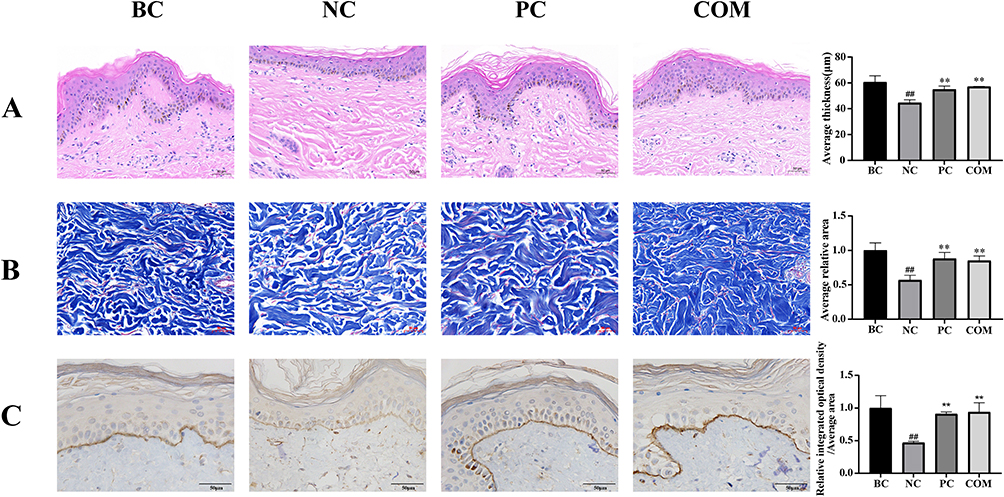
The study first employed network pharmacology to analyze the five-colored plant combination, identifying 27 core bioactive constituents and predicting 636 potential targets, including key proteins related to skin aging like CBS, CDK5, and AKR1B10. The proposed synergistic effects were then validated through a series of in vitro cell experiments, including a fibroblast scratch assay to measure wound healing/migration and a β-galactosidase staining assay on human fibroblasts to assess cellular senescence. Finally, ex vivo skin models were utilized, involving UVA/UVB irradiation and subsequent drug treatment, followed by histological analysis using H&E staining, Masson’s Trichrome staining, and immunofluorescence to evaluate changes in epidermal thickness and collagen content.
Key Findings
• Network pharmacological analysis identified 27 core components and 636 targets, including CBS, CDK5, and AKR1B10, which are known to be involved in skin anti-aging and repair.
• The combination’s mechanism of action was linked to the modulation of key skin aging pathways, notably the AGE-RAGE signaling pathway in diabetic complications, PI3K-Akt signaling pathway, p53 signaling pathway, and estrogen signaling pathway.
• In the fibroblast scratch assay, the five-colored plant combination (at 0.5% concentration) demonstrated a wound healing rate of 59.89% after 24 hours, which was 22.83% higher than the healing rate achieved by the individual raw materials.
• The combination exhibited significant anti-senescence effects: β-galactosidase staining revealed that the blue-stained senescent area in the experimental group (0.5% concentration) was 0.777%, representing a 76.32% reduction compared to the negative control and a 101.53% increase in effect compared to the individual raw materials.
• In the ex vivo skin model, treatment with the combination significantly increased the thickness of the epidermal living cell layer by 28.16%, collagen fiber content by 49.12%, and type IV collagen content by 100.00%.
The study demonstrates that the five-colored plant combination (mung bean, white truffle, black truffle, chrysanthemum, and Lycium barbarum) possesses significant synergistic effects in skin repair and delaying aging. The novelty of this research lies in its innovative bridge between the classical TCM theory of “the Five Colors Entering the Five Organs” and modern anti-aging cosmetic research. This represents the first attempt to integrate five-colored botanical ingredients based on TCM’s theory of “holistic synergy” and to systematically link this classical doctrine to functional cosmetic outcomes through experimental validation. The comprehensive research framework utilized—integrating network pharmacology with cellular and ex vivo validation—confirms the synergistic potential of chromatically diverse botanical ingredients.
The future implication of this work is the modernization of traditional Chinese medical theories, providing empirical support for ancient wisdom within a contemporary scientific context. However, the sources also acknowledge limitations, emphasizing that future studies should focus on the detailed analysis of the specific bioactive components and require further in vivo and in vitro experiments to verify the precise molecular mechanisms underpinning the synergistic effects observed in these specific pathways. This foundation sets the stage for the rational and efficacious application and development of TCM-based anti-aging cosmetic formulations.
Link to the study: https://www.dovepress.com/a-multidimensional-study-integrating-traditional-chinese-medicine-and–peer-reviewed-fulltext-article-CCID
In the figure: Ex vivo Skin Experiment Results. BC represents the blank control, NC represents the negative control (UVA+UVB), PC indicates the positive control (100μg/mL VC+7μg/mL VE+UVA+UVB), and COM denotes the five-colored plant combination. (A) Morphological staining of epidermal living cell layer revealed a significantly higher thickness of living cell layer in the COM group compared with NC group, showing an increase of 28.16%; (B) Following collagen fiber staining, the COM group demonstrated a significant increase of 49.12% in the content of collagen fiber compared with the NC group. (C) The immunohistochemical results of collagen IV showed a significant increase of 100.00% in the content of collagen IV in the COM group compared with the NC group. In the figure, ## indicates a significance of P < 0.01 compared with the BC group; ** indicates a significance of P < 0.01 compared with the NC group.