

Traditional and modern applications recognize the therapeutic potential of Sapindus mukorossi (S. mukorossi), commonly known as the soapnut tree, particularly for skin care and wound treatment. Extracts from the fruit pericarp and seed oil of S. mukorossi have shown promising anti-inflammatory, antibacterial, and antioxidant properties, suggesting their utility in wound healing and cosmetic applications. Specifically, S. mukorossi seed oil has been demonstrated to promote skin regeneration and wound healing due to high levels of bioactive compounds.
However, the oily nature of the seed extract presents practical limitations for daily skincare applications, particularly for non-greasy formulations, or when frequent application is needed. Oils often require emulsification and may have a distinct odor, whereas aqueous solutions are typically milder, less likely to irritate the skin, and do not clog pores, making them ideal for toners, sprays, dressings, or baby care products. Plant hydrosols, the aqueous byproduct of steam distillation, contain water-soluble components and various bioactive compounds such as polyphenols, alkaloids, and terpenes, which possess medicinal properties including antioxidant, anti-inflammatory, and wound-healing effects. Although the skin-repairing properties of S. mukorossi seeds have been reported, this study was the first to explore the beneficial activities of the aqueous S. mukorossi seed extract (hydrosol or SMH) as a promising, water-based solution for wound healing and skincare ingredient development.
Methods
The S. mukorossi seed hydrosol (SMH) was prepared using the hydro-distillation technique on ground seed powder at various powder-to-water mixing ratios, with the 1:2 dilution (SMH 1:2) chosen for optimal performance in subsequent tests. Phytochemical components were analyzed via Gas Chromatography–Mass Spectrometry (GC–MS). In vitro experiments included assessing antibacterial activity against Staphylococcus aureus, cell viability and migration using CCD-966SK fibroblasts via MTT and scratch assays, and anti-inflammatory activity by measuring nitric oxide (NO) production in LPS-stimulated RAW 264.7 macrophages. Finally, the wound-healing efficacy of SMH 1:2 was tested in vivo on full-thickness excisional wounds in Sprague–Dawley rats over a 14-day period, complemented by histological examination of the tissue.
Key Findings
• Phytochemical analysis identified two key bioactive aromatic hydrocarbons in SMH: benzene, 1,3-bis(1,1-dimethylethyl), and 2,4-di-tert-butylphenol (2,4-DTBP).
• SMH 1:2 significantly reduced S. aureus colony counts by 60% (p < 0.05), demonstrating concentration-sensitive antibacterial activity.
• In vitro viability assays on CCD-966SK fibroblasts showed that SMH supported cell survival under nutrient-deprived (serum-free) conditions and offered more sustained protective effects compared to the control.
• SMH 1:2 significantly promoted fibroblast migration in scratch assays and accelerated wound closure at 24 and 48 hours (p < 0.05).
• Anti-inflammatory testing revealed that SMH 1:2 significantly reduced LPS-induced nitric oxide (NO) production in RAW 264.7 cells (p < 0.01).
• In vivo testing in rats demonstrated that SMH 1:2 application resulted in significantly smaller wound areas (8.25% ± 3.85%) compared to the control (14.04% ± 3.50%) on day 14 (p < 0.05).
• Histological examination confirmed that SMH-treated wounds showed enhanced re-epithelialization, with a thicker and more continuous epidermal layer observed by day 14.
This research represents the first report in the literature on the application of aqueous S. mukorossi seed extract (hydrosol) for skin care. The study successfully demonstrated that S. mukorossi seed hydrosol exhibits significant antibacterial and anti-inflammatory activity, alongside the ability to stimulate skin cell proliferation and migration.
The novelty lies in identifying SMH, a water-based extract, as an effective natural wound-healing agent, overcoming the limitations associated with the oily nature of previously studied S. mukorossi seed oil. The beneficial effects of SMH are largely attributed to bioactive aromatic hydrocarbons, particularly 2,4-DTBP, which is known for its potent antimicrobial and anti-inflammatory properties.
These findings propose that S. mukorossi seed hydrosol is a promising candidate for natural skin care applications and may serve as a valuable reference for future medical applications, given the high potential for practical use of water-based products. Future implications include developing this hydrosol into topical products such as sprays or dressings, enhancing its practical utility in clinical and cosmetic settings. However, further research using techniques like Masson’s trichrome staining is needed to provide information regarding collagen status and better restrict discussion of the wound-healing mechanism associated with SMH application.
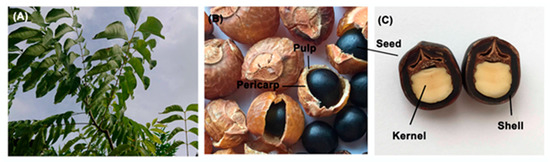
In the figure below: (A) Fresh S. mukorossi fruit and leaf. (B) After maturation, the S. mukorossi fruit turn dark brown and contain a black seed. (C) The seed consists of an oil-enriched pulp covered with a hard shell.
Link to the study: https://www.nature.com/articles/s41598-025-27030-9