Skin irritation is a widespread dermatological concern that negatively impacts skin comfort and physical appearance. This condition is driven by complex mechanisms, including heightened inflammatory responses, oxidative stress, and compromised skin barrier function, often triggered by environmental exposures or immune activation. Although numerous topical products are available to soothe irritated skin and support recovery, many treatments offer only partial relief or may induce sensitivity with prolonged use, creating an urgent need for safe, naturally derived ingredients.
Birch sap, a nutrient-rich fluid collected from Betula species, has historically been used in Northern Europe and Asia for general wellness and various cosmetic applications. The fluid contains numerous bioactive substances, including polysaccharides, organic acids, vitamins, and essential minerals. Given the documented capacity of birch sap (specifically from Betula Alba) to reduce ultraviolet-induced cell damage in vitro, researchers aimed to investigate whether birch sap could modulate inflammatory responses and maintain skin barrier functions in controlled models of skin irritation.
Methods
The study characterized the polysaccharide composition of birch sap before conducting both in vitro and in vivo experiments. For the cellular studies, TNF−α/IFN−γ-stimulated HaCaT keratinocytes were utilized to evaluate birch sap’s effects on the expression of inflammatory cytokines and the activation of MAPK and NF−κB signaling pathways using quantitative PCR and Western blot assays. For the in vivo assessment, BALB/c mice were subjected to a chemically induced skin irritation model using 2,4-Dinitrochlorobenzene (DNCB). Researchers evaluated the impact of oral birch sap administration on skin physiological parameters, including transepidermal water loss (TEWL), hydration, erythema, epidermal thickening, and cutaneous blood flow using a multifunctional skin analysis system and laser speckle contrast imaging (LSCI).
Key Findings
The research established that birch sap exhibited anti-inflammatory and barrier-supportive effects in both cellular and animal models:
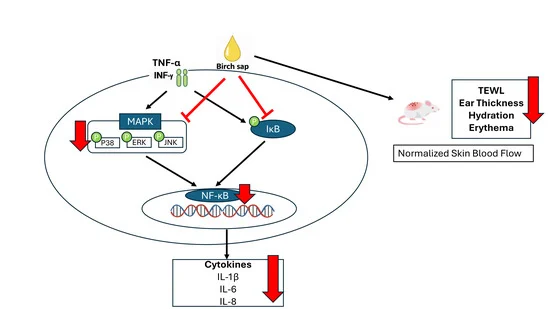
• Birch sap significantly reduced the expression of pro-inflammatory cytokines, specifically IL−1β, IL-6, and IL-8, in TNF−α/IFN−γ-stimulated HaCaT cells.
• The anti-inflammatory effects were linked to the attenuation of signaling pathways, as birch sap decreased the phosphorylation of both the MAPK pathway components (p38, ERK, JNK) and NF−κB pathway components (IκBα and NF−κB).
• In the animal model of skin irritation, oral administration of birch sap significantly alleviated erythema and reduced epidermal hyperplasia (epidermal thickening).
• Birch sap improved skin hydration and reduced transepidermal water loss (TEWL), indicating restoration of epidermal barrier function.
• The treatment normalized elevated cutaneous blood flow (hyperemia) associated with inflammation, further providing functional evidence of its anti-inflammatory effect.
Conclusion
This study provides compelling evidence that birch sap offers modulatory effects on inflammation and supports skin barrier function, suggesting its potential as a naturally derived cosmetic ingredient. The novelty of this research lies in elucidating the mechanisms by which birch sap exerts its anti-inflammatory effects—specifically, its ability to inhibit the canonical inflammatory MAPK and NF−κB pathways in activated keratinocytes, which leads to the observed decrease in cytokine expression and robust physiological improvements in vivo.
The successful demonstration of birch sap’s ability to attenuate inflammation and promote restoration of epidermal homeostasis suggests significant translational value. Future implications require comprehensive follow-up investigations, including a detailed compositional analysis to identify the specific bioactive compounds responsible for these effects. Furthermore, rigorous clinical investigations, standardized preparation methods, and thorough toxicological examinations are necessary to confirm birch sap’s potential as a valuable, safe, and well-defined agent in cosmetic products.
The findings suggest birch sap acts like a natural damper for inflamed skin, soothing the molecular signaling cascade (MAPK and NF−κB) in the same way a volume control lowers the overwhelming noise of an amplifier, thereby restoring the skin’s physiological balance.
Link to the study: https://www.mdpi.com/2079-9284/12/6/282