

The primary challenge in topical skin care is overcoming the stratum corneum, the skin’s outermost layer, which acts as a tightly packed lipid barrier preventing the deep penetration of active molecules. Epidermal Growth Factor (EGF) is a potent polypeptide for skin regeneration and anti-aging, yet its large molecular size and protein structure lead to poor transdermal absorption, limiting its clinical efficacy. To address this, elastosome technology was developed as an innovative delivery system. Unlike conventional rigid liposomes, elastosomes incorporate single-chain surfactants into their lipid bilayer, granting them extreme deformability. This flexibility allows the vesicles to “squeeze” through microscopic gaps in the skin barrier, significantly enhancing the delivery of encapsulated bioactives like EGF to deeper layers.
Methods
The researchers used a high-pressure microfluidizer (1000 bar) to create EGF-loaded elastosomes (EGF FLEXIR-SOME) containing dexpanthenol and NMN. The particles were characterized using Cryo-TEM for structure, laser light scattering for size and zeta potential, and Franz-type diffusion cells for skin penetration analysis. Efficacy was validated through in vitro assays (antioxidant/anti-inflammatory) and clinical trials on healthy subjects using a randomized split-face method to measure elasticity, wrinkle reduction, and barrier repair over two weeks.
Key Findings
• Superior Stability and Size: The formulation achieved a stable average particle size of 124.8 nm and a high zeta potential of −57.53 mV, indicating excellent colloidal stability compared to conventional liposomes.
• Enhanced Penetration: Transdermal absorption testing confirmed that the elastosome formulation successfully delivered active ingredients through the skin barrier, whereas the conventional liposome control showed no detectable peak.
• Potent Biological Efficacy: In vitro tests revealed significant tyrosinase inhibition (90.96%) for whitening and powerful ABTS radical scavenging for antioxidant protection.
• Proven Clinical Anti-Aging: After two weeks of use, subjects showed a 9.87% improvement in eye elasticity, an 8.97% reduction in wrinkles, and a 6.15% increase in skin lifting.
• Rapid Hydration and Repair: A single application increased skin moisture by 448.52% and improved damaged skin barrier recovery by 197.96% over the control group.
• Safety: Clinical evaluations classified the formulation as non-irritating, with an average skin reaction score of 0.00.
The novelty of this research lies in the successful implementation of an elastosome-based platform to co-load EGF, NMN, and dexpanthenol, effectively bypassing the skin’s natural resistance through vesicle deformability. By maximizing both the stability and transdermal efficiency of these potent ingredients, the study introduces a more effective strategy for treating aging and hyperpigmentation than traditional lipid-based carriers. Future implications suggest this technology could serve as a multifunctional platform for various bioactive ingredients in advanced cosmeceuticals. However, further research is needed to explore its efficacy across diverse ethnic populations and to compare it against other high-end delivery systems like ethosomes.
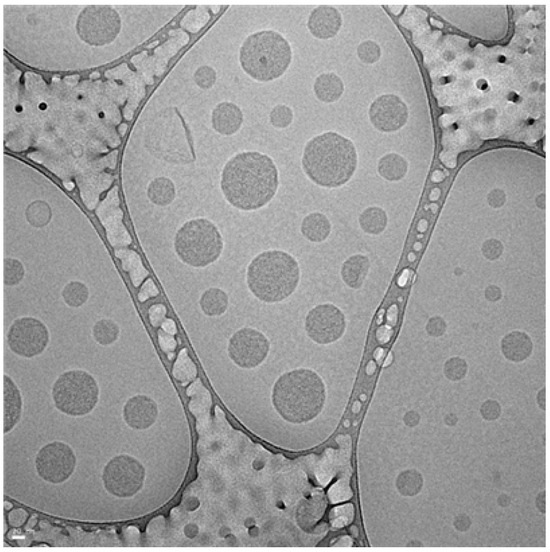
Structure of EGF FLEXIR-SOME particles. Magnification: 100K.
Link to the study: https://www.mdpi.com/2079-9284/13/1/10