

Surfactants are essential components in cosmetic and cleaning formulations due to their ability to stabilize emulsions and generate foam. Sodium lauryl sulfate (SLS) is a widely used anionic surfactant valued for its high cleaning power and foaming capacity; however, it is associated with significant skin irritation as it penetrates the stratum corneum and disrupts essential lipids and proteins. To address this issue, researchers have explored the use of surfactant mixtures, specifically combining anionic surfactants with amphoteric ones like lauryl dimethylamine oxide (LDAO). This potential solution was considered because such blends can form mixed micelles that are more stable than those formed by single surfactants. By incorporating LDAO, the electrostatic repulsion between the charged head groups of SLS is reduced, leading to a decrease in the concentration of free monomers in the solution, which are primarily responsible for skin irritation.
Methods
The study evaluated binary mixtures of SLS and LDAO at various ratios (90:10 to 50:50), measuring surface tension and Critical Micelle Concentration (CMC) using an optical tensiometer via the Pendant Drop method. Foam generation and stability were assessed using a SITA Foam Tester R-2000, which recorded volume over multiple agitation cycles. Skin irritant potential was quantified through the Zein test, where dissolved protein was measured using the Kjeldahl method to determine a “Zein number”. Finally, the researchers compared experimental results against theoretical cumulative values to quantify the degree of synergistic interaction.
Key Findings
• Enhanced Micellization: All SLS + LDAO mixtures achieved a significantly lower CMC and minimum surface tension than the individual surfactants alone, indicating superior efficiency in liquid solutions.
• Improved Foam Performance: The binary mixtures outperformed individual components in both generation speed and total foam volume, with the 60:40 ratio demonstrating the highest foam volume.
• Irritation Reduction: Increasing the proportion of LDAO consistently led to a decrease in the Zein number, transitioning the formulation from a Type I irritant (SLS alone) to a non-irritating category at 60:40 and 50:50 ratios.
• Quantifiable Synergy: The experimental Zein solubilization values were significantly lower than the calculated cumulative values, proving that the mixture is milder than the sum of its parts.
• Micelle Stability: The observed synergy is attributed to LDAO molecules coiling around SLS head groups, which screens electrostatic repulsions and creates larger, more stable micelles that are less likely to penetrate the skin.
The novelty of this research lies in its specific focus on how the ratio between anionic and amphoteric surfactants influences skin irritation, providing a quantitative framework to evaluate synergy rather than just observing qualitative improvements. By proving that dermal irritation is not necessarily proportional to surfactant concentration, the study demonstrates that total surfactant levels can be increased to improve performance while simultaneously enhancing mildness. The future implications of these findings are significant for the rational design of cleaning products, such as hand dishwashing liquids and shampoos, where balancing high foaming capacity with skin protection is a critical consumer requirement.
Link to the study: https://www.mdpi.com/2079-9284/13/1/17
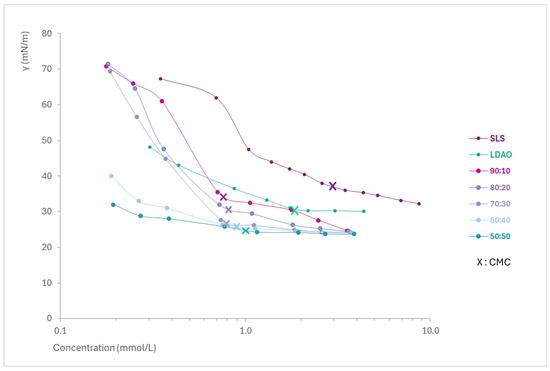
In the image: Surface tension profiles of SLS, LDAO, and their binary mixtures as a function of the concentration.