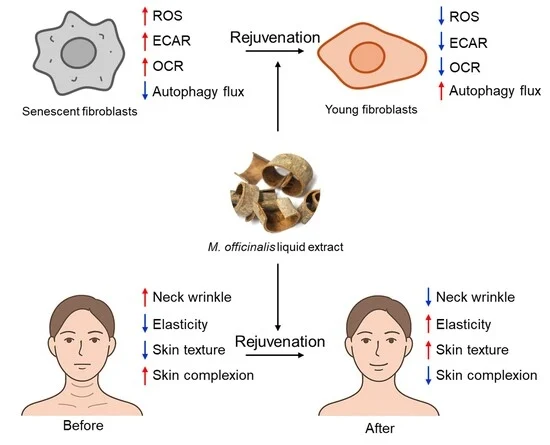
Reactive oxygen species (ROS) are a primary driver of skin aging, causing the oxidation and cleavage of collagen that maintains skin structure. Mitochondrial dysfunction in senescent cells creates a detrimental cycle where electron leakage generates excessive ROS, further damaging cellular organelles. While traditional antioxidants like Vitamin C or Niacinamide act as general free radical scavengers, the sources identify Magnolia officinalis liquid extract as a superior solution because it specifically reduces mitochondria-enriched ROS and restores organelle function. The liquid form was specifically chosen for its standardized manufacturing protocols and its ability to be integrated directly into cosmetic formulations without prior dissolution.
Methods
Researchers utilized human dermal fibroblasts to evaluate the extract’s impact on mitochondrial membrane potential, ROS levels, and mitophagy through flow cytometry and metabolic flux analysis. Phytochemical profiling of the extract was conducted using High-Performance Liquid Chromatography (HPLC) to quantify active ingredients like honokiol and magnolol. A randomized, double-blind clinical trial followed, involving 21 women who applied a cream containing 3% M. officinalis liquid extract for four weeks. Objective skin measurements were taken using ANTERA® CS for wrinkles, a cutometer for elasticity, and atomic force microscopy for surface texture.
Key Findings
• Mitochondrial Recovery: The extract significantly reduced mitochondrial superoxide and hydroxyl radicals while increasing mitochondrial membrane potential (MMP) in senescent cells.
• Metabolic Efficiency: Treatment restored oxidative phosphorylation (OXPHOS) efficiency and reduced the cellular reliance on glycolysis.
• Mitophagy Activation: The extract promoted mitophagy, the selective removal of defective mitochondria, which effectively reduced the mass of dysfunctional organelles.
• Senescence Reversal: Treated fibroblasts showed a reduction in the senescence marker p16 and an increase in SLIT2, a ligand that aids skin tissue regeneration.
• Clinical Wrinkle Reduction: Participants experienced a 12.73% reduction in mean neck wrinkle depth and a 17.44% reduction in maximum depth.
• Enhanced Skin Quality: The clinical trial recorded a 3.76% increase in skin elasticity, significant improvements in skin roughness (Ra, Rq, and Rmax), and a 0.76% increase in skin brightness.
This research is characterized by its novelty as the first study to demonstrate that M. officinalis liquid extract can clinically rejuvenate skin by specifically targeting mitophagy activation rather than just external radical scavenging. By restoring mitochondrial homeostasis, the extract offers a “next-generation” approach to anti-aging cosmetics. Future implications of this work include the development of high-quality therapeutic treatments for senescence, though the sources suggest that further studies are required to determine optimal skin penetration concentrations and to validate these findings across diverse ethnic groups for long-term efficacy.
Link to the study: https://www.mdpi.com/2079-9284/13/1/22