

Environmental pollution, including particulate matter, heavy metals, and ozone, is a primary driver of oxidative stress in the skin, leading to premature aging, chronic inflammation, and various dermatological pathologies. These pollutants generate reactive oxygen species (ROS) that disrupt the skin’s redox balance and can overwhelm natural defense mechanisms, such as the Nrf2 pathway. Pycnogenol®, a standardized extract from French maritime pine bark rich in procyanidins and bioflavonoids, was considered as a potential solution due to its proven ability to scavenge free radicals and exert potent anti-inflammatory effects. While oral intake has previously shown benefits, this study explores topical application to determine if the extract can provide a direct, local defense against the specific atmospheric insults faced by urban populations.
Methods
This study utilized ex vivo human skin explants topically treated with Pycnogenol® (0.5%, 1%, and 2%) and exposed to a standardized pollutant mixture containing heavy metals and diesel particles. Researchers employed immunostaining to evaluate the expression of stress markers Nrf2 and AHR, while lipid peroxidation was quantified by measuring malondialdehyde (MDA) via spectrofluorimetry. The use of the Pollubox® system ensured that the skin’s morphology and metabolism were preserved, providing a biologically relevant context for assessing the extract’s efficacy. This rigorous setup allowed for the dose-dependent evaluation of the extract’s protective capacity against accelerated environmental stress.
Key Findings
• Mitigation of Nrf2 Over-expression: Pycnogenol® significantly reduced pollutant-induced Nrf2 over-expression by up to 64% at the highest dose, indicating a reduction in acute cellular damage and a lessened need for compensatory defense.
• Suppression of AHR Signaling: The extract inhibited the over-expression of the Aryl Hydrocarbon Receptor (AHR) by up to 85%, which helps prevent the pro-inflammatory signaling and barrier disruption typically triggered by urban toxins.
• Reduction in Lipid Peroxidation: Treatment with 2% Pycnogenol® significantly decreased MDA levels by 25% following pollution exposure, demonstrating a strong protective effect against oxidative damage to cell membranes.
• Adaptive Cellular Response: In the absence of pollutants, the extract modestly increased AHR expression, which may enhance the skin’s “readiness” to detoxify xenobiotics through upregulated phase I and II enzymes.
• Lowered Basal Stress: Pycnogenol® was shown to decrease basal Nrf2 levels in non-stressed conditions, suggesting it improves the skin’s overall redox balance even before environmental insults occur.
The novelty of this research lies in its use of an advanced ex vivo human skin model to provide the first evidence of Pycnogenol®’s direct topical efficacy against a complex mixture of urban pollutants. By modulating the Nrf2/AHR/MDA triad, the extract demonstrates a multi-target approach to skin protection that goes beyond simple antioxidant scavenging. Future implications suggest that Pycnogenol® is a highly valuable ingredient for anti-pollution cosmetic formulations tailored for urban environments. However, future studies should include multiple donors to account for human variability and investigate further markers, such as pro-inflammatory cytokines (IL-6, TNF-α), to fully map the extract’s protective network.
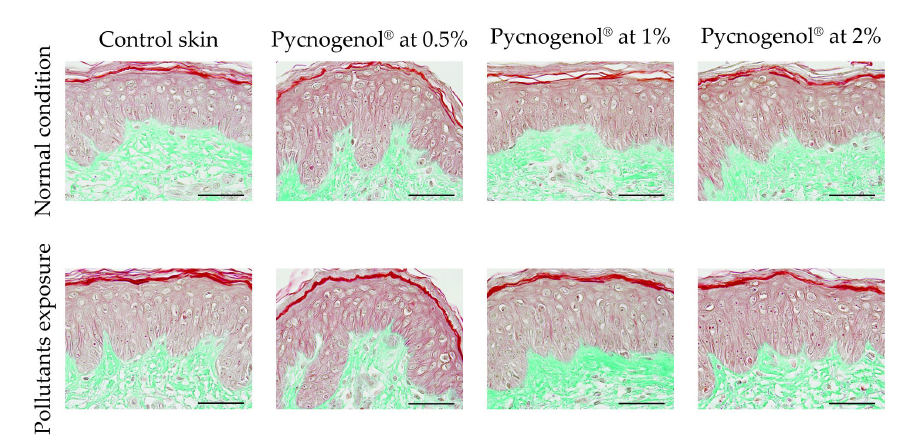
Representative images of the analysis of cellular and tissular viability in skin explants upon different conditions, treated with Pycnogenol® (0.5–2%), without (normal condition) and with exposure to pollution (stress). Scale bar (black solid line): 50 μm (325 pixels).
Link to the study: https://www.mdpi.com/2079-9284/13/1/26