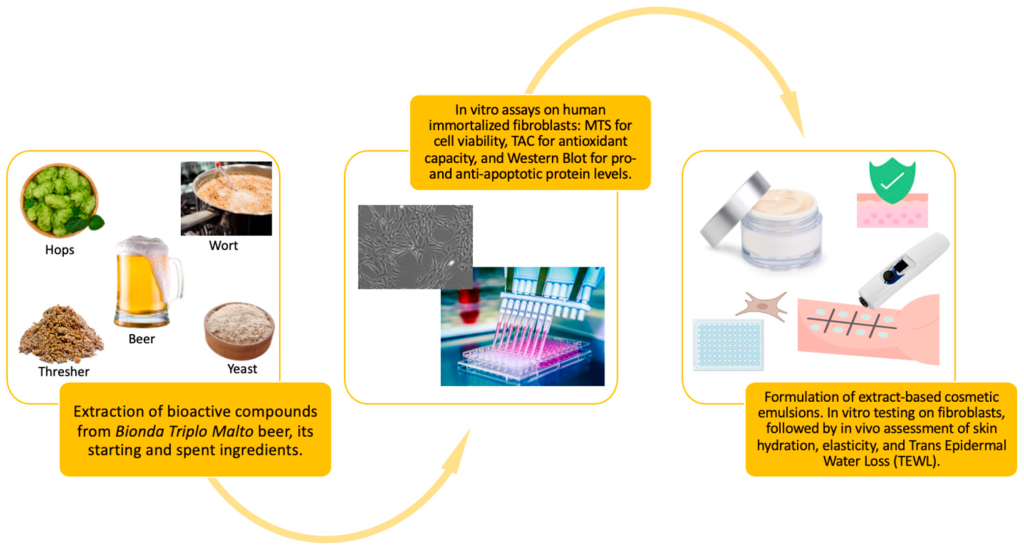
Skin aging is a complex biological process characterized by the impairment of dermal fibroblasts, which are crucial for maintaining tissue homeostasis and structural integrity. When these cells lose activity due to intrinsic factors or extrinsic stressors like UV radiation, the skin suffers from increased transepidermal water loss (TEWL), decreased elasticity, and visible signs of senescence. To address this, the cosmetic industry is increasingly seeking sustainable, bioactive ingredients derived from agri-food by-products. Brewing by-products (such as spent grain, hops, and yeast) were considered a potential solution because they are abundant, underutilized resources rich in phenolic acids, flavonoids, and proteins that possess significant antioxidant and anti-aging properties.
The researchers developed oil-in-water (O/W) emulsions containing 20% (w/w) aqueous extracts from Bionda Triplo Malto beer, wort, and by-products like yeast and spent grain. These were evaluated in vitro using human dermal fibroblasts (BJ-5ta) to measure cell viability and antioxidant capacity after UV-induced oxidative stress. Finally, a 30-day double-blind, randomized clinical study was conducted on 50 healthy volunteers to assess changes in skin hydration, elasticity, and TEWL.
Key Findings
- Formulation-Dependent Efficacy: While free aqueous extracts showed limited inherent activity and some cytotoxicity at high concentrations, their incorporation into emulsions fully prevented cell death and significantly enhanced biological responses.
- Cellular Protection: Emulsions containing beer and yeast extracts significantly increased fibroblast metabolic activity and intracellular antioxidant buffering compared to the vehicle alone.
- Improved Barrier Function: Clinical results showed that beer, yeast, and spent grain formulations reduced TEWL by approximately one-third, reinforcing the stratum corneum barrier.
- Hydration and Elasticity: Daily application of beer and yeast-based emulsions led to a significant increase in skin hydration and elasticity (e.g., yeast emulsion improved elasticity from 61.21 to 72.13 N/m).
- Strong Correlation: Exploratory analysis revealed that higher in vitro activity scores were strongly associated with greater clinical improvements in skin elasticity.
The novelty of this research lies in its integrated approach, demonstrating that the cosmetic efficacy of brewing by-products is not just a result of their intrinsic composition but is critically determined by formulation-driven modulation of bioavailability. By transforming “waste” into high-value functional actives, this study provides a scientifically validated model for circular-economy principles in the beauty industry. Future implications suggest that these sustainable ingredients could replace conventional actives, though further studies are needed to explore their long-term benefits and exact skin penetration mechanisms.
Link to the study: https://www.mdpi.com/2079-9284/13/2/63