

Pequi oil (Caryocar brasiliense) is a lipid-rich natural ingredient derived from the Brazilian Cerrado biome, holding recognized potential for cosmetic applications due to its bioactive properties. The oil contains carotenoids, tocopherols, and fatty acids that possess antioxidant and anti-inflammatory activities, and previous topical applications have suggested improved skin barrier function and hydration. However, a significant knowledge gap existed between the documented preclinical evidence (such as physiochemical characterization and in vitro bioactivity) and comprehensive, controlled clinical validation using standardized instrumental measurements. Specifically, the time-dependent clinical effects of pequi oil in non-encapsulated, minimalist formulations suitable for oily and acne-prone skin remained underexplored. The potential solution investigated—incorporating pequi oil into a lightweight serum—was considered due to the ingredient’s composition, rich in oleic acid (55.89%) and palmitic acid (34.90%), which mimics the skin’s natural lipids, suggesting it could restore the hydrolipidic balance without exacerbating oiliness.
Methods
This study aimed to characterize pequi oil using GC-MS, formulate a minimalist serum containing 3% pequi oil (SPO), and evaluate its clinical efficacy compared to a vehicle control (SV). The formulations were tested in a randomized, single-blind, vehicle-controlled clinical trial involving twenty healthy female participants aged 22–30 years with oily/acne-prone skin. Immediate (2 hours), short-term (7 days), and long-term (28 days) efficacy were evaluated using non-invasive instrumental devices to measure key skin parameters, including stratum corneum water content (Corneometer®), transepidermal water loss (Tewameter®), sebum content (Sebumeter®), porphyrin count (Visiopor®), sebaceous gland activity (Sebufix®), and skin microrelief (Visioscan®). Statistical analyses, including ANOVA and Kruskal–Wallis tests, were conducted, with p<0.05 considered significant.
Key Findings
• The pequi oil was predominantly composed of monounsaturated fatty acids (60.16%), with oleic acid (55.89%) and palmitic acid (34.90%) as the most abundant constituents.
• The SPO formulation significantly enhanced skin hydration (stratum corneum water content) both immediately (t2h) and long-term (t28d), compared to baseline and the vehicle.
• Application of SPO led to a significant reduction in transepidermal water loss (TEWL) at 2 hours and 28 days compared to baseline, suggesting improved skin barrier function.
• After 28 days, the SPO group showed a significant decrease in superficial sebum levels and the count of oily spots compared to baseline and the vehicle group.
• Porphyrin quantification analysis showed a significant decrease in the GSPO group after 28 days, with 100% of participants achieving the lowest score (Score 1), indicating a reduction in potential C. acnes metabolic activity.
• SPO significantly improved skin microrelief after 28 days by reducing roughness (increased SEr) and surface volume, and increasing uniformity (homogeneity), resulting in a smoother, more uniform skin surface.
• Long-term perceived efficacy confirmed these instrumental results, with participants reporting better hydration, enhanced smoothness, effective oil control, and overall high satisfaction with SPO, while reporting no perceived oiliness or discomfort.
Conclusion
The research provides novel and comprehensive instrumental validation for the use of non-encapsulated pequi oil in cosmetic formulations, specifically tailored for oily and acne-prone skin. The study successfully demonstrates that pequi oil, even at a 3% concentration in a minimalist serum, significantly enhances skin barrier integrity, hydration, and microrelief, while simultaneously modulating sebaceous activity and reducing porphyrin fluorescence. This dual action—providing hydration and barrier restoration without promoting oiliness—is crucial for managing challenging skin types and supports pequi oil’s non-comedogenic profile. The future implications of this research are significant, reinforcing pequi oil’s strong potential as an effective, multifunctional cosmetic ingredient for targeted strategies against oily and acne-prone skin. To further solidify these findings, future research should include microbiological analyses to confirm the hypothesized antimicrobial contribution of pequi oil’s fatty acids and should extend the application period with larger, more heterogeneous populations to validate broader applicability across various skin types. The comprehensive results presented here serve as a robust foundation for positioning pequi oil alongside established cosmetic oils like argan and jojoba.
Link to the study: https://www.mdpi.com/2079-9284/12/6/283
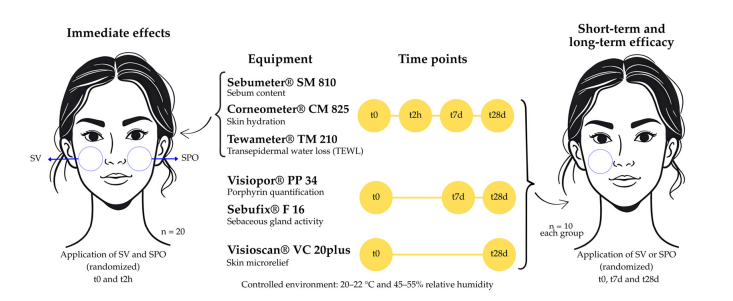
Schematic representation of the clinical study design. Immediate effects: split-face randomized application of the vehicle formulation (SV) and the pequi oil formulation (SPO) on the
malar regions, with evaluations at baseline (t0) and 2 h (t2h). Short-term and long-term efficacy:
participants were divided into two groups (n = 10 each), receiving either SV or SPO applied twice
daily to one malar region, with evaluations performed at baseline (t0), 7 days (t7d), and 28 days
(t28d).