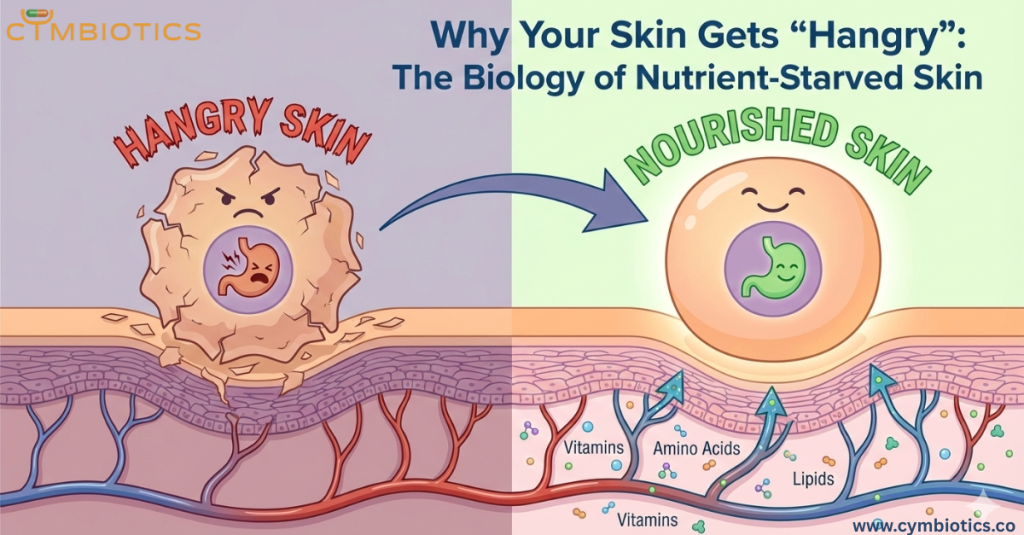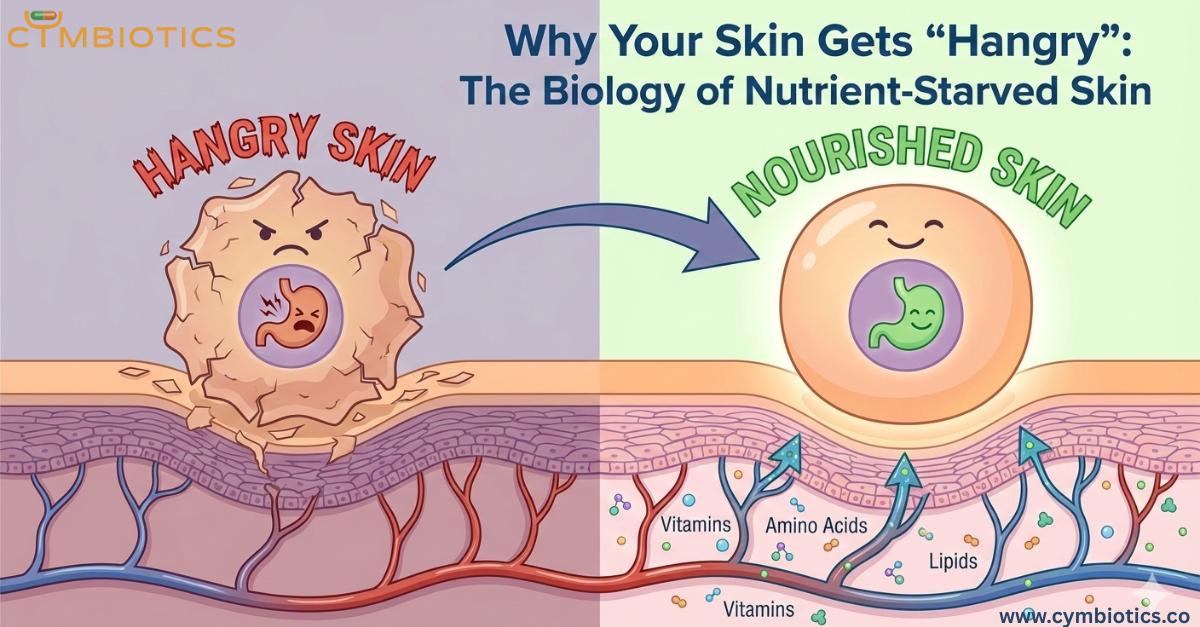

We talk about “hangry” moods all the time, that irritable, restless feeling when the body wants fuel. But here’s the strange part: your skin can get hangry too.
Not in a metaphorical sense.
In a biological, measurable, real-world way.
When blood flow slows down, hydration drops, lipids decline, and renewal lags, the skin behaves exactly like an organ that’s not getting enough nutrients. The result? Irritation, dullness, tightness, and a sensitive, reactive surface, all classic signs of a hungry, stressed tissue.
Let’s break down the science behind nutrient-starved skin and why it behaves this way.
The Skin Is a Nutrient-Dependent Organ, More Than Most People Realize
Your skin might sit on the outside, but its metabolism runs deep:
- It needs oxygen to fuel cellular turnover
- It needs glucose and amino acids for barrier repair
- It needs lipids to keep its structure intact
- It needs hydration to keep enzymes working
- It needs circulation to deliver all of the above
When these inputs dip, due to cold weather, stress, dehydration, disrupted sleep, harsh products, or season-induced vascular changes, the skin essentially runs on empty.
Which brings us to the first “hangry trigger.”
1. Vasoconstriction: The Skin’s Nutrient Pipeline Shrinks
Cold air and sudden temperature changes cause vasoconstriction, tightening of blood vessels near the skin’s surface.
This is your body’s heat-saving mechanism, but it comes with consequences:
- Reduced oxygen supply
- Reduced nutrient delivery
- Slowed cellular repair
- Lowered metabolic activity
- Delayed turnover
When the skin isn’t getting fed properly, everything slows down.
That’s when dryness becomes flakiness.
Flakiness becomes irritation.
Irritation becomes sensitivity.
A classic hangry cascade.
2. Slow Turnover = Skin Running on Yesterday’s Energy
Keratinocyte turnover is highly energy-dependent. When nutrients drop:
- Cell renewal slows
- Dead cells linger on the surface
- Brightness decreases
- Texture becomes uneven
- Actives absorb poorly
The skin starts behaving like someone who hasn’t slept and hasn’t eaten, low energy, low performance, and low resilience.
This is why “dullness” is one of the earliest signs of skin hangriness.
3. Low Hydration Makes the Barrier “Metabolically Stiff”
Hydration isn’t just moisture, it powers essential enzymes that control:
- Natural exfoliation (desquamation)
- Lipid processing
- Ceramide formation
- Barrier repair speed
When hydration drops:
- Enzymes slow
- Lipid synthesis declines
- Barrier cracks form more easily
- Irritation becomes more likely
Dry skin is slow skin.
Slow skin is nutrient-poor skin.
And nutrient-poor skin becomes reactive, just like a hungry body.
4. Lipid Decline: The Skin’s Fuel Tanks Are Empty
Ceramides, cholesterol, and fatty acids form the outermost shield of the skin. They’re also the “fuel reserves” that protect and insulate the barrier.
But cold weather, harsh washes, and stress decrease lipid synthesis.
When these reserves drop:
- The barrier becomes porous
- Irritants penetrate easily
- TEWL increases
- Surface nerves become exposed
- Redness and burning sensations increase
It’s the skin’s version of saying:
“Feed me, now.”
5. Micro-Inflammation: The Hangry Mood Swing
When nutrients drop and the barrier weakens, the skin enters a state of micro-inflammation, low-grade, invisible irritation.
This shows up as:
- Redness
- Burning
- Sudden sensitivity
- Patchiness
- Random breakouts
Just like a hungry body becomes irritable, nutrient-starved skin becomes reactive.
Cymbiotics’ Perspective: Feeding Skin Intelligence
When the skin is “hangry,” the goal isn’t just to moisturize, it’s to restore the biological pathways that support proper nutrient flow, hydration, and barrier repair.
Cymbiotics focuses on technologies that do exactly this.
Cetosomes™: Supporting Efficient Nutrient Movement
Cetosomes™ are self-assembling nanoparticles that help:
- Enhance penetration without damaging the barrier
- Improve stability of sensitive ingredients
- Support better delivery during low-circulation states
- Replenish lipids more efficiently
When vasoconstriction slows nutrient delivery, Cetosomes™ help actives reach deeper layers that need them most.
FADD™ (Fast Acting Dermal Delivery): Feeding the Skin Faster
Using CFEP (Cetylated Fatty Ester Penetrant Complex) with polar solvents and stabilizing components, FADD™:
- Speeds up active delivery
- Boosts hydration response
- Supports lipid balance
- Helps the skin recover faster when stressed
It’s like giving the skin a nutrient refill precisely when it’s running on empty.
Supporting Skin Intelligence Means Reducing Hangriness
By focusing on:
- Hydration balance
- Lipid replenishment
- Efficient delivery
- Barrier-first innovation
Cymbiotics aims to help skin stay stable, nourished, and resilient, even when environmental or biological stress tries to starve it.
Because well-fed skin isn’t just healthier.
It’s calmer, clearer, stronger, and far more predictable.
References
- Camilion JV, et al. Physiological, Pathological, and Circadian Factors Impacting Skin Hydration. Cureus. 2022;14(8):e28427.
Full text: https://pmc.ncbi.nlm.nih.gov/articles/PMC9440333/? - Baker P, et al. Skin Barrier Function: The Interplay of Physical, Chemical, and Immunologic Properties. Cells. 2023;12(21):2550.
Full text: https://pmc.ncbi.nlm.nih.gov/articles/PMC10706187/? - Sagrafena I, et al. Structure and Function of Skin Barrier Lipids: Effects of Hydration and Natural Moisturizers In Vitro. Biophys J. 2024;123(2):259–273.
Full text: https://pmc.ncbi.nlm.nih.gov/articles/PMC11617626/? - Bower C, et al. Impact of Water Exposure and Temperature Changes on Skin Barrier Function. J Clin Med. 2022;11(3):781.
Full text: https://pmc.ncbi.nlm.nih.gov/articles/PMC8778033/? - Elias PM. Skin Barrier Function. Curr Allergy Asthma Rep. 2008;8(4):299–305.
Full text: https://pmc.ncbi.nlm.nih.gov/articles/PMC2843412/?