

Aging is a natural biological process that has become a significant global health concern, particularly in tropical regions like Indonesia where high ultraviolet (UV) radiation accelerates skin aging through DNA damage and mitochondrial dysfunction. While synthetic anti-aging agents like retinoids are widely available, they frequently cause adverse effects such as skin irritation, redness, and dryness. Consequently, there is a growing demand for safer, natural alternatives. Oil palm (Elaeis guineensis Jacq.) was identified as a promising candidate because it is rich in bioactive compounds—including vitamin E (tocopherols and tocotrienols), carotenoids, and fatty acids—and has a history of traditional use in wound healing and tissue regeneration.
Methods
The researchers produced an ethanol extract of oil palm mesocarp (EEOPM) using Microwave-Assisted Extraction (MAE) and identified its metabolites via LC-MS. The anti-aging potential was evaluated through in vitro enzymatic assays against mushroom tyrosinase and collagenase from Clostridium histolyticum to determine IC₅₀ values. Furthermore, in silico molecular docking simulations were performed to analyze the binding affinities of specific compounds, such as α-tocotrienol and β-carotene, against tyrosinase (PDB: 5M8P) and collagenase (PDB: 2D1N) receptors.
Key Findings
- High Extraction Efficiency: The extraction process yielded a 71.8% concentrated extract with a brownish-orange color, indicating a high concentration of carotene compounds.
- Strong Collagenase Inhibition: EEOPM demonstrated a very strong inhibitory effect on collagenase with an IC₅₀ of 22.44 µg/mL, which, while lower than ascorbic acid (5.58 µg/mL), signifies potent anti-aging activity.
- Moderate Tyrosinase Inhibition: The extract showed dose-dependent inhibition of tyrosinase with an IC₅₀ of 218.42 µg/mL, categorized as moderate activity compared to the standard kojic acid.
- Molecular Affinity: In silico results confirmed that α-tocotrienol had the strongest binding affinity for tyrosinase (-7.33 kcal/mol), while β-carotene showed the highest affinity for collagenase (-12.71 kcal/mol).
The novelty of this research lies in providing the first combined in vitro and in silico evidence that validates oil palm mesocarp as a viable source of bioactive metabolites for skin health. By successfully inhibiting enzymes responsible for collagen degradation and melanin synthesis, EEOPM proves to be a prospective natural alternative to synthetic chemicals. The future implications of these findings suggest that oil palm extracts can be integrated into the development of safer, effective pharmaceutical and cosmetic anti-aging products, leveraging Indonesia’s vast palm oil resources for high-value dermatological applications.
Link to the study: https://dergipark.org.tr/en/pub/fabadeczacilik/article/1792099
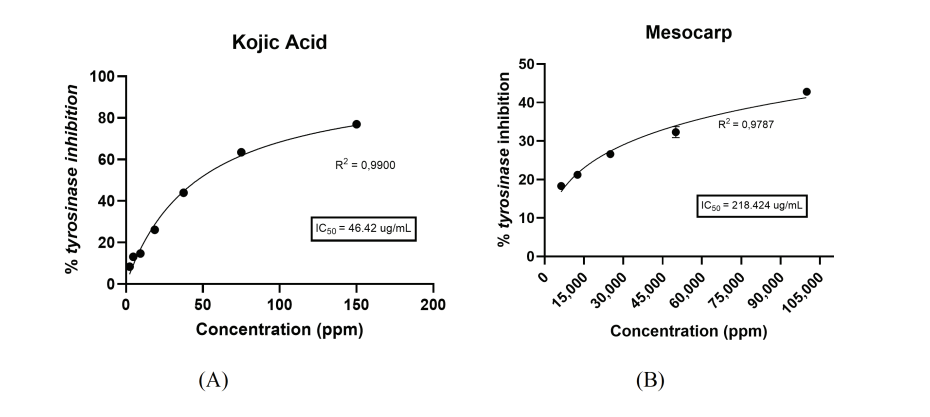
Figure: Regression graph of the relationship between concentration and percentage inhibition of (A) kojic
acid and (B) oil palm mesocarp