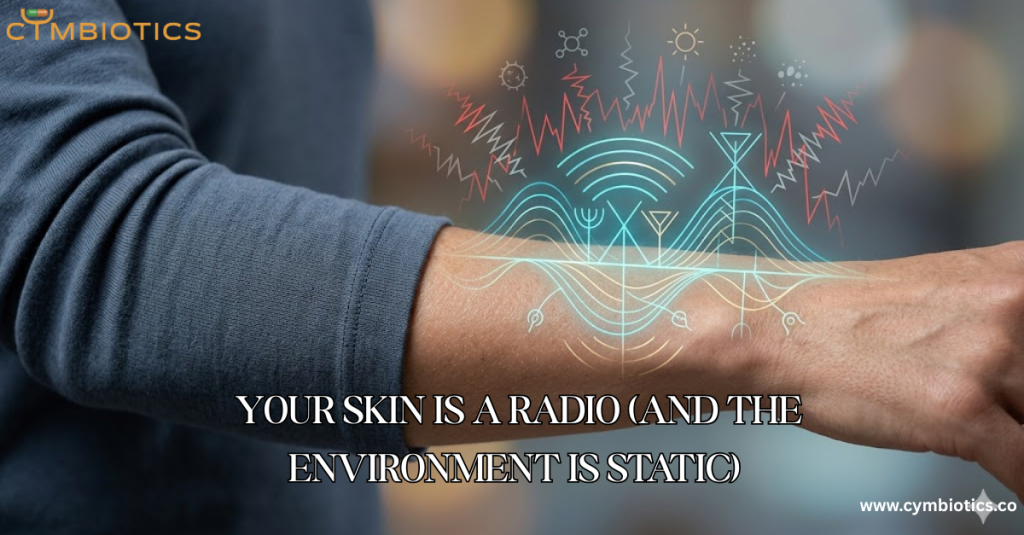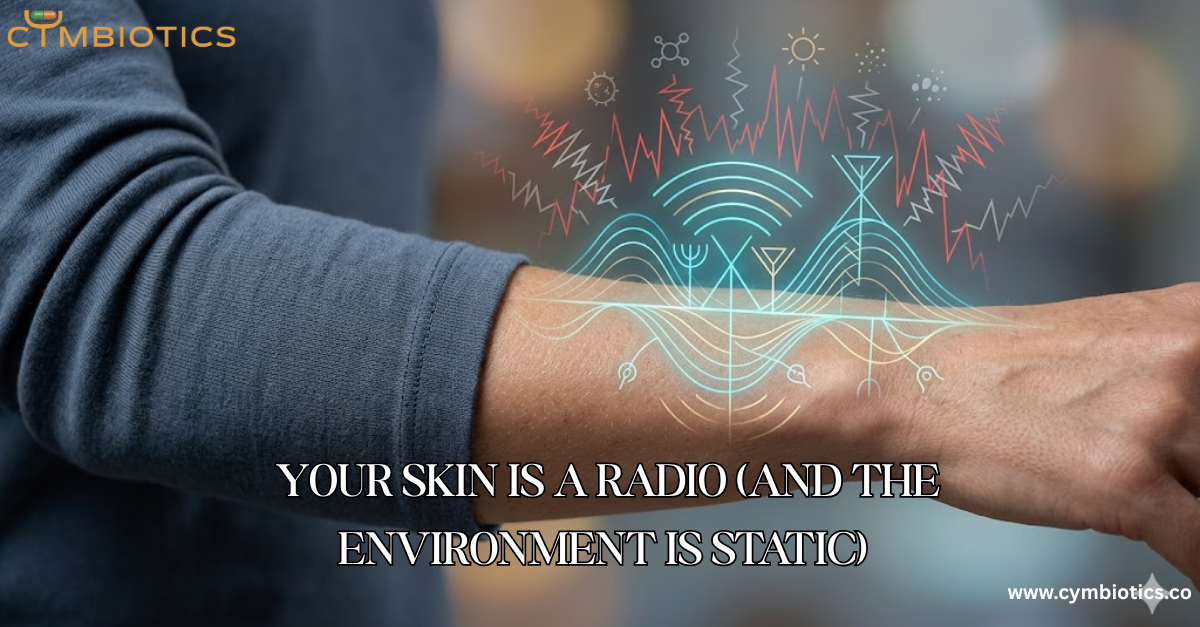

We are used to thinking of our skin as a biological shield: a tough, waterproof barrier designed to keep the world out. But modern dermatology is beginning to reveal a much more dynamic truth. Your skin isn’t just a wall; it’s a sophisticated, high-fidelity antenna.
At any given moment, your skin cells are “tuning in” to a constant stream of signals from the atmosphere. They are sensing changes in humidity, detecting shifts in air pressure, and even “hearing” the microscopic vibrations of the world around them. In the language of biology, your skin is a radio. And right now, the environment might be creating a lot of static.
Tuning In: The Science of Mechanobiology
How does a cell “hear”? The answer lies in a field called mechanobiology. Research indicates that keratinocytes, the primary cells of your outer skin layer, are packed with specialized sensors called mechanoreceptors. These receptors are tuned to detect physical forces. When the wind blows against your face, or when you apply a topical cream, your skin cells aren’t just getting wet or cold; they are translating that physical pressure into a chemical signal.
This “tuning” allows your skin to adapt its barrier function in real-time. Studies suggest that when the environment is “quiet” (balanced humidity, clean air, gentle touch), the skin’s internal radio plays a clear, harmonious tune. The barrier stays flexible, and the cellular repair cycles run on time.
When the Static Takes Over
The problem arises when the environment gets “loud.” Pollution, extreme temperature swings, harsh synthetic fragrances, and even high-frequency blue light act like biological static. When your skin is bombarded by these conflicting signals, the “reception” breaks down.
Evidence suggests that chronic environmental “noise” can overstimulate the skin’s sensory receptors, leading to a state of constant high alert. This is often the hidden culprit behind “phantom sensitivity”—when your skin feels irritated, but there’s no obvious allergen in sight. In this state of static, the skin’s internal communication falters. The message to produce lipids gets garbled. The signal to shed old cells (desquamation) becomes faint. The result? A barrier that is out of sync and prone to “interference.”
Clearing the Signal: Intelligent Biology
If the skin is a radio, then formulation science is the signal booster. We cannot change the environment, but we can help the skin tune out the static. To achieve this, topicals must be able to navigate the skin’s complex sensory landscape without adding to the noise.
True innovation lies in creating a “clear signal” for the skin. By utilizing advanced delivery systems like Cetosomes™, we can support the barrier’s natural architecture using components that the skin already recognizes. This allows for deep tissue support without triggering the sensory alarms that lead to irritation. Furthermore, speed is essential when the environment is noisy. Systems like FADD™ ensure that these beneficial components are integrated fluidly and efficiently, allowing the skin to return to its natural rhythm before the “static” causes lasting damage.
Respect the Reception
Understanding the skin as a sensory organ changes the way we treat it. It’s not about “scrubbing” or “stripping” the surface; it’s about refining the reception. It means choosing formulations that respect the delicate mechanobiology of the barrier. When we reduce the biological static, we allow the skin to stop reacting and start recovering. Because at the end of the day, your skin is always listening. The goal of science is to make sure it hears exactly what it needs to thrive.
References
- “Keratinocytes mediate innocuous and noxious touch via ATP-P2X4 signaling”- Moehring F, Halder P, et al. eLife, 2018.
- “Review of sensory systems deployed by epidermal keratinocytes”- Doucet YS, Woo SH, et al. Frontiers in Neuroscience, 2023.
- “Emerging roles of keratinocytes in nociceptive transduction”- Pang Z, et al. Frontiers in Molecular Neuroscience, 2022.
- “Lifting the veil on the keratinocyte contribution to cutaneous nociception”- Sadler KE, et al. Frontiers in Cellular Neuroscience, 2020.