

Glycolic acid (GA) is a premier alpha-hydroxy acid used in cosmetics for exfoliation and collagen synthesis stimulation; however, its effectiveness is hindered by its hydrophilic nature, which restricts penetration through the lipophilic stratum corneum. Furthermore, clinical use of GA often leads to skin irritation, such as burning and erythema, due to rapid penetration of the free acid. To address these challenges, ethanol-based niosomes were proposed as a solution because they combine the biocompatibility and controlled-release properties of non-ionic surfactant vesicles with the membrane fluidity provided by ethanol. This modification allows the vesicles to become more flexible and “deformable,” enabling them to bypass the skin’s rigid barrier more efficiently than conventional delivery systems.
Methods
The researchers utilized a thin-film hydration method followed by probe sonication to develop the vesicles, specifically testing different non-ionic surfactants, surfactant-to-cholesterol ratios, and ethanol concentrations. The optimized formulation consisted of Brij 97 and cholesterol (1:1 ratio) hydrated with 10% ethanol and 10% GA. Evaluation included physicochemical characterization via dynamic light scattering and scanning electron microscopy (SEM), entrapment efficiency analysis, and in vitro permeation studies using Strat-M® synthetic membranes in Franz diffusion cells.
Key Findings
- Optimal Physicochemical Properties: The optimized 10% GA-loaded vesicles achieved a mean size of 176.93 ± 1.51 nm, a low polydispersity index (PDI) of 0.12, and a high entrapment efficiency of 75.48%.
- Enhanced Skin Penetration: The niosomal system demonstrated a significantly higher cumulative skin penetration (49.56 ± 8.95 mg/cm²) compared to a standard GA solution.
- Sustained Release Profile: Unlike the GA solution, which plateaued after 12 hours, the ethanol-based niosomes provided continuous, sustained release over a 24-hour period.
- Superior Skin Deposition: The amount of GA retained within the membrane was approximately 1.7 times higher for the niosomal system than for the free solution.
- Storage Stability: Formulations maintained physical stability and homogeneity (PDI < 0.3) for three months at 4 °C and room temperature, though high-temperature storage (45 °C) led to vesicle aggregation.
The novelty of this research lies in the integrated optimization of ethanol-modified niosomes to create a “deformable” carrier specifically tailored for the challenging molecular properties of glycolic acid. By significantly improving dermal deposition and sustaining active release, this system offers a superior alternative to conventional topicals, potentially reducing the irritation associated with high-concentration free acids. The future implications of this study suggest that ethanol-based niosomes could serve as a highly effective platform for a wide range of hydrophilic cosmetic actives, paving the way for more potent yet tolerable anti-aging and skin-brightening formulations.
Link to the study: https://www.mdpi.com/2079-9284/13/2/86
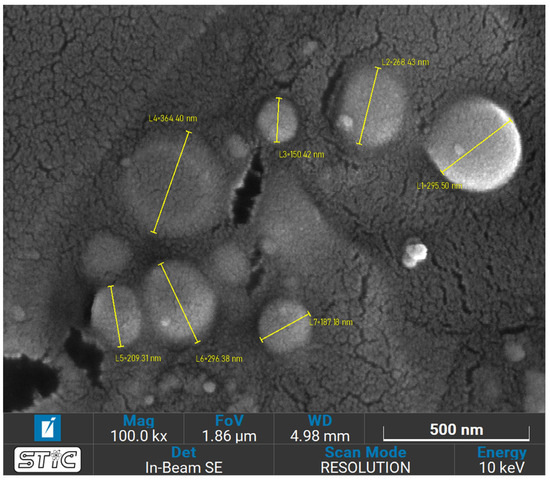
In the figure: Scanning electron microscopy (SEM) images of 10% glycolic acid-loaded ethanol-based niosomes.