

Plant-derived essential oils are increasingly recognized for their antimicrobial, antioxidant, and enzyme-inhibitory activities, making them valuable for cosmetic and dermatological applications. Specifically, the essential oil from Hedychium coronarium (white ginger lily) contains monoterpenoids like eucalyptol, which are effective against enzymes like elastase, hyaluronidase, and tyrosinase that contribute to skin aging and hyperpigmentation. However, the direct topical use of these oils is severely hindered by their high volatility, chemical instability, and potential to cause significant skin irritation. To address these challenges, microencapsulation using natural polymers such as gum Arabic and maltodextrin was investigated as a solution. This technique creates a protective carrier matrix that enhances water solubility, protects sensitive bioactives from degradation, and reduces irritancy by limiting direct contact between volatile compounds and the skin.
Methods
Essential oil from H. coronarium rhizomes was extracted via hydrodistillation and screened for anti-aging enzyme-inhibitory activities. Microencapsulation was achieved through freeze-drying using gum Arabic or maltodextrin at oil loadings of 1–5% w/w. The powders were then characterized for their morphology, moisture content, and an entrapment efficiency exceeding 99.8%. Biological stability was assessed through accelerated heating–cooling cycles, while irritation potential was evaluated using the HET-CAM assay.
Key Findings
- Potent Bioactivity: The essential oil showed exceptional enzyme inhibition, particularly against hyaluronidase (IC50 = 0.1 ± 0.0 µg/mL), which was significantly more potent than the standard positive control.
- Irritation Reduction: Encapsulation transformed the essential oil from a severe irritant (score of 13.3 ± 1.4) into a mildly irritating powder (scores of 3.6–4.2), significantly improving its safety profile for dermal use.
- High Retention and Stability: Both polymers achieved nearly 100% entrapment efficiency, and the encapsulated forms retained over 90% of their biological activity after thermal stress, whereas non-encapsulated solutions saw marked declines.
- Distinct Physical Properties: Gum Arabic produced rough, porous particles with lower moisture uptake, while maltodextrin yielded smoother, more compact structures with lower water activity, supporting better chemical stability.
This research highlights the novelty of using natural polymer-based microencapsulation to convert a highly volatile and irritating essential oil into a stable, safe, and multifunctional bioactive ingredient. By effectively masking the irritant properties of terpenoids while preserving their potent anti-aging effects, this study bridges the gap between traditional herbal medicine and modern cosmeceutical standards. Future implications include the integration of these encapsulated powders into topical delivery systems and the advancement of clinical trials to confirm their efficacy and safety in commercial skincare products.
Link to the study: https://www.mdpi.com/1999-4923/18/4/443
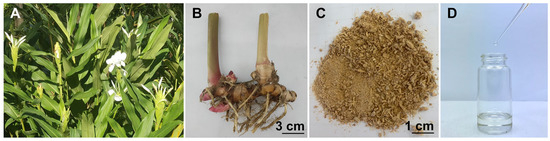
In the figure: H. coronarium plants with blooming flowers (A), fresh rhizomes (B), dried rhizome powder (C), and essential oil (D).