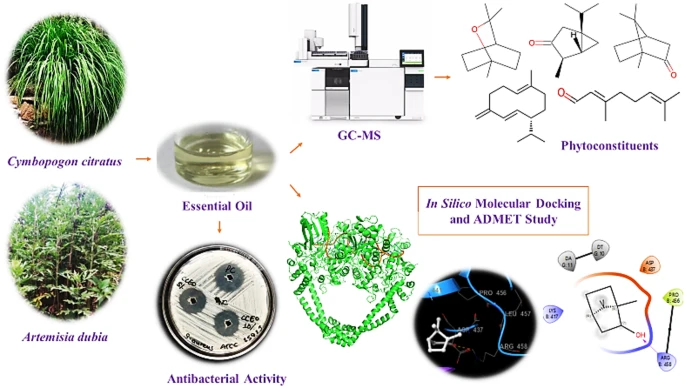
The global healthcare system faces a critical challenge due to the rapid rise of antimicrobial resistance (AMR) and the emergence of “superbugs” that evade conventional synthetic antibiotics. If left unaddressed, AMR is projected to cause approximately 10 million deaths annually by 2050, prompting an urgent search for sustainable, plant-derived alternatives. Essential oils from Cymbopogon citratus (lemongrass) and Artemisia dubia (Titepati) were considered as potential solutions because they have been historically used in traditional Nepalese medicine to treat wounds and infections. These natural products are valued for their broad-spectrum antibacterial properties and their potential to provide eco-friendly, low-toxicity therapeutic options.
Methods
The researchers extracted essential oils through hydro-distillation and identified their chemical constituents using GC-MS analysis. The oils were tested in vitro against four prevalent bacterial strains using well diffusion and broth microdilution assays. Furthermore, in silico molecular docking was employed to evaluate the binding affinity of these compounds to the bacterial enzyme DNA gyrase, while ADMET profiling predicted their pharmacokinetic and toxicity properties.
Key Findings
- Chemical Composition: C. citratus oil was found to be exceptionally rich in citral isomers (geranial and neral), making up approximately 90% of its content, while A. dubia oil was characterized by high levels of camphor, eucalyptol, and germacrene D.
- In Vitro Efficacy: C. citratus oil demonstrated potent antibacterial activity against all tested strains (S. aureus, K. pneumoniae, E. coli, and P. aeruginosa), whereas A. dubia oil showed selective activity specifically against S. aureus.
- Molecular Docking: Major phytoconstituents showed effective binding to the catalytic site of DNA gyrase, with Germacrene D exhibiting the highest binding affinity at -6.9 kcal/mol.
- Safety Profile: Most constituents satisfied Lipinski’s Rule of Five, indicating good drug-likeness and favorable safety profiles regarding hepatotoxicity and nephrotoxicity.
- Permeability: The essential oils exhibited higher skin permeability compared to the standard antibiotic ciprofloxacin, suggesting their suitability for topical applications.
This research is novel as it represents the first comprehensive study to integrate GC-MS characterization with both in vitro assays and advanced in silico docking and ADMET evaluations for these specific Nepal-origin plant species. The findings validate the ethnopharmacological use of these plants and highlight their potential as natural antibacterial agents for treating skin infections and serving as food preservatives. Future implications include the development of optimized topical formulations and the necessity for in vivo studies to further confirm the therapeutic safety and mechanisms of action of these bioactive terpenes.
Link to the study: https://link.springer.com/article/10.1007/s44371-026-00637-1