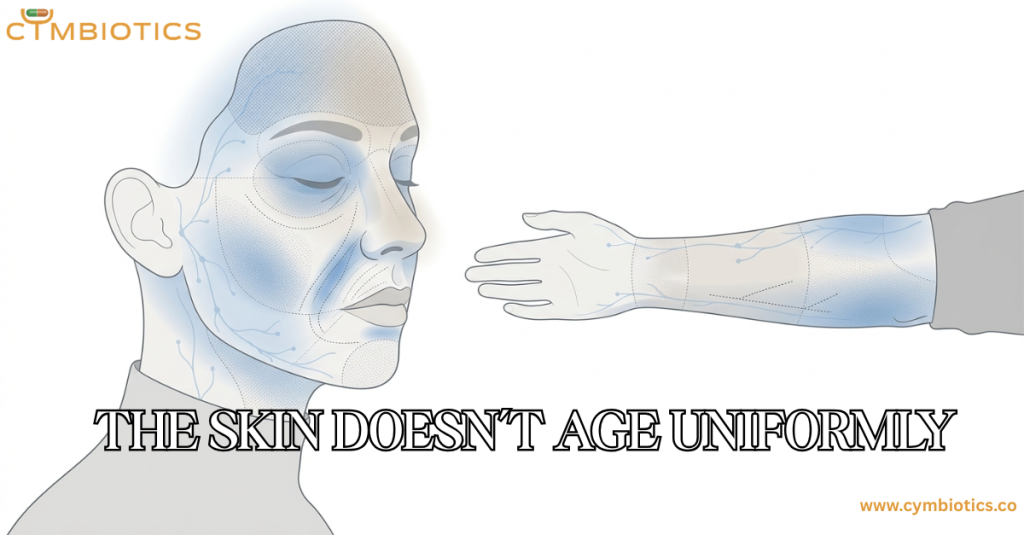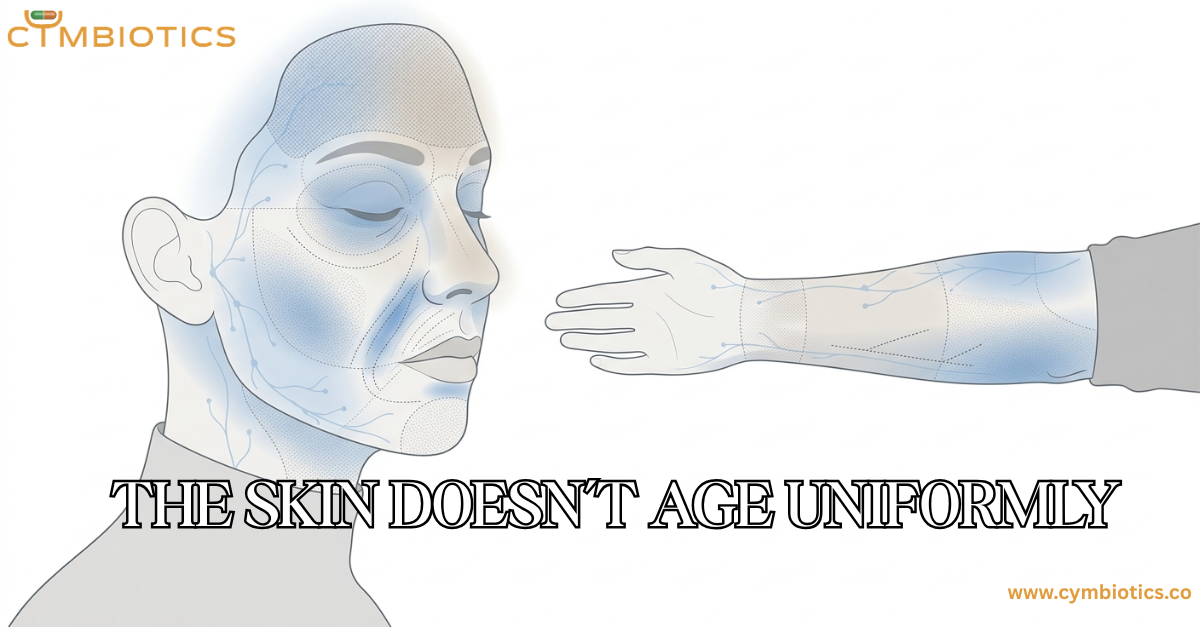

Why aging is a spatial process, not a global one
Aging Is Not Evenly Distributed
Skin aging is often described as a singular process, something that progresses uniformly across the face or body over time.
But this assumption does not hold under biological scrutiny.
Aging does not occur at the same rate everywhere.
It does not affect all regions equally.
And it does not follow a perfectly synchronized timeline.
Instead, it unfolds in patches.
Areas of the skin, sometimes just millimeters apart, can exhibit measurable differences in structure, function, and resilience. These differences are not incidental. They are the result of localized biological conditions.
In that sense, aging is not a global phenomenon.
It is a spatially uneven process.
Microenvironments Beneath the Surface
Each region of the skin exists within its own microenvironment.
These microenvironments are shaped by subtle but significant variables: vascular supply, mechanical stress, environmental exposure, and cellular activity. Together, they influence how that specific region repairs, regenerates, and responds over time.
The skin, therefore, is not one continuous field behaving uniformly.
It is a collection of localized systems, each operating under slightly different biological rules.
Over time, these small differences accumulate, translating into visible variation in aging patterns.
Circulation Shapes Repair Capacity
Not all regions of the skin receive the same level of vascular support.
Areas with richer microcirculation benefit from more efficient delivery of oxygen and nutrients, as well as improved clearance of metabolic byproducts. These conditions support more effective cellular turnover and repair.
In contrast, regions with relatively reduced circulation may exhibit slower regenerative processes, making them more susceptible to cumulative damage.
The result is not dramatic in isolation, but over years, it contributes to uneven aging trajectories across the skin.
Movement Leaves a Structural Imprint
Skin is not static. It is constantly subjected to mechanical forces, stretching, folding, compressing.
Regions involved in repetitive movement, such as around the eyes and mouth experience continuous mechanical stress. This affects:
- Collagen organization
- Elastin integrity
- Cellular signaling pathways linked to repair and inflammation
Over time, these forces do more than create visible lines.
They influence how the underlying tissue ages at a structural level.
In contrast, less mobile areas follow a different aging pattern, often slower, but not necessarily more resilient.
Exposure Is Never Equal
Environmental exposure is one of the most well-established drivers of skin aging.
But even here, exposure is not uniform.
Sunlight, pollution, and external stressors do not interact evenly across the skin. Differences in angle, orientation, and daily habits create asymmetrical exposure patterns.
This is why certain regions consistently show earlier or more pronounced signs of aging, not because the skin is inherently weaker there, but because the cumulative burden is higher.
A Variable Surface Meets Uniform Formulation
This spatial variability introduces a critical challenge for topical science.
Most formulations are applied as if the skin were a uniform surface, one that would respond consistently across all regions.
But each microenvironment presents:
- Different lipid composition
- Variable permeability
- Distinct metabolic activity
This means that even within a single application, a formulation may behave differently across adjacent areas of the skin.
The assumption of uniform response does not reflect biological reality.
Designing for Uneven Biology
If aging is spatially uneven, then delivery must be capable of functioning across that unevenness.
Technologies such as Cetosomes™, with their lipid-compatible and adaptive architecture, enable more consistent interaction across regions with differing surface chemistry and barrier properties.
Similarly, FADD™ (Fast Acting Dermal Delivery) is designed to facilitate efficient penetration across variable microenvironments, where conventional systems may encounter inconsistencies in solubility and diffusion.
These approaches do not assume uniform skin.
They are built to perform within biological variability.
Aging, Reconsidered
Skin aging is not a single timeline unfolding across a uniform surface.
It is a distributed process, shaped by local conditions, repeated forces, and uneven exposure.
What appears as a global change is, in reality, the sum of many localized shifts—each progressing at its own pace.
To understand aging, then, is not to track time alone.
It is to recognize where and how biology diverges across the skin.
References
- “Natural and Sun-Induced Aging of Human Skin” – Rittié L, Fisher GJ. Cold Spring Harbor Perspectives in Medicine, 2015.
- “Structural and Functional Changes and Possible Molecular Mechanisms in Aged Skin” – Shin JW, et al. International Journal of Molecular Sciences, 2021.
- “Changes in Human Skin Composition Due to Intrinsic Aging: A Histologic Study” – Ionescu-Tirgoviste C, et al. Biomedicines, 2023.
- “Exploring Mechanisms of Skin Aging: Insights for Clinical Treatment” – Zhang S, et al. Frontiers in Medicine, 2024.