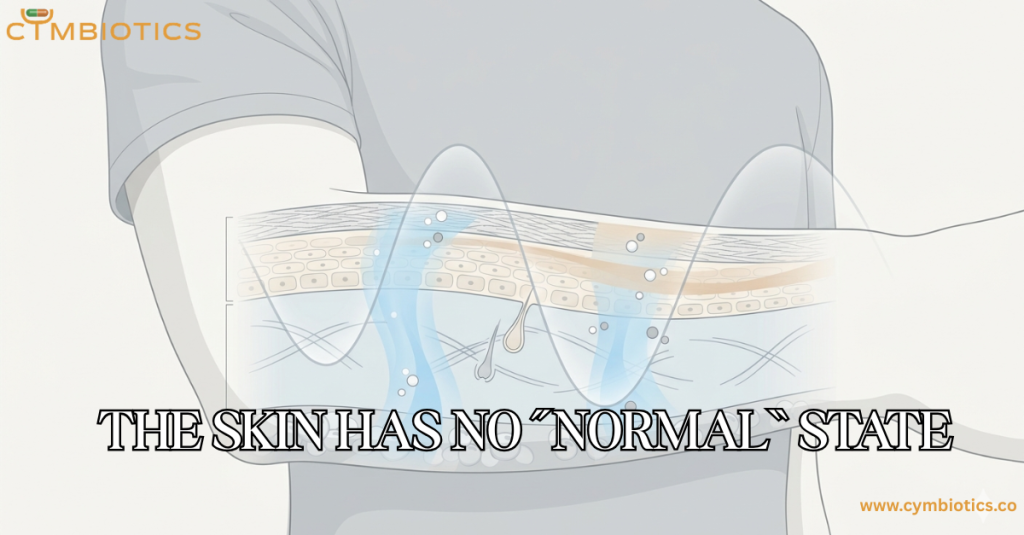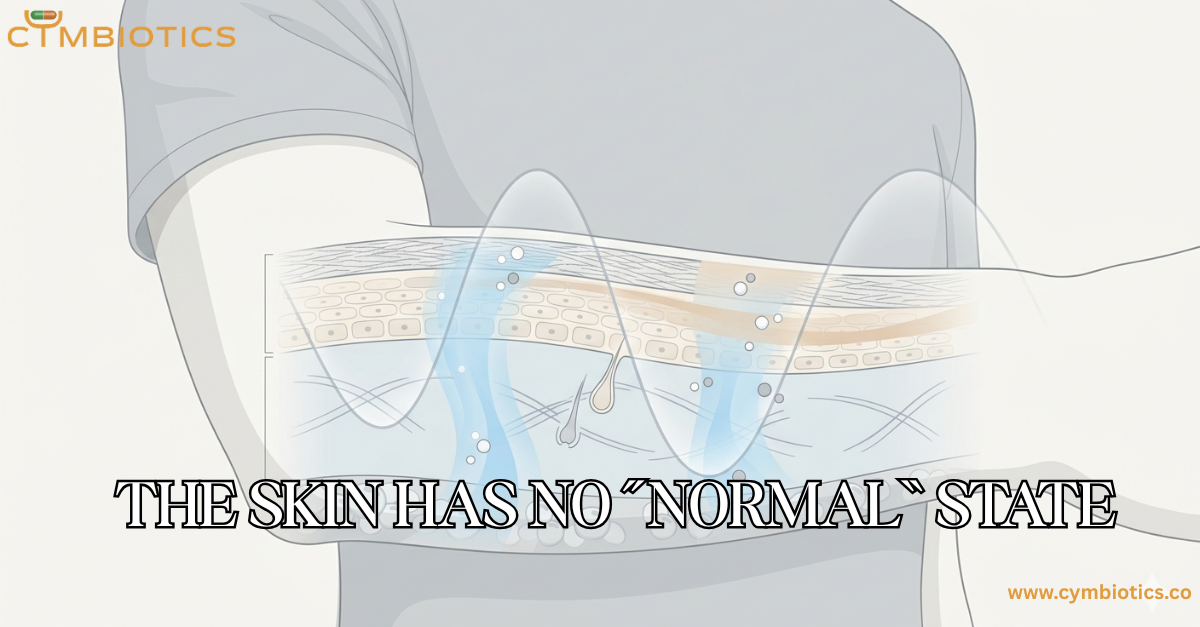

In both clinical and consumer language, skin is often described in categories—normal, dry, oily, sensitive.
These labels suggest stability.
They imply that the skin can exist in a fixed, balanced state.
But biologically, this is not how the skin operates.
There is no single, stable baseline the skin returns to.
There is no fixed definition of “normal.”
What we call normal is simply a momentary alignment of multiple dynamic processes.
A System in Constant Adjustment
The skin is continuously regulating itself.
Hydration levels shift in response to environment and barrier function.
Lipid composition changes with hormonal signaling and metabolic activity.
Cell turnover adjusts based on internal and external stressors.
Even at rest, the skin is not static.
It is actively balancing:
- water retention and loss
- lipid synthesis and breakdown
- immune vigilance and tolerance
These processes do not pause.
They fluctuate—subtly, but constantly.
Why Stability Is an Illusion
At any given time, the skin reflects a temporary equilibrium.
A slight change in humidity, temperature, or exposure can shift this balance.
A minor disruption in barrier integrity can alter water dynamics.
Microbial activity can influence local chemistry within hours.
What appears as “normal skin” is not a fixed state.
It is a moving range—one that is continuously recalibrated.
The Role of Microvariability
These fluctuations are not errors in the system.
They are part of how the skin maintains function.
Small variations in hydration, lipid organization, and immune signaling allow the skin to adapt to changing conditions without requiring large-scale responses.
This is not instability.
It is controlled variability.
And it is essential for resilience.
Implications for Topical Science
This dynamic baseline presents a fundamental challenge.
Most topical formulations are designed with the assumption of consistency—a stable surface, predictable absorption, uniform response.
But the skin does not provide that consistency.
Instead, it presents:
- fluctuating permeability
- shifting lipid environments
- variable biochemical activity
This means that the same formulation may behave differently:
- across individuals
- across regions of the same skin
- across time on the same individual
Designing for a Moving Target
If the baseline itself is dynamic, then delivery systems must be capable of functioning within that variability.
Technologies such as Cetosomes™, designed with lipid-compatible structures, can integrate more effectively across changing surface conditions—supporting consistency in otherwise inconsistent environments.
Similarly, FADD™ (Fast Acting Dermal Delivery) enables efficient penetration even when permeability and solubility conditions fluctuate.
These systems are not built for static skin.
They are built for skin in motion.
Rethinking “Normal”
The concept of normal skin is convenient—but incomplete.
It suggests a stability that biology does not support.
In reality, the skin is continuously adjusting, recalibrating, and responding.
What we observe as normal is simply a snapshot within a dynamic range.
To understand skin, then, is not to define a fixed state.
It is to recognize the fluid baseline that underlies all visible outcomes.
References
“Topographical and Temporal Diversity of the Human Skin Microbiome” – Grice EA, Kong HH, et al. Science, 2009.
“The Skin Microbiome” – Grice EA, Segre JA. Nature Reviews Microbiology, 2011.
“Skin microbiota: Microbial community structure and its potential association with health and disease” – Kong HH, Segre JA. Dermatology Research and Practice, 2011.
“The skin microbiome: potential for novel diagnostic and therapeutic approaches to cutaneous disease” – Grice EA. Seminars in Cutaneous Medicine and Surgery, 2014.