
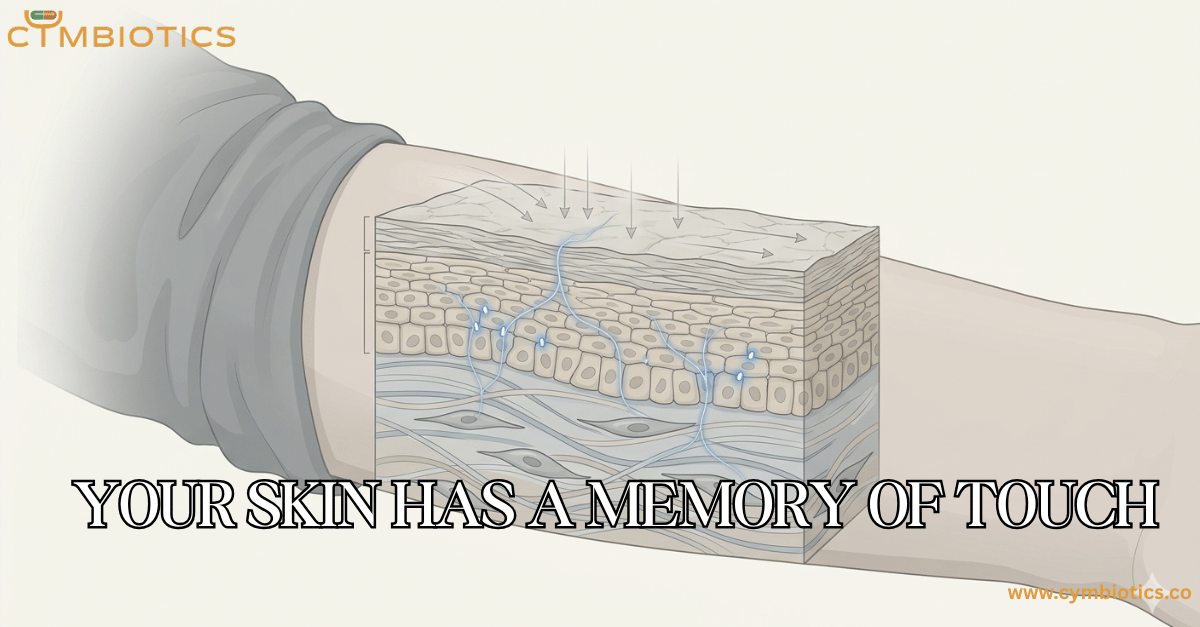

How mechanical experiences become biological instructions
Touch Isn’t Temporary
Touch feels momentary.
A brush, a press, a stretch and it’s gone.
But your skin doesn’t treat it that way.
Every repeated interaction, tight clothing, habitual rubbing, even the way a formulation is applied, feeds into a system that doesn’t just respond in real time. It records patterns of force and adapts accordingly.
Not as sensation.
But as structure.
When Force Becomes Biology
Skin operates through a principle known as Mechanotransduction.
Mechanical inputs: pressure, friction, stretch are converted into intracellular signals through specialized pathways. Ion channels such as Piezo channels respond to deformation of the cell membrane, initiating cascades that alter gene expression.
This means a physical event doesn’t end at the surface.
It becomes a biochemical instruction.
And when repeated, that instruction begins to persist.
Fibroblasts and the Architecture of Memory
Beneath the surface, fibroblasts are not passive structural cells. They are responsive, adaptive, and remarkably sensitive to mechanical environments.
Under sustained stress:
- Collagen fibers reorganize along lines of tension
- Extracellular matrix density increases
- Tissue stiffness begins to shift
This is why areas exposed to repeated friction or pressure don’t just “recover.”
They reconfigure.
Over time, the dermis reflects a history of mechanical exposure, encoded in its architecture.
Keratinocytes Learn the Surface Patterns
At the epidermal level, keratinocytes respond to micro-friction in ways that are subtle but cumulative.
Repeated low-grade stress can:
- Alter differentiation signaling
- Modify barrier renewal dynamics
- Trigger low-level inflammatory pathways
These changes don’t appear dramatic in isolation.
But over time, they create site-specific behavioral patterns in the skin.
The surface begins to anticipate stress: adjusting turnover, resilience, and sensitivity accordingly.
Memory Without a Brain
This is not memory in the neurological sense.
It is structural and biochemical memory.
A form of adaptation where:
- Cells alter their response thresholds
- Tissues reorganize based on repeated input
- The skin becomes conditioned to its mechanical environment
In essence, your skin doesn’t just experience touch.
It becomes shaped by it.
Rethinking Topical Interaction
Topical science often focuses on chemistry:
- Active selection
- Stability
- Penetration
But interaction with skin is never purely chemical.
Every application introduces:
- Pressure
- Directional movement
- Repetition over time
These mechanical variables influence how the skin receives and responds to actives.
Delivery, therefore, is not just about crossing the barrier.
It is about how the barrier is engaged.
Technologies like Cetosomes™ are designed to integrate with the skin’s lipid architecture without disruption, allowing for a more adaptive interface.
FADD™ (Fast Acting Dermal Delivery) supports efficient transport of actives, reducing the need for excessive mechanical manipulation during application.
The goal is not to override the skin.
But to work with its inherent responsiveness.
The Skin Remembers What You Repeat
Not every touch leaves a mark.
But repeated touch leaves a pattern.
And over time, that pattern becomes biology.
Your skin is not just a surface that reacts.
It is a system that learns, quietly, structurally, and continuously from every interaction it experiences.
References
“Keratinocyte PIEZO1 modulates cutaneous mechanosensation” – Moehring F et al. eLife, 2022.
“Mechanotransduction in Skin Inflammation” – Deng H et al. Cells, 2022.
“Mechanical stretch promotes hypertrophic scar formation through Piezo1” – He L et al. Cell Death & Disease, 2021.
“The mechanotransducer Piezo1 coordinates metabolism and inflammation to promote skin growth” – Liu X et al., 2025.