

Topical 5-fluorouracil (5-FU) is a gold-standard field therapy for actinic keratoses (AKs), offering exceptional clearance rates and unique chemopreventive benefits by reducing the incidence of squamous-cell carcinoma. However, its real-world effectiveness is severely hampered by treatment-limiting local skin reactions (LSRs), such as intense inflammation, erythema, and pain, which lead nearly half of all patients to discontinue treatment early. To address this unmet clinical need, researchers investigated the adjunctive use of BB5+ repair balm, a prebiotic and panthenol-containing formulation. This solution was considered because its key ingredients—including 5% panthenol, madecassoside, and a prebiotic complex—possess proven anti-inflammatory, barrier-restoring, and soothing properties that have successfully reduced skin downtime in other dermatological procedures.
Methods
This single-blind, randomized controlled trial involved 50 adults prescribed a four-week course of topical 5-FU for AKs on the face, scalp, or extremities. Participants were randomized to receive either standard of care (5-FU twice daily) or the intervention (5-FU followed by BB5+ balm 30 minutes later). Adherence was tracked via daily electronic logs, while blinded dermatologists assessed local skin reaction severity using a validated scale and evaluated quality-of-life impacts through the Dermatology Life Quality Index (DLQI).
Key Findings
- Reduced Reaction Severity: The intervention group experienced significantly lower mean LSR scores at day 14 and day 21, showing up to a 35% reduction in skin toxicity compared to the control group.
- Improved Quality of Life: Participants treating the face or scalp reported significantly better quality-of-life outcomes, with a fourfold lower likelihood of experiencing moderate-to-high DLQI impact by the end of treatment.
- Site-Specific Benefits: While overall adherence rates were similar between groups, the balm was particularly effective for facial treatments, where it helped stabilize skin reactions during the peak inflammatory phase.
- Maintained Treatment Exposure: The use of the repair balm did not interfere with the application of 5-FU, as the mean number of applications remained identical between the two study arms.
- Peak Toxicity Mitigation: BB5+ was associated with a lower mean “worst” LSR score (9.2 vs. 10.2), suggesting it effectively blunts the most severe inflammatory peaks of therapy.
The novelty of this research lies in demonstrating that targeted barrier repair can significantly mitigate the notorious “downtime” of 5-FU without compromising the intensity of the treatment itself. By proving that a simple, accessible dermocosmetic can improve the patient experience—particularly for highly visible facial areas—this study provides a practical framework for enhancing treatment acceptability in routine clinical practice. The future implications of these findings suggest that proactive, adjunctive skin care should be integrated into standard field therapy protocols to support patient-centered outcomes and long-term adherence to skin cancer prevention regimens.
Link to the study: https://link.springer.com/article/10.1007/s13555-026-01775-1
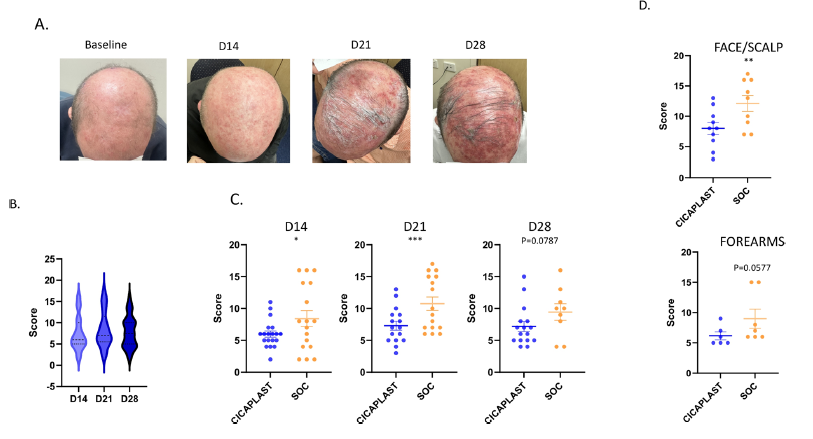
In the figure: Assessment of treatment-related skin reactions
during 5-fluorouracil field therapy. a Representative clinical
photographs of the scalp at baseline and days 14, 21
and 28 following treatment initiations. b Distribution of
clinician-assessed skin reaction severity scores at days 14,
21 and 28 based on clinical photography. c Comparison
of severity scores between the BB5+ and SOC groups at
days 14 (n = 34), 21 (n = 32) and 28 (n = 25). d Effect of
intervention on severity scores stratified by treatment site
(face/scalp and forearms). Data are presented as individual
data points with mean ± standard error. p-Values indicate
between-group comparisons using unpaired t-test with
Welch correction. *p < 0.05; **p < 0.01; and ***p < 0.001