

Eczematous dermatitis encompasses a variety of inflammatory skin disorders—such as seborrheic dermatitis, atopic dermatitis, and contact dermatitis—that are primarily characterized by chronic inflammation and dysfunction of the epidermal barrier. A core goal in managing these conditions is improving patient outcomes and quality of life by reversing microscopic skin changes and disrupting the persistent itch–scratch cycle. Beyond physical barrier damage and immune system dysfunction, the pathogenesis of eczematous dermatitis is strongly linked to oxidative stress, which compromises the skin barrier and exacerbates symptoms through lipid peroxidation and cellular damage. Traditional treatments often rely on topical moisturizers for hydration and barrier function. However, modern dermatological advancements necessitate the inclusion of antioxidants to mitigate the effects of reactive oxygen species (ROS). The potential solution investigated is a topical medical device (GSEBA®) combining hyaluronic acid with the potent antioxidant derivative N-butanoyl glutathione (GSH-C4). Glutathione (GSH) is a critical molecule known for combating oxidative stress and scavenging ROS. GSH-C4, a derivative, offers therapeutic potential by reducing oxidative stress and modulating pro-inflammatory responses, specifically through NF-kB inhibition. This dual-action approach aims to enhance skin hydration while counteracting oxidative damage and inflammation, providing a comprehensive strategy for managing these chronic inflammatory conditions.
Methods
This prospective, single-center clinical trial enrolled 30 immunocompetent adult participants presenting with very mild to moderate eczematous dermatitis (IGA score 1–3). Subjects applied the non-steroidal medical device (GSEBA® cream or mousse containing GSH-C4 and hyaluronic acid) once daily for a 28-day study period. Clinical improvement was tracked at baseline, day 14, and day 28 using the Investigator’s Global Assessment (IGA), a Visual Analog Scale (VAS) for itching, and a quality of life index (IDL). To assess microscopic changes, the study utilized high-resolution, non-invasive imaging methods: reflectance confocal microscopy (RCM) and Dynamic Optical Coherence Tomography (D-OCT).
Key Findings
The study demonstrated strong clinical efficacy and microscopic resolution of inflammation:
• Clinical Response: The primary endpoint, defined as an improvement of ≥1 IGA grade, was achieved in 90% of the evaluated sites.
• Disease Severity Reduction: The mean IGA score dropped significantly from 2.48 at baseline to 0.18 after 28 days of treatment (p<0.001).
• Symptom Relief: Pruritus, measured by the VAS itching score, decreased markedly from 4.52 to 0.32 (p<0.001), reflecting significant symptom alleviation.
• Quality of Life Improvement: The self-reported index of disease impact on quality of life (IDL) decreased significantly from 4.86 to 0.79 (p<0.001).
• Microscopic Inflammation Resolution (RCM): RCM analysis showed statistically significant reductions in epidermal features of inflammation, including spongiosis, vesiculation, exocytosis, and overall inflammatory infiltrate.
• Vascular Reduction (OCT): OCT revealed a significant decrease in vascularization/vascular network area (by over 50%) specifically at the 150 µm depth after 28 days of treatment (p=0.003).
• Safety Profile: The product was well tolerated with no serious adverse events, and D-OCT confirmed the absence of changes in collagen density, indicating the product did not compromise dermal structure or induce atrophy.
The study highlights the significant efficacy and excellent tolerability of the GSH-C4/hyaluronic acid-based mousse/cream (GSEBA®) in managing inflammatory eczematous dermatitis. The novelty of this research lies in its use of non-invasive, high-resolution imaging (RCM and OCT) to objectively correlate clinical improvement with the microscopic resolution of inflammatory features and superficial vascular density. This approach provided valuable insights, confirming that the treatment effectively reduces microscopic markers of inflammation without inducing dermal structure changes, such as decreased collagen density. The product’s dual mechanism of action—hydration via hyaluronic acid and powerful antioxidant/anti-inflammatory effects via GSH-C4 (including NF−κB inhibition)—offers a comprehensive therapeutic strategy that addresses both the symptoms and underlying causes of inflammation. The future implication of this research is substantial, as GSEBA® demonstrates potential as a steroid-sparing alternative or adjunctive option for chronic inflammatory skin diseases, suitable for long-term use due to its excellent safety and tolerability profile. Further research involving larger, more diverse populations and extended follow-up periods is necessary to confirm these efficacy signals, determine recurrence rates, and fully define its role within real-world therapeutic algorithms.
Link to the study: Non-Invasive Imaging to Detect the Effects of Topical N-Butanoyl Glutathione (GSH-C4) and Hyaluronic Acid in Inflammatory Eczematous Dermatitis
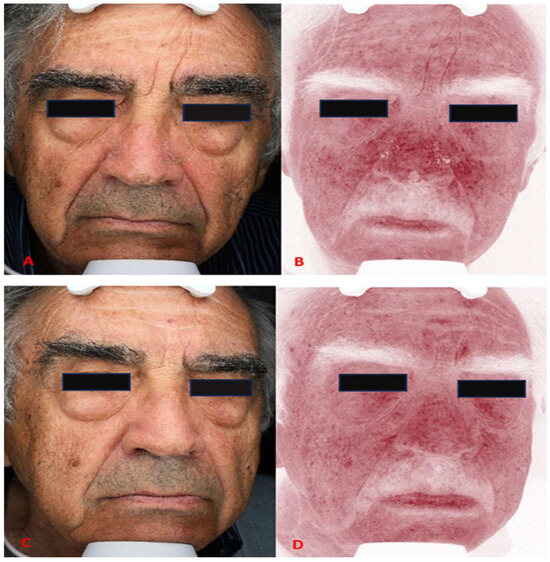
In the image : Patient with seborrheic dermatitis: (A) Baseline clinical image (IGA 3). (B) Baseline red filter highlights the erythema in the central face. (C) After 4 weeks of treatment (T2) clinical image showing disease improvement (IGA 0). (D) After 4 weeks of treatment (T2) red filter showing the decrease in erythema compared with the image at baseline. (Imaging obtained using VISIA Generation 7 model, Canfield Scientific, Parsippany, NJ, USA).